School of Psychology, University of Birmingham, Birmingham, UK.
Cerebellum. 2021 Aug;20(4):518-532. doi: 10.1007/s12311-020-01223-6. Epub 2021 Jan 19.
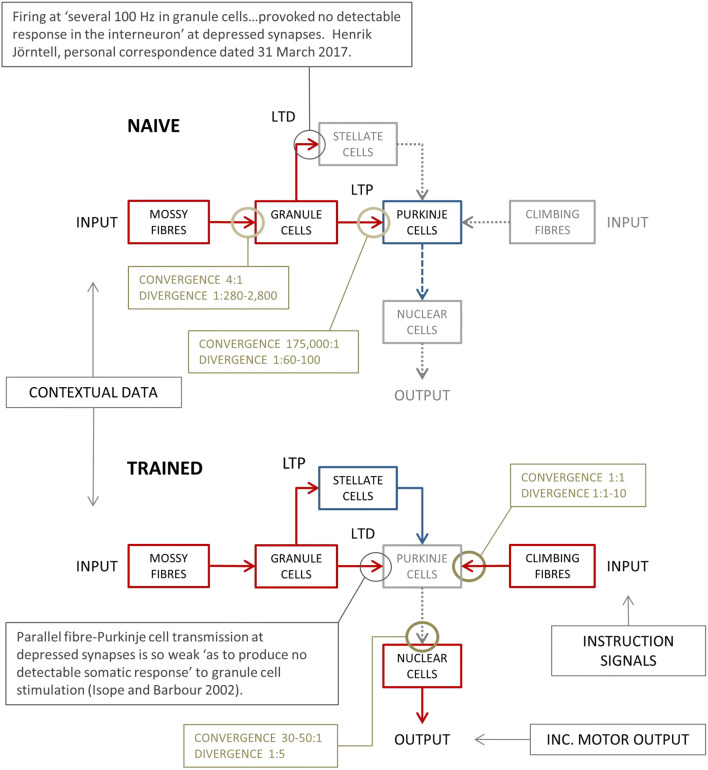
The attempt to understand the cerebellum has been dominated for years by supervised learning models. The central idea is that a learning algorithm modifies transmission strength at repeatedly co-active synapses, creating memories stored as finely calibrated synaptic weights. As a result, Purkinje cells, usually the de facto output cells of these models, acquire a modified response to input in a remembered pattern. This paper proposes an alternative model of pattern memory in which the function of a match is permissive, allowing but not driving output, and accordingly controlling the timing of output but not the rate of firing by Purkinje cells. Learning does not result in graded synaptic weights. There is no supervised learning algorithm or memory of individual patterns, which, like graded weights, are unnecessary to explain the evidence. Instead, patterns are classed as simply either known or not, at the level of input to a functional population of 100s of Purkinje cells (a microzone). The standard is strict. If only a handful of Purkinje cells receive a mismatch output of the whole circuit is blocked. Only if there is a full and accurate match are projection neurons in deep nuclei, which carry the output of most circuits, released from default inhibitory restraint. Purkinje cell firing at those times is a linear function of input rates. There is no effect of modification of synaptic transmission except to either allow or block output.
多年来,理解小脑的尝试一直由监督学习模型主导。其核心思想是,学习算法会修改在反复共同活跃的突触处的传输强度,从而创建以精细校准的突触权重存储的记忆。因此,浦肯野细胞通常是这些模型的实际输出细胞,会对记忆模式中的输入产生修改后的响应。本文提出了一种模式记忆的替代模型,其中匹配的作用是允许的,允许但不驱动输出,因此控制输出的时间,但不控制浦肯野细胞的发射率。学习不会导致分级突触权重。没有监督学习算法或单个模式的记忆,这些记忆像分级权重一样,对于解释证据是不必要的。相反,模式被简单地分为已知或未知,在 100 多个浦肯野细胞(一个微区)的功能群体的输入水平上。标准很严格。如果只有少数浦肯野细胞接收到整个电路的不匹配输出,则会被阻止。只有当存在完整且准确的匹配时,深部核中的投射神经元才会从默认的抑制约束中释放出来,这些神经元承载着大多数电路的输出。在这些时候,浦肯野细胞的发射是输入率的线性函数。除了允许或阻止输出之外,没有突触传递修改的效果。