• 文献检索
  • 文档翻译
  • 深度研究
  • 学术资讯
  • Suppr Zotero 插件Zotero 插件
  • 邀请有礼
  • 套餐&价格
  • 历史记录
应用&插件
Suppr Zotero 插件Zotero 插件浏览器插件Mac 客户端Windows 客户端微信小程序
定价
高级版会员购买积分包购买API积分包
服务
文献检索文档翻译深度研究API 文档MCP 服务
关于我们
关于 Suppr公司介绍联系我们用户协议隐私条款
关注我们

Suppr 超能文献

核心技术专利:CN118964589B侵权必究
粤ICP备2023148730 号-1Suppr @ 2026

文献检索

告别复杂PubMed语法,用中文像聊天一样搜索,搜遍4000万医学文献。AI智能推荐,让科研检索更轻松。

立即免费搜索

文件翻译

保留排版,准确专业,支持PDF/Word/PPT等文件格式,支持 12+语言互译。

免费翻译文档

深度研究

AI帮你快速写综述,25分钟生成高质量综述,智能提取关键信息,辅助科研写作。

立即免费体验

基于模型的加拿大 COVID-19 数据预测。

Model-based forecasting for Canadian COVID-19 data.

机构信息

Department of Statistical and Actuarial Sciences, University of Western Ontario, London, Ontario, Canada.

Department of Computer Science, University of Western Ontario, London, Ontario, Canada.

出版信息

PLoS One. 2021 Jan 19;16(1):e0244536. doi: 10.1371/journal.pone.0244536. eCollection 2021.

DOI:10.1371/journal.pone.0244536
PMID:33465142
原文链接:https://pmc.ncbi.nlm.nih.gov/articles/PMC7815137/
Abstract

BACKGROUND

Since March 11, 2020 when the World Health Organization (WHO) declared the COVID-19 pandemic, the number of infected cases, the number of deaths, and the number of affected countries have climbed rapidly. To understand the impact of COVID-19 on public health, many studies have been conducted for various countries. To complement the available work, in this article we examine Canadian COVID-19 data for the period of March 18, 2020 to August 16, 2020 with the aim to forecast the dynamic trend in a short term.

METHOD

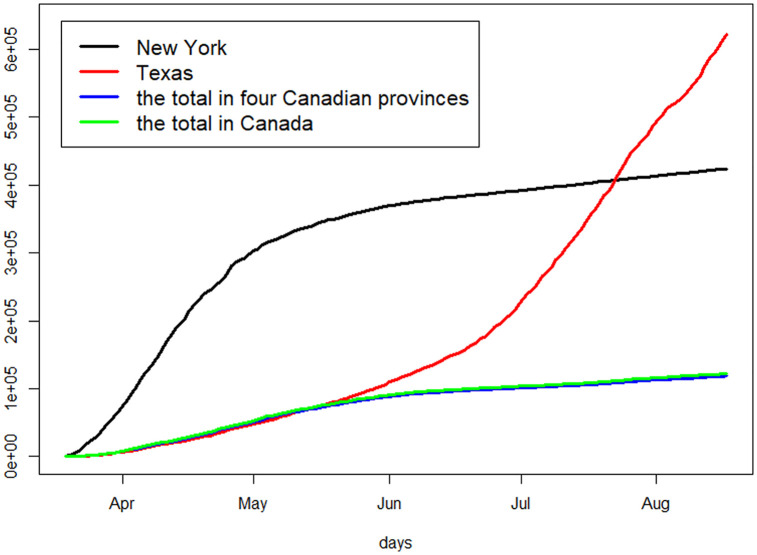
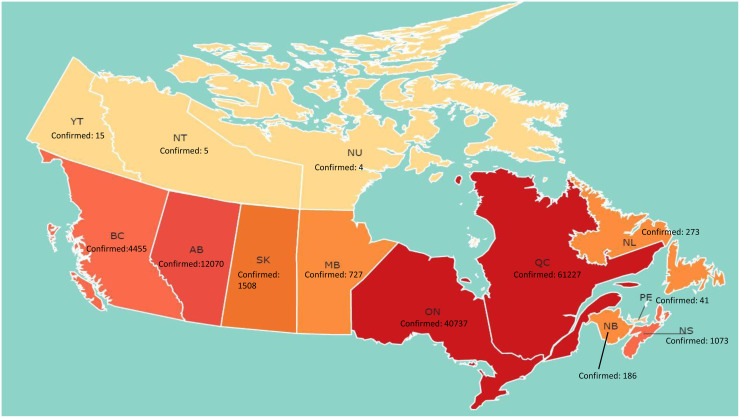
We focus our attention on Canadian data and analyze the four provinces, Ontario, Alberta, British Columbia, and Quebec, which have the most severe situations in Canada. To build predictive models and conduct prediction, we employ three models, smooth transition autoregressive (STAR) models, neural network (NN) models, and susceptible-infected-removed (SIR) models, to fit time series data of confirmed cases in the four provinces separately. In comparison, we also analyze the data of daily infections in two states of USA, Texas and New York state, for the period of March 18, 2020 to August 16, 2020. We emphasize that different models make different assumptions which are basically difficult to validate. Yet invoking different models allows us to examine the data from different angles, thus, helping reveal the underlying trajectory of the development of COVID-19 in Canada.

FINDING

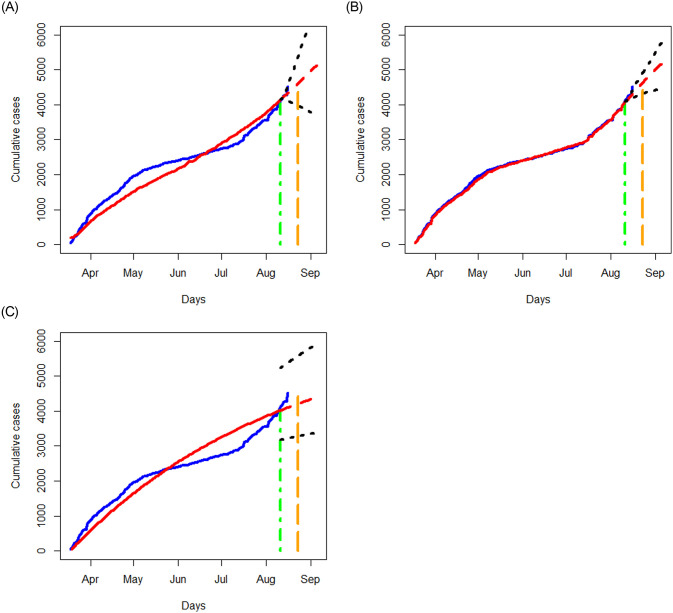
The examinations of the data dated from March 18, 2020 to August 11, 2020 show that the STAR, NN, and SIR models may output different results, though the differences are small in some cases. Prediction over a short term period incurs smaller prediction variability than over a long term period, as expected. The NN method tends to outperform other two methods. All the methods forecast an upward trend in all the four Canadian provinces for the period of August 12, 2020 to August 23, 2020, though the degree varies from method to method. This research offers model-based insights into the pandemic evolvement in Canada.

摘要

背景

自 2020 年 3 月 11 日世界卫生组织(WHO)宣布 COVID-19 大流行以来,感染病例、死亡人数和受影响国家的数量迅速攀升。为了了解 COVID-19 对公共卫生的影响,许多国家进行了研究。为了补充现有工作,本文研究了 2020 年 3 月 18 日至 2020 年 8 月 16 日期间加拿大的 COVID-19 数据,旨在短期预测其动态趋势。

方法

我们关注加拿大的数据,分析加拿大疫情最严重的四个省份安大略省、艾伯塔省、不列颠哥伦比亚省和魁北克省。为了构建预测模型和进行预测,我们分别采用了三种模型,即平稳转移自回归(STAR)模型、神经网络(NN)模型和易感感染清除(SIR)模型,对这四个省份的确诊病例时间序列数据进行拟合。相比之下,我们还分析了 2020 年 3 月 18 日至 2020 年 8 月 16 日期间美国德克萨斯州和纽约州的每日感染数据。我们强调,不同的模型有不同的假设,这些假设基本上很难验证。然而,调用不同的模型可以让我们从不同的角度来分析数据,从而帮助揭示 COVID-19 在加拿大的发展轨迹。

发现

对 2020 年 3 月 18 日至 2020 年 8 月 11 日的数据进行分析表明,STAR、NN 和 SIR 模型可能会输出不同的结果,尽管在某些情况下差异很小。短期预测比长期预测的预测变化更小,这是意料之中的。NN 方法往往优于其他两种方法。所有方法都预测 2020 年 8 月 12 日至 2020 年 8 月 23 日期间加拿大四个省份的病例数呈上升趋势,尽管程度因方法而异。本研究为加拿大大流行的演变提供了基于模型的见解。
https://cdn.ncbi.nlm.nih.gov/pmc/blobs/d320/7815137/3323cbe64254/pone.0244536.g011.jpg
https://cdn.ncbi.nlm.nih.gov/pmc/blobs/d320/7815137/9f0f08df0e47/pone.0244536.g001.jpg
https://cdn.ncbi.nlm.nih.gov/pmc/blobs/d320/7815137/4a5b837c060a/pone.0244536.g002.jpg
https://cdn.ncbi.nlm.nih.gov/pmc/blobs/d320/7815137/7b203d92a094/pone.0244536.g003.jpg
https://cdn.ncbi.nlm.nih.gov/pmc/blobs/d320/7815137/dacd640d4e41/pone.0244536.g004.jpg
https://cdn.ncbi.nlm.nih.gov/pmc/blobs/d320/7815137/f51aacb903da/pone.0244536.g005.jpg
https://cdn.ncbi.nlm.nih.gov/pmc/blobs/d320/7815137/1aa0b5d9207b/pone.0244536.g006.jpg
https://cdn.ncbi.nlm.nih.gov/pmc/blobs/d320/7815137/6dbfd276eb04/pone.0244536.g007.jpg
https://cdn.ncbi.nlm.nih.gov/pmc/blobs/d320/7815137/5eb7f643fabf/pone.0244536.g008.jpg
https://cdn.ncbi.nlm.nih.gov/pmc/blobs/d320/7815137/83bf256e7b45/pone.0244536.g009.jpg
https://cdn.ncbi.nlm.nih.gov/pmc/blobs/d320/7815137/f97739d0c868/pone.0244536.g010.jpg
https://cdn.ncbi.nlm.nih.gov/pmc/blobs/d320/7815137/3323cbe64254/pone.0244536.g011.jpg
https://cdn.ncbi.nlm.nih.gov/pmc/blobs/d320/7815137/9f0f08df0e47/pone.0244536.g001.jpg
https://cdn.ncbi.nlm.nih.gov/pmc/blobs/d320/7815137/4a5b837c060a/pone.0244536.g002.jpg
https://cdn.ncbi.nlm.nih.gov/pmc/blobs/d320/7815137/7b203d92a094/pone.0244536.g003.jpg
https://cdn.ncbi.nlm.nih.gov/pmc/blobs/d320/7815137/dacd640d4e41/pone.0244536.g004.jpg
https://cdn.ncbi.nlm.nih.gov/pmc/blobs/d320/7815137/f51aacb903da/pone.0244536.g005.jpg
https://cdn.ncbi.nlm.nih.gov/pmc/blobs/d320/7815137/1aa0b5d9207b/pone.0244536.g006.jpg
https://cdn.ncbi.nlm.nih.gov/pmc/blobs/d320/7815137/6dbfd276eb04/pone.0244536.g007.jpg
https://cdn.ncbi.nlm.nih.gov/pmc/blobs/d320/7815137/5eb7f643fabf/pone.0244536.g008.jpg
https://cdn.ncbi.nlm.nih.gov/pmc/blobs/d320/7815137/83bf256e7b45/pone.0244536.g009.jpg
https://cdn.ncbi.nlm.nih.gov/pmc/blobs/d320/7815137/f97739d0c868/pone.0244536.g010.jpg
https://cdn.ncbi.nlm.nih.gov/pmc/blobs/d320/7815137/3323cbe64254/pone.0244536.g011.jpg

相似文献

1
Model-based forecasting for Canadian COVID-19 data.基于模型的加拿大 COVID-19 数据预测。
PLoS One. 2021 Jan 19;16(1):e0244536. doi: 10.1371/journal.pone.0244536. eCollection 2021.
2
A COVID-19 Pandemic Artificial Intelligence-Based System With Deep Learning Forecasting and Automatic Statistical Data Acquisition: Development and Implementation Study.一种基于人工智能的新冠肺炎大流行深度学习预测与自动统计数据采集系统:开发与实施研究
J Med Internet Res. 2021 May 20;23(5):e27806. doi: 10.2196/27806.
3
SARS-CoV-2 Surveillance System in Canada: Longitudinal Trend Analysis.加拿大 SARS-CoV-2 监测系统:纵向趋势分析。
JMIR Public Health Surveill. 2021 May 10;7(5):e25753. doi: 10.2196/25753.
4
Forecasting COVID-19 confirmed cases, deaths and recoveries: Revisiting established time series modeling through novel applications for the USA and Italy.预测 COVID-19 确诊病例、死亡和康复人数:通过美国和意大利的新应用重新审视既定时间序列模型。
PLoS One. 2021 Jan 7;16(1):e0244173. doi: 10.1371/journal.pone.0244173. eCollection 2021.
5
Estimation of COVID-19 Period Prevalence and the Undiagnosed Population in Canadian Provinces: Model-Based Analysis.基于模型的分析:估算加拿大各省 COVID-19 流行期患病率和未诊断人群。
JMIR Public Health Surveill. 2021 Sep 9;7(9):e26409. doi: 10.2196/26409.
6
The performance of phenomenological models in providing near-term Canadian case projections in the midst of the COVID-19 pandemic: March - April, 2020.在 COVID-19 大流行期间,现象学模型在提供加拿大近期病例预测方面的表现:2020 年 3 月-4 月。
Epidemics. 2021 Jun;35:100457. doi: 10.1016/j.epidem.2021.100457. Epub 2021 Mar 19.
7
Modeling COVID-19 Latent Prevalence to Assess a Public Health Intervention at a State and Regional Scale: Retrospective Cohort Study.建模 COVID-19 潜伏期患病率,以在州和地区层面评估公共卫生干预措施:回顾性队列研究。
JMIR Public Health Surveill. 2020 Jun 19;6(2):e19353. doi: 10.2196/19353.
8
Predicting the development trend of the second wave of COVID-19 in five European countries.预测五个欧洲国家新冠疫情第二波的发展趋势。
J Med Virol. 2021 Oct;93(10):5896-5907. doi: 10.1002/jmv.27143. Epub 2021 Jun 23.
9
Learning models for forecasting hospital resource utilization for COVID-19 patients in Canada.用于预测加拿大 COVID-19 患者医院资源利用情况的学习模型。
Sci Rep. 2022 May 24;12(1):8751. doi: 10.1038/s41598-022-12491-z.
10
Regional Variability in COVID-19 Case Fatality Rate in Canada, February-December 2020.2020 年 2 月至 12 月加拿大 COVID-19 病死率的地域差异。
Int J Environ Res Public Health. 2021 Feb 14;18(4):1839. doi: 10.3390/ijerph18041839.

引用本文的文献

1
COVINet: a deep learning-based and interpretable prediction model for the county-wise trajectories of COVID-19 in the United States.COVINet:一种基于深度学习的、可解释的美国各县新冠疫情轨迹预测模型。
J Appl Stat. 2024 Oct 8;52(5):1063-1080. doi: 10.1080/02664763.2024.2412284. eCollection 2025.
2
Deep learning in public health: Comparative predictive models for COVID-19 case forecasting.深度学习在公共卫生领域的应用:用于 COVID-19 病例预测的比较预测模型。
PLoS One. 2024 Mar 14;19(3):e0294289. doi: 10.1371/journal.pone.0294289. eCollection 2024.
3
Forecasting daily COVID-19 cases with gradient boosted regression trees and other methods: evidence from U.S. cities.

本文引用的文献

1
On an interval prediction of COVID-19 development based on a SEIR epidemic model.基于SEIR疫情模型的新冠肺炎发展区间预测
Annu Rev Control. 2021;51:477-487. doi: 10.1016/j.arcontrol.2021.01.006. Epub 2021 Feb 18.
2
Estimation of the basic reproduction number, average incubation time, asymptomatic infection rate, and case fatality rate for COVID-19: Meta-analysis and sensitivity analysis.对 COVID-19 的基本繁殖数、平均潜伏期、无症状感染率和病死率的估计:荟萃分析和敏感性分析。
J Med Virol. 2020 Nov;92(11):2543-2550. doi: 10.1002/jmv.26041. Epub 2020 Jun 9.
3
Analysis and forecast of COVID-19 spreading in China, Italy and France.
用梯度提升回归树和其他方法预测每日 COVID-19 病例:来自美国城市的证据。
Front Public Health. 2023 Dec 11;11:1259410. doi: 10.3389/fpubh.2023.1259410. eCollection 2023.
4
Do more stringent policies reduce daily COVID-19 case counts? Evidence from Canadian provinces.更严格的政策会降低新冠肺炎每日病例数吗?来自加拿大各省的证据。
Econ Anal Policy. 2023 Jun;78:225-242. doi: 10.1016/j.eap.2023.03.006. Epub 2023 Mar 8.
5
Comparative Evaluation of the Multilayer Perceptron Approach with Conventional ARIMA in Modeling and Prediction of COVID-19 Daily Death Cases.多层感知机方法与传统 ARIMA 在建模和预测 COVID-19 每日死亡病例中的比较评估。
J Healthc Eng. 2022 Nov 9;2022:4864920. doi: 10.1155/2022/4864920. eCollection 2022.
6
Estimating the Effects of Non-Pharmaceutical Interventions and Population Mobility on Daily COVID-19 Cases: Evidence from Ontario.评估非药物干预措施和人口流动对每日新冠病毒病例的影响:来自安大略省的证据。
Can Public Policy. 2022 Mar 1;48(1):144-161. doi: 10.3138/cpp.2021-022.
7
Characterizing the COVID-19 dynamics with a new epidemic model: Susceptible-exposed-asymptomatic-symptomatic-active-removed.用一种新的流行病模型刻画新冠疫情动态:易感-暴露-无症状-有症状-活跃-康复。
Can J Stat. 2022 Jun;50(2):395-416. doi: 10.1002/cjs.11698. Epub 2022 Apr 15.
8
Estimating surge in COVID-19 cases, hospital resources and PPE demand with the interactive and locally-informed .用交互式和具有本地信息的方法估计 COVID-19 病例、医院资源和个人防护装备需求的激增。
Int J Popul Data Sci. 2022 Apr 6;5(4):1710. doi: 10.23889/ijpds.v5i4.1710. eCollection 2020.
9
Interval forecasts of weekly incident and cumulative COVID-19 mortality in the United States: A comparison of combining methods.美国每周新增和累计 COVID-19 死亡人数的区间预测:组合方法的比较。
PLoS One. 2022 Mar 29;17(3):e0266096. doi: 10.1371/journal.pone.0266096. eCollection 2022.
10
Examining the association between reported COVID-19 symptoms and testing for COVID-19 in Canada: a cross-sectional survey.调查加拿大报告的 COVID-19 症状与 COVID-19 检测之间的关联:一项横断面调查。
BMJ Open. 2022 Mar 4;12(3):e056229. doi: 10.1136/bmjopen-2021-056229.
新冠病毒在中国、意大利和法国传播情况的分析与预测。
Chaos Solitons Fractals. 2020 May;134:109761. doi: 10.1016/j.chaos.2020.109761. Epub 2020 Mar 21.
4
Mathematical modelling of COVID-19 transmission and mitigation strategies in the population of Ontario, Canada.加拿大安大略省 COVID-19 传播及其在人群中缓解策略的数学建模。
CMAJ. 2020 May 11;192(19):E497-E505. doi: 10.1503/cmaj.200476. Epub 2020 Apr 8.
5
High Contagiousness and Rapid Spread of Severe Acute Respiratory Syndrome Coronavirus 2.高传染性和严重急性呼吸综合征冠状病毒 2 的快速传播。
Emerg Infect Dis. 2020 Jul;26(7):1470-1477. doi: 10.3201/eid2607.200282. Epub 2020 Jun 21.
6
Forecasting the novel coronavirus COVID-19.预测新型冠状病毒(COVID-19)。
PLoS One. 2020 Mar 31;15(3):e0231236. doi: 10.1371/journal.pone.0231236. eCollection 2020.
7
Public Health Responses to COVID-19 Outbreaks on Cruise Ships - Worldwide, February-March 2020.邮轮上的 COVID-19 疫情公共卫生应对措施-全球,2020 年 2 月至 3 月。
MMWR Morb Mortal Wkly Rep. 2020 Mar 27;69(12):347-352. doi: 10.15585/mmwr.mm6912e3.