Baldassarre Roberto, Pennacchi Maddalena, La Torre Antonio, Bonifazi Marco, Piacentini Maria Francesca
Department of Movement, Human and Health Sciences, University of Rome Foro Italico, 00135 Rome, Italy.
Department of Biomedical Sciences for Health, University of Milan, 20133 Milan, Italy.
J Funct Morphol Kinesiol. 2019 Mar 20;4(1):15. doi: 10.3390/jfmk4010015.
It has been shown that the fastest open-water swimmers (OW-swimmers) increase significantly the speed in the last split of the open-water events. The aim of the present work was to determine if the fastest OW-swimmers have a higher speed in the middle- and long-distance pool swimming events, and to develop a multivariate model that can predict the medalist group in the 10-km competition.
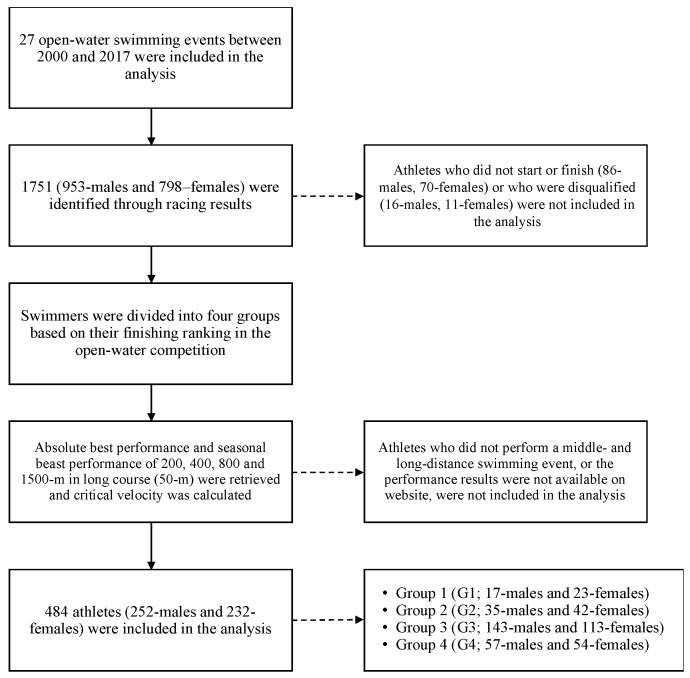
A total of 484 athletes (252-males and 232-females) were included in the analysis. Swimmers were divided into four groups based on their finishing position in the competition. For each swimmer, the absolute best performance (PB) of 200, 400, 800 and 1500-meter in long course, the seasonal best performance (SPB) obtained before the open-water events and critical velocity (CV) were analyzed. Multivariate analysis of variance (MANOVA) was used to detect significant differences between groups and discriminant analysis was used to predict a grouping variable.
All the variables analyzed were significantly different between groups ( < 0.001). The first discriminant function correctly classified 50% of the overall female and male swimmers.
Fastest OW-swimmers have a higher speed in middle- and long-distance pool swimming events. Further studies should include different anthropometric and physiological variables to increase the accuracy of classification.
研究表明,速度最快的公开水域游泳运动员(OW 游泳运动员)在公开水域赛事的最后一段会显著提高速度。本研究的目的是确定速度最快的 OW 游泳运动员在中长距离泳池游泳赛事中是否具有更高的速度,并建立一个多元模型来预测 10 公里比赛的奖牌获得者群体。
共有 484 名运动员(252 名男性和 232 名女性)纳入分析。根据运动员在比赛中的完赛名次将其分为四组。对每位游泳运动员,分析其长池 200 米、400 米、800 米和 1500 米的绝对最佳成绩(PB)、公开水域赛事前获得的赛季最佳成绩(SPB)以及临界速度(CV)。采用多变量方差分析(MANOVA)检测组间的显著差异,并使用判别分析预测分组变量。
所有分析变量在组间均存在显著差异(<0.001)。第一个判别函数正确分类了 50%的总体女性和男性游泳运动员。
速度最快的 OW 游泳运动员在中长距离泳池游泳赛事中具有更高速度。进一步的研究应纳入不同的人体测量和生理变量,以提高分类的准确性。