Wu Mengze, Lu Yongdi, Yang Wenli, Wong Shen Yuong
Department of Information Engineering, Wuhan University of Technology, Wuhan, China.
Department of Electrical and Electronics Engineering, Xiamen University Malaysia, Sepang, Malaysia.
Front Comput Neurosci. 2021 Jan 5;14:564015. doi: 10.3389/fncom.2020.564015. eCollection 2020.
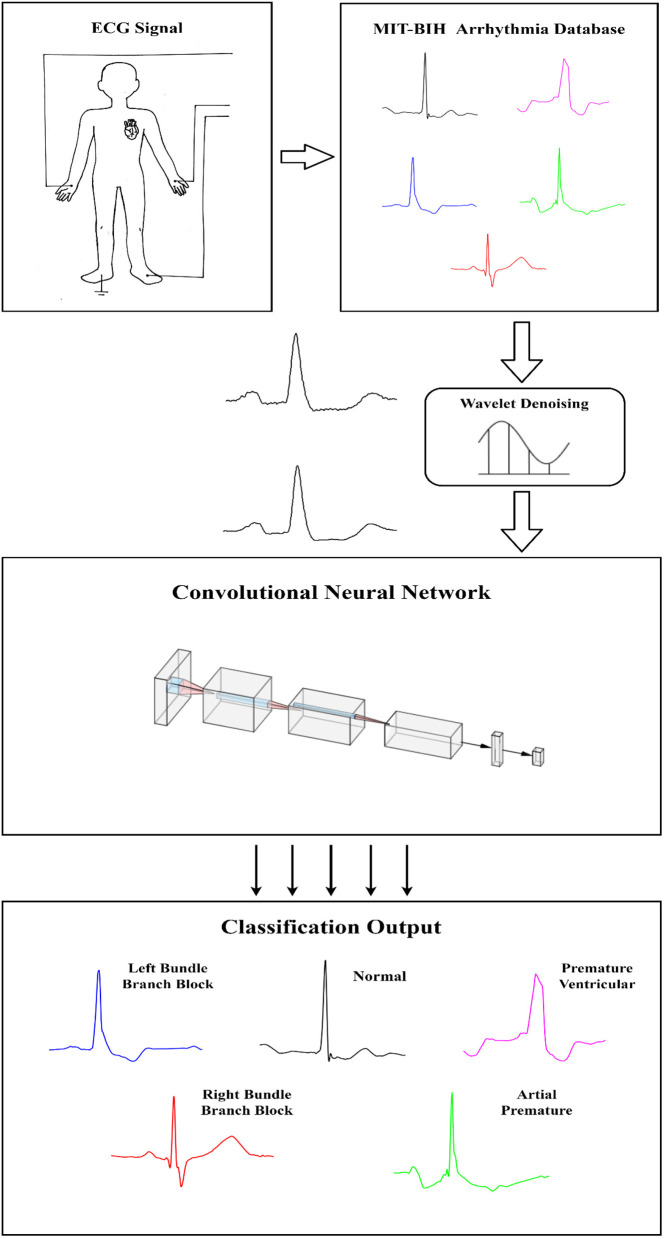
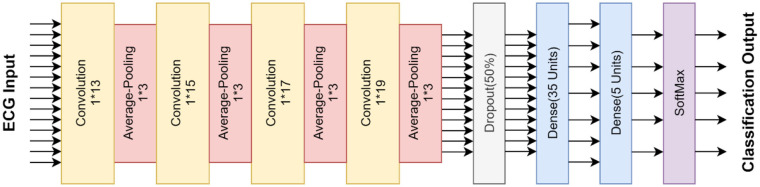
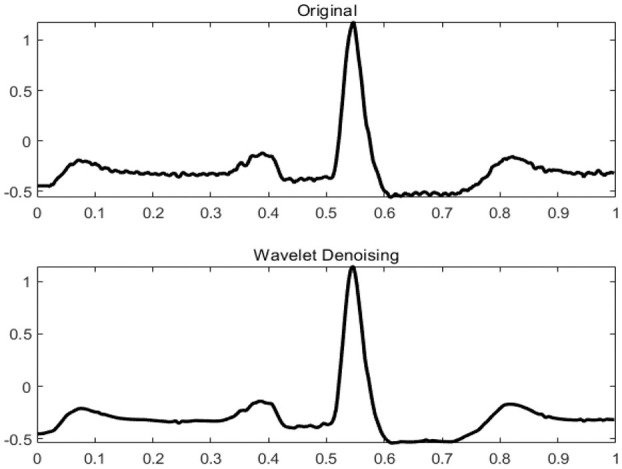
Cardiovascular diseases (CVDs) are the leading cause of death today. The current identification method of the diseases is analyzing the Electrocardiogram (ECG), which is a medical monitoring technology recording cardiac activity. Unfortunately, looking for experts to analyze a large amount of ECG data consumes too many medical resources. Therefore, the method of identifying ECG characteristics based on machine learning has gradually become prevalent. However, there are some drawbacks to these typical methods, requiring manual feature recognition, complex models, and long training time. This paper proposes a robust and efficient 12-layer deep one-dimensional convolutional neural network on classifying the five micro-classes of heartbeat types in the MIT- BIH Arrhythmia database. The five types of heartbeat features are classified, and wavelet self-adaptive threshold denoising method is used in the experiments. Compared with BP neural network, random forest, and other CNN networks, the results show that the model proposed in this paper has better performance in accuracy, sensitivity, robustness, and anti-noise capability. Its accurate classification effectively saves medical resources, which has a positive effect on clinical practice.
心血管疾病(CVDs)是当今主要的死亡原因。目前对这些疾病的识别方法是分析心电图(ECG),这是一种记录心脏活动的医学监测技术。不幸的是,寻找专家来分析大量的心电图数据会消耗过多的医疗资源。因此,基于机器学习识别心电图特征的方法逐渐变得流行起来。然而,这些典型方法存在一些缺点,需要人工特征识别、复杂的模型和较长的训练时间。本文提出了一种强大且高效的12层深度一维卷积神经网络,用于对麻省理工学院 - 贝斯以色列女执事医疗中心心律失常数据库中的五种微类心跳类型进行分类。对五种心跳特征进行分类,并在实验中使用小波自适应阈值去噪方法。与BP神经网络、随机森林和其他卷积神经网络相比,结果表明本文提出的模型在准确性、敏感性、鲁棒性和抗噪声能力方面具有更好的性能。其准确的分类有效地节省了医疗资源,对临床实践具有积极作用。