Unit of Nutritional Epidemiology, Department of Nutrition and Food Sciences, University of Bonn, Bonn, Germany.
APC Microbiome Ireland, University College Cork, Cork, Ireland.
Am J Clin Nutr. 2021 Mar 11;113(3):647-656. doi: 10.1093/ajcn/nqaa340.
Gut microbiota composition as influenced by long-term diet may be associated with the risk of adult chronic diseases. Thus, establishing the relation of long-term diet, particularly starting from early life, with adult microbiota composition would be an important research advance.
We aimed to investigate the association of long-term intake of energy, carbohydrate, fiber, protein, and fat from infancy to late adolescence with microbiota composition in adulthood.
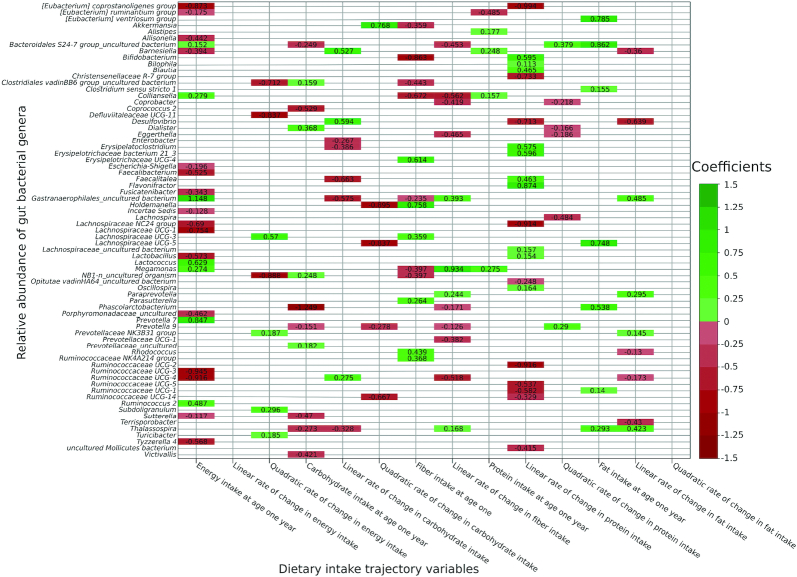
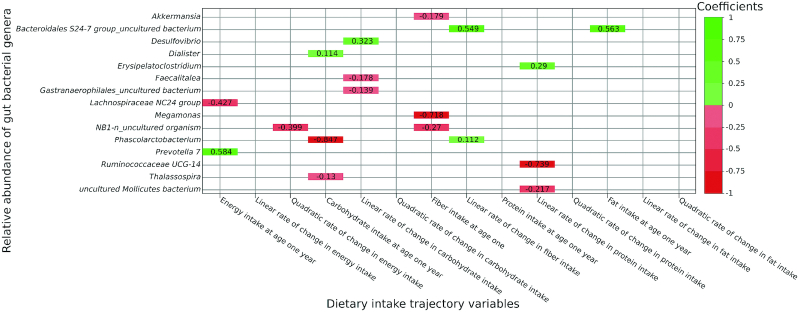
Within the prospective DOrtmund Nutritional and Anthropometric Longitudinally Designed (DONALD) Study, we sampled stool 1 or 2 times within 1 y from 128 adults (median age: 29 y). Microbiota composition was profiled by 16S ribosomal RNA sequencing. Annual dietary records from age 1 to 18 y were retrieved. We estimated trajectories of energy, energy-adjusted carbohydrate, fiber, protein, and fat intake with multilevel models, producing predicted intake at age 1 y and rates of change in intake. A multivariate, zero-inflated, logistic-normal model was used to model the association between intake trajectories and the composition of 158 genera in single-sampled individuals. Associations found in this model were confirmed in double-sampled individuals using a zero-inflated Beta regression model.
Adjusting for covariates and temporal differences in microbiota composition, long-term carbohydrate intake was associated with 3 genera. Specifically, carbohydrate intake at age 1 y was negatively associated with Phascolarctobacterium [coefficient = -4.31; false discovery rate (FDR)-adjusted P = 0.006] and positively associated with Dialister (coefficient = 3.06; FDR-adjusted P = 0.003), and the rate of change in carbohydrate intake was positively associated with Desulfovibrio (coefficient = 13.16; FDR-adjusted P = 0.00039). Energy and other macronutrients were not associated with any genus.
This work links long-term carbohydrate intake to microbiota composition. Considering the associations of high carbohydrate intake and microbiota composition with some diseases, these findings could inform the development of gut microbiota-targeted dietary recommendations for disease prevention.
长期饮食对肠道微生物组成的影响可能与成人慢性疾病的风险有关。因此,建立长期饮食(尤其是从生命早期开始)与成人肠道微生物组成之间的关系将是一项重要的研究进展。
本研究旨在调查从婴儿期到青少年晚期长期摄入能量、碳水化合物、纤维、蛋白质和脂肪与成年期肠道微生物组成的关系。
在前瞻性多特蒙德营养和人体测量纵向设计(DOrtmund Nutritional and Anthropometric Longitudinally Designed,DONALD)研究中,我们在 1 年内从 128 名成年人(中位年龄:29 岁)中采集了 1 或 2 次粪便样本。通过 16S 核糖体 RNA 测序对肠道微生物组成进行了分析。我们从 1 岁到 18 岁时获取了年度饮食记录。使用多水平模型估计能量、能量调整后的碳水化合物、纤维、蛋白质和脂肪的摄入轨迹,生成 1 岁时的预测摄入量和摄入量变化率。使用多元、零膨胀、正态分布模型来对摄入轨迹与单样本个体中 158 个属的组成之间的关系进行建模。在双样本个体中,使用零膨胀 Beta 回归模型对该模型中发现的关联进行了验证。
调整协变量和肠道微生物组成的时间差异后,长期碳水化合物摄入与 3 个属有关。具体来说,1 岁时的碳水化合物摄入与 Phascolarctobacterium 呈负相关(系数=-4.31;经错误发现率(false discovery rate,FDR)校正的 P 值=0.006),与 Dialister 呈正相关(系数=3.06;经 FDR 校正的 P 值=0.003),碳水化合物摄入量的变化率与 Desulfovibrio 呈正相关(系数=13.16;经 FDR 校正的 P 值=0.00039)。能量和其他宏量营养素与任何属均无关联。
本研究将长期碳水化合物摄入与肠道微生物组成联系起来。考虑到高碳水化合物摄入和肠道微生物组成与某些疾病的关联,这些发现可能为制定针对肠道微生物的饮食建议以预防疾病提供信息。