Health and Counseling Center, Osaka University, 1-17 Machikaneyamacho, Toyonaka, Osaka 560-0043, Japan.
Department of Nephrology, Osaka University Graduate School of Medicine, 2-2-D11 Yamadaoka, Suita, Osaka 565-0871, Japan.
Nutrients. 2021 Jan 19;13(1):271. doi: 10.3390/nu13010271.
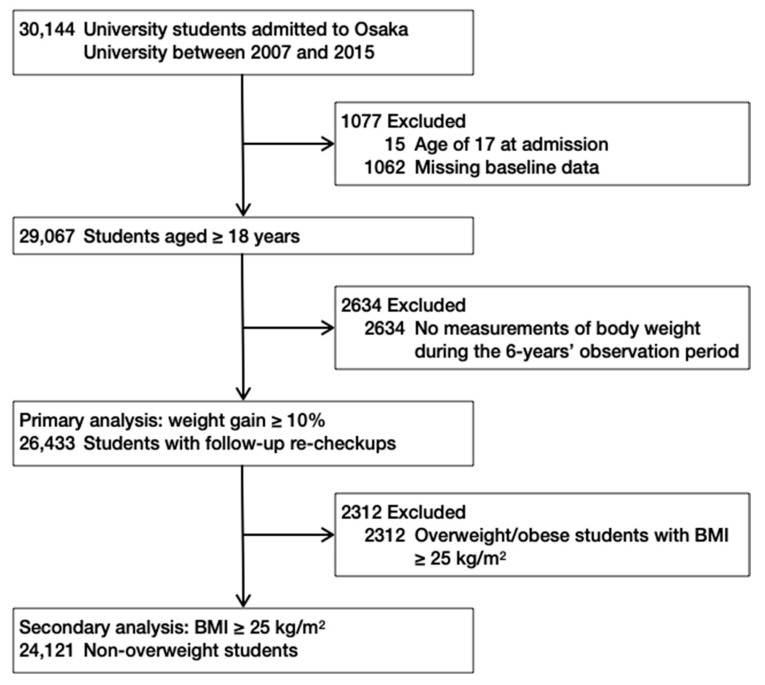
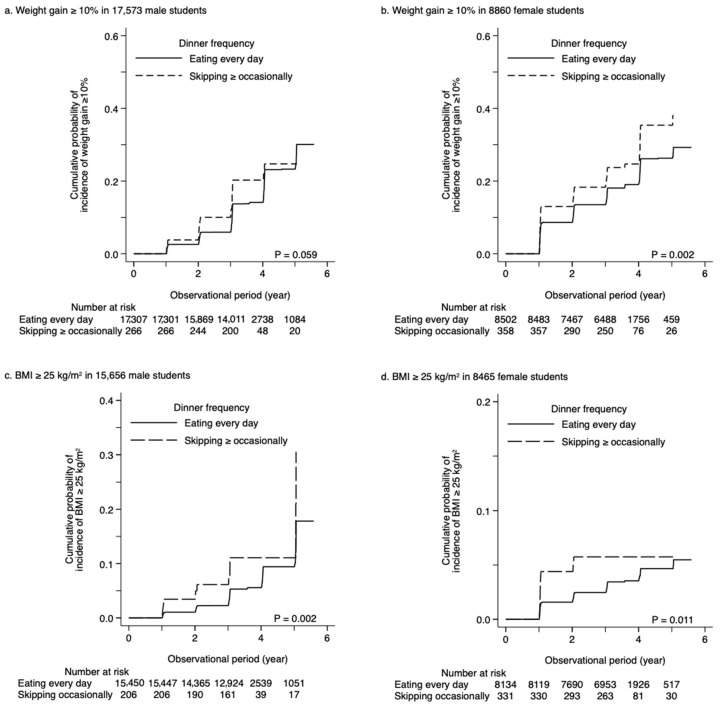
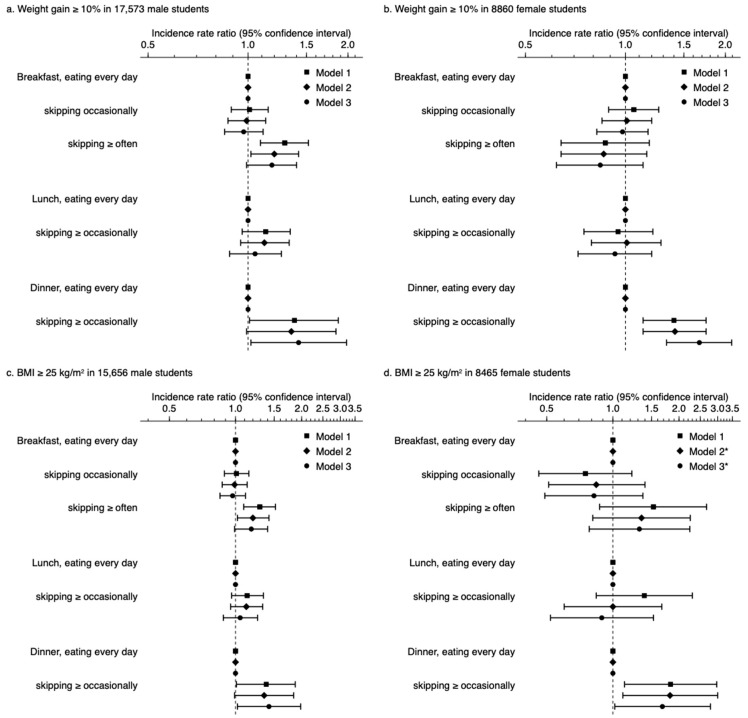
Although multiple studies have identified skipping breakfast as a risk factor for weight gain, there is limited evidence on the clinical impact of skipping lunch and dinner on weight gain. This retrospective cohort study including 17,573 male and 8860 female university students at a national university in Japan, assessed the association of the frequency of breakfast, lunch, and dinner with the incidence of weight gain (≥10%) and overweight/obesity (body mass index ≥ 25 kg/m), using annual participant health checkup data. Within the observation period of 3.0 ± 0.9 years, the incidence of ≥10% weight gain was observed in 1896 (10.8%) men and 1518 (17.1%) women, respectively. Skipping dinner was identified as a significant predictor of weight gain in multivariable-adjusted Poisson regression models for both men and women (skipping ≥ occasionally vs. eating every day, adjusted incidence rate ratios, 1.45 (95% confidence interval: 1.04-2.01) and 1.67 (1.33-2.09) in male and female students, respectively), whereas skipping breakfast and lunch were not. Similarly, skipping dinner, not breakfast or lunch, was associated with overweight/obesity (1.74 (1.07-2.84) and 1.68 (1.02-2.78) in men and women, respectively). In conclusion, skipping dinner predicted the incidence of weight gain and overweight/obesity in university students.
尽管多项研究已经确定不吃早餐是体重增加的一个风险因素,但对于不吃午餐和晚餐对体重增加的临床影响的证据有限。这项回顾性队列研究包括日本一所国立大学的 17573 名男性和 8860 名女性大学生,使用年度参与者健康检查数据评估了早餐、午餐和晚餐频率与体重增加(≥10%)和超重/肥胖(体重指数≥25kg/m )的发生率之间的关联。在 3.0±0.9 年的观察期内,分别有 1896 名(10.8%)男性和 1518 名(17.1%)女性发生体重增加≥10%。在多变量调整泊松回归模型中,对于男性和女性来说,晚餐偶尔不吃或每天不吃均与体重增加显著相关(与每天进食相比,调整后的发病率比分别为 1.45(95%置信区间:1.04-2.01)和 1.67(1.33-2.09)),而不吃早餐和午餐则没有。同样,不吃晚餐,而不是早餐或午餐,与超重/肥胖有关(男性和女性分别为 1.74(1.07-2.84)和 1.68(1.02-2.78))。总之,晚餐不吃预测了大学生体重增加和超重/肥胖的发生。