Kim Ga-Yeong, Son Jaejung, Han Jong-In, Park Je-Kyun
Department of Civil and Environmental Engineering, Korea Advanced Institute of Science and Technology (KAIST), 291 Daehak-ro, Yuseong-gu, Daejeon 34141, Korea.
Department of Bio and Brain Engineering, Korea Advanced Institute of Science and Technology (KAIST), 291 Daehak-ro, Yuseong-gu, Daejeon 34141, Korea.
Micromachines (Basel). 2021 Jan 19;12(1):97. doi: 10.3390/mi12010097.
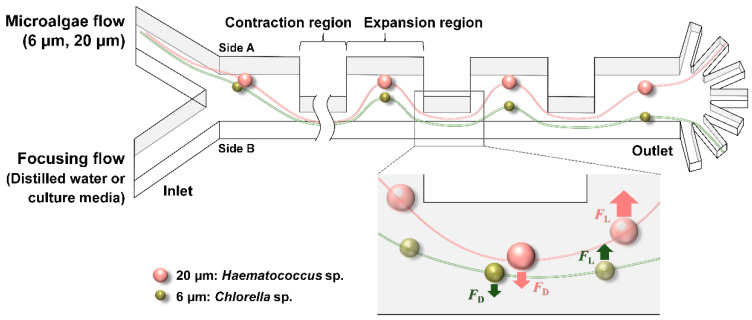
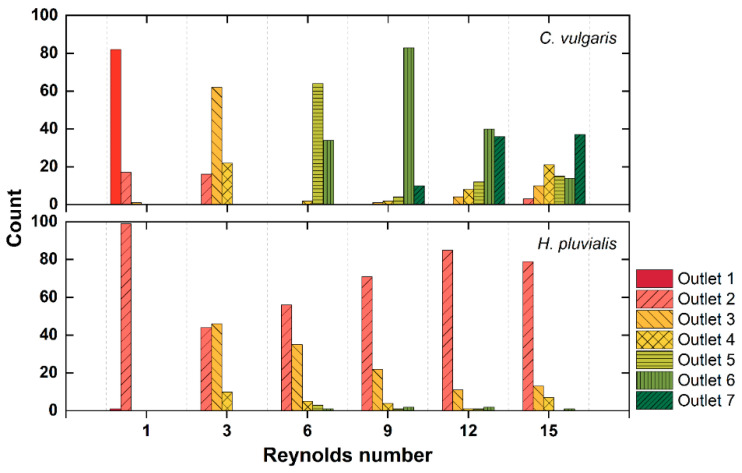
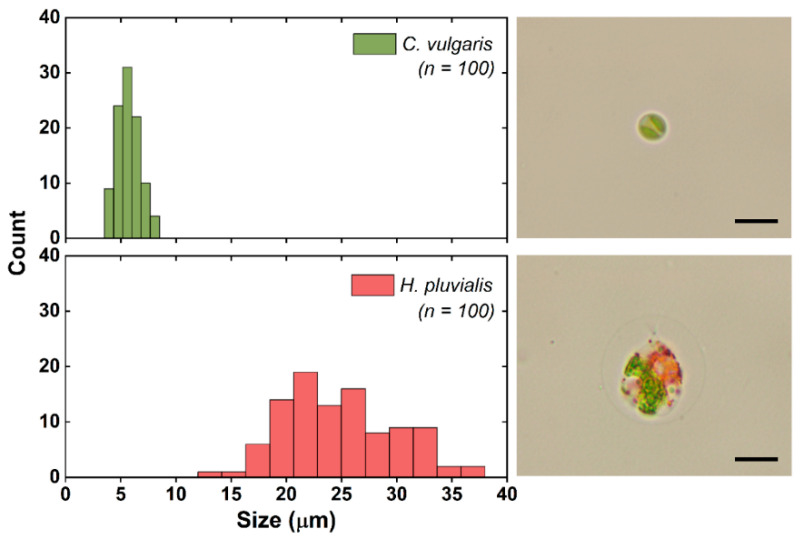
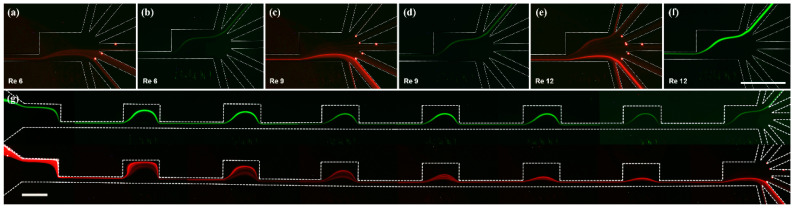
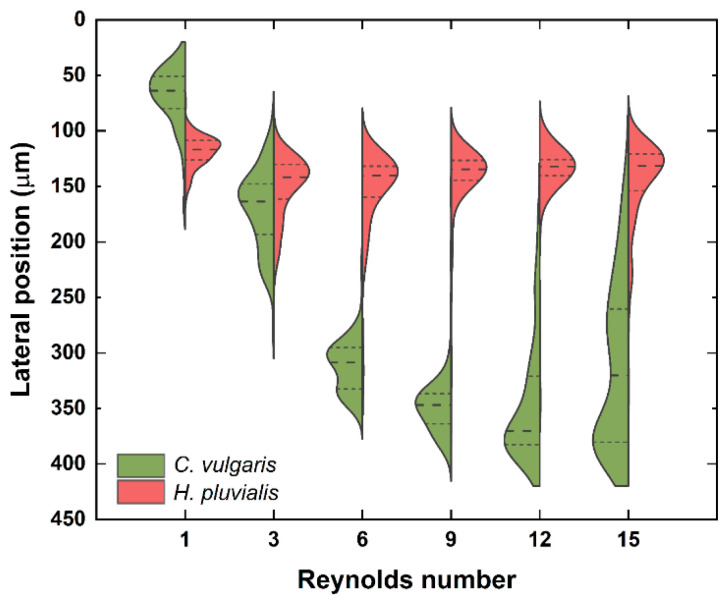
Microalgae separation technology is essential for both executing laboratory-based fundamental studies and ensuring the quality of the final algal products. However, the conventional microalgae separation technology of micropipetting requires highly skilled operators and several months of repeated separation to obtain a microalgal single strain. This study therefore aimed at utilizing microfluidic cell sorting technology for the simple and effective separation of microalgae. Microalgae are characterized by their various morphologies with a wide range of sizes. In this study, a contraction-expansion array microchannel, which utilizes these unique properties of microalgae, was specifically employed for the size-based separation of microalgae. At Reynolds number of 9, two model algal cells, () and (), were successfully separated without showing any sign of cell damage, yielding a purity of 97.9% for and 94.9% for . The result supported that the inertia-based separation technology could be a powerful alternative to the labor-intensive and time-consuming conventional microalgae separation technologies.
微藻分离技术对于开展基于实验室的基础研究以及确保最终藻类产品的质量都至关重要。然而,传统的微量移液微藻分离技术需要高技能的操作人员,并且要经过数月的反复分离才能获得微藻单株。因此,本研究旨在利用微流控细胞分选技术实现微藻的简单有效分离。微藻的特点是具有各种形态且大小范围广泛。在本研究中,利用微藻这些独特特性的收缩-扩张阵列微通道专门用于基于大小的微藻分离。在雷诺数为9时,两种模型藻细胞,()和(),成功分离,且未显示出任何细胞损伤迹象,对于()的纯度为97.9%,对于()的纯度为94.9%。结果表明,基于惯性的分离技术可能成为替代劳动密集型且耗时的传统微藻分离技术的有力选择。