MacGibbon Kimber W, Kim Sarah, Mullin Patrick M, Fejzo Marlena S
HER Foundation, Damascus, OR, USA.
Brown University, Providence, RI, USA.
Geburtshilfe Frauenheilkd. 2021 Jan;81(1):90-98. doi: 10.1055/a-1309-1997. Epub 2021 Jan 19.
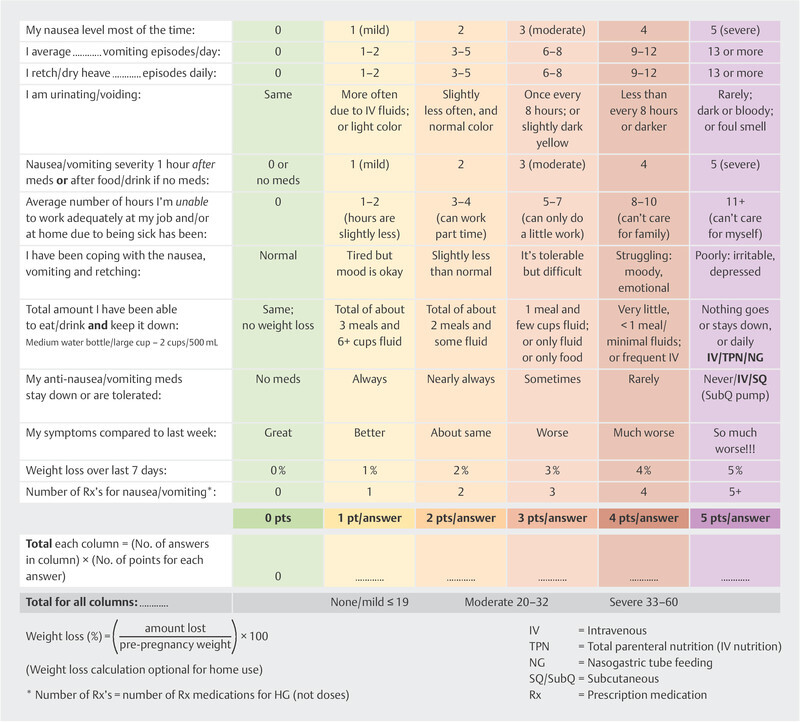
Hyperemesis gravidarum (HG) severity can be underestimated resulting in undertreatment and adverse outcomes. This study was conducted to validate a tool (HELP Score) designed to score HG severity. A survey link which included PUQE and HELP Score (HELP) tool questions was posted on websites related to HG. HELP scores were compared to PUQE scores for indicators of severe disease. HELP classified 92% of women reporting "nothing goes or stays down" as severe, compared to 58% using PUQE. Women self-categorizing symptoms as severe were more likely categorized as severe using HELP. Women hospitalized for HG were more likely classified as severe using HELP. HELP performs better than PUQE in identifying patients with severe symptoms requiring intervention. This study provides a novel tool that should be implemented to determine the need for intervention for NVP that may be overlooked using PUQE or empirical assessment.
妊娠剧吐(HG)的严重程度可能被低估,从而导致治疗不足和不良后果。本研究旨在验证一种用于评估HG严重程度的工具(HELP评分)。一个包含PUQE和HELP评分(HELP)工具问题的调查链接被发布在与HG相关的网站上。将HELP评分与PUQE评分进行比较,以作为严重疾病的指标。HELP将92%报告“吃什么吐什么”的女性归类为严重,而使用PUQE的这一比例为58%。自我将症状归类为严重的女性使用HELP更有可能被归类为严重。因HG住院的女性使用HELP更有可能被归类为严重。在识别需要干预的严重症状患者方面,HELP比PUQE表现更好。本研究提供了一种新工具,应采用该工具来确定对于可能被PUQE或经验性评估忽视的恶心和呕吐妊娠反应(NVP)进行干预的必要性。