Hildebrand Lindsey A, Pierce Colin J, Dennis Michael, Paracha Munizay, Maoz Asaf
Department of Medicine, Boston University School of Medicine and Boston Medical Center, Boston, MA 02118, USA.
Division of Hematology Oncology, Department of Medicine, University of California San Diego, San Diego, CA 92093, USA.
Cancers (Basel). 2021 Jan 21;13(3):391. doi: 10.3390/cancers13030391.
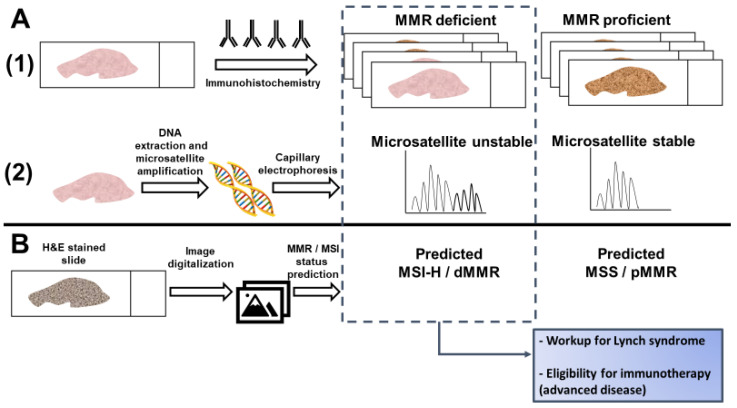
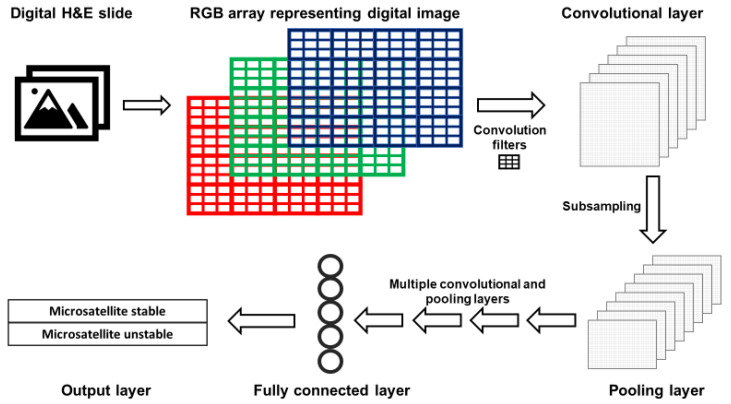
Microsatellite instability (MSI) is a molecular marker of deficient DNA mismatch repair (dMMR) that is found in approximately 15% of colorectal cancer (CRC) patients. Testing all CRC patients for MSI/dMMR is recommended as screening for Lynch Syndrome and, more recently, to determine eligibility for immune checkpoint inhibitors in advanced disease. However, universal testing for MSI/dMMR has not been uniformly implemented because of cost and resource limitations. Artificial intelligence has been used to predict MSI/dMMR directly from hematoxylin and eosin (H&E) stained tissue slides. We review the emerging data regarding the utility of machine learning for MSI classification, focusing on CRC. We also provide the clinician with an introduction to image analysis with machine learning and convolutional neural networks. Machine learning can predict MSI/dMMR with high accuracy in high quality, curated datasets. Accuracy can be significantly decreased when applied to cohorts with different ethnic and/or clinical characteristics, or different tissue preparation protocols. Research is ongoing to determine the optimal machine learning methods for predicting MSI, which will need to be compared to current clinical practices, including next-generation sequencing. Predicting response to immunotherapy remains an unmet need.
微卫星不稳定性(MSI)是DNA错配修复缺陷(dMMR)的一种分子标志物,约15%的结直肠癌(CRC)患者中可检测到该标志物。建议对所有CRC患者进行MSI/dMMR检测,以筛查林奇综合征,最近还用于确定晚期疾病患者是否符合免疫检查点抑制剂治疗的条件。然而,由于成本和资源限制,尚未统一实施MSI/dMMR的普遍检测。人工智能已被用于直接从苏木精和伊红(H&E)染色的组织切片预测MSI/dMMR。我们回顾了关于机器学习在MSI分类中的应用的最新数据,重点关注CRC。我们还向临床医生介绍了机器学习和卷积神经网络的图像分析方法。在高质量的、经过整理的数据集上,机器学习可以高精度地预测MSI/dMMR。当应用于具有不同种族和/或临床特征或不同组织制备方案的队列时,准确率可能会显著降低。目前正在进行研究以确定预测MSI的最佳机器学习方法,这需要与包括下一代测序在内的当前临床实践进行比较。预测免疫治疗反应仍然是一个未满足的需求。