Zheng Wen, Yu Ailin, Li Disi, Fang Ping, Peng Kaiping
Department of Medical Psychology, Capital Medical University, Beijing, China.
Department of Psychology, Tsinghua University, Beijing, China.
Front Psychol. 2021 Jan 11;11:538793. doi: 10.3389/fpsyg.2020.538793. eCollection 2020.
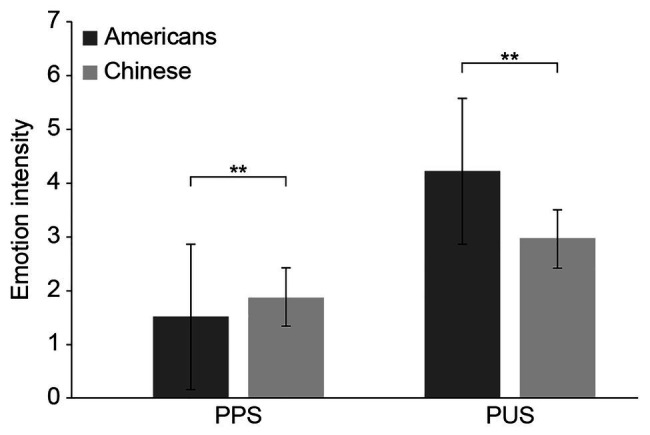
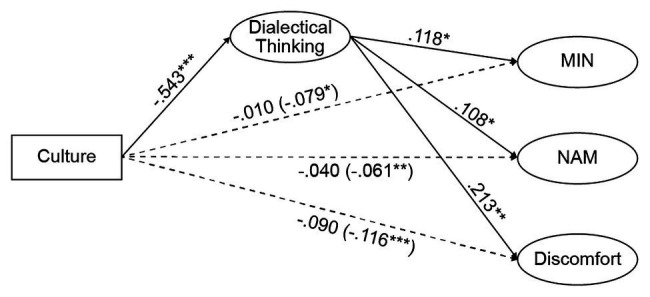
Who can feel both happy and sad at the same time, but not discomfort? This study aimed to investigate the cultural differences in mixed emotional experiences induced by conflict stimuli among American and Chinese undergraduate students. In total, 160 Americans and 158 Chinese watched two different valence advertisements (one predominantly positive and the other predominantly negative) that elicited mixed emotions; their feelings were assessed through self-reported measures. Findings indicated the impact that cultural differences have in people's mixed emotional experiences depends on the emotional components of the mixed emotional situations. The Americans and Chinese both experience a comparably intense mixture of emotions in different valence situations, but their discomfort toward conflicting stimuli is different. Further, dialectical thinking may be a mechanism behind the influence of cultural differences in people's mixed emotional experiences. Implications for emotion theory and research are discussed.
谁能同时感到开心和悲伤,却没有不适感呢?本研究旨在调查美国和中国本科生在冲突刺激引发的混合情绪体验中的文化差异。共有160名美国人和158名中国人观看了两个引发混合情绪的不同效价广告(一个主要是积极的,另一个主要是消极的);通过自我报告的方式评估他们的感受。研究结果表明,文化差异对人们混合情绪体验的影响取决于混合情绪情境的情感成分。美国人和中国人在不同效价情境中都经历了强度相当的情绪混合,但他们对冲突刺激的不适感有所不同。此外,辩证思维可能是文化差异影响人们混合情绪体验的一种机制。文中还讨论了对情绪理论和研究的启示。