Department of Internal Medicine, Seoul National University Hospital, Seoul, Republic of Korea.
Department of Internal Medicine, National Health Insurance Service Ilsan Hospital, Goyang, Republic of Korea.
Sci Rep. 2021 Jan 28;11(1):2514. doi: 10.1038/s41598-021-81666-x.
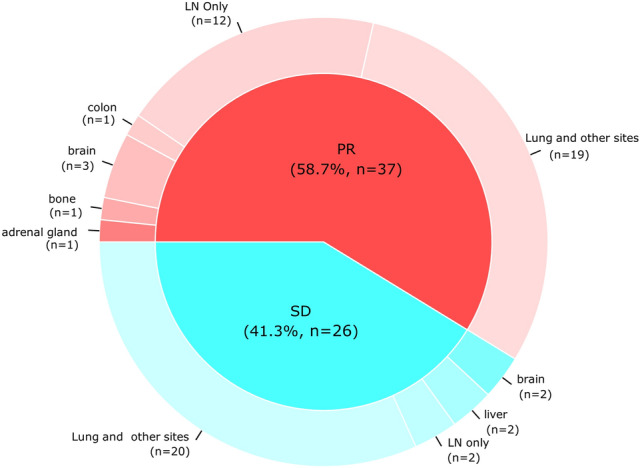
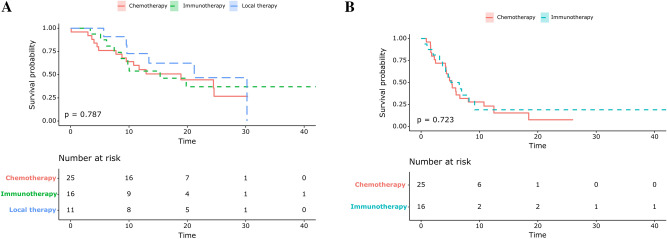
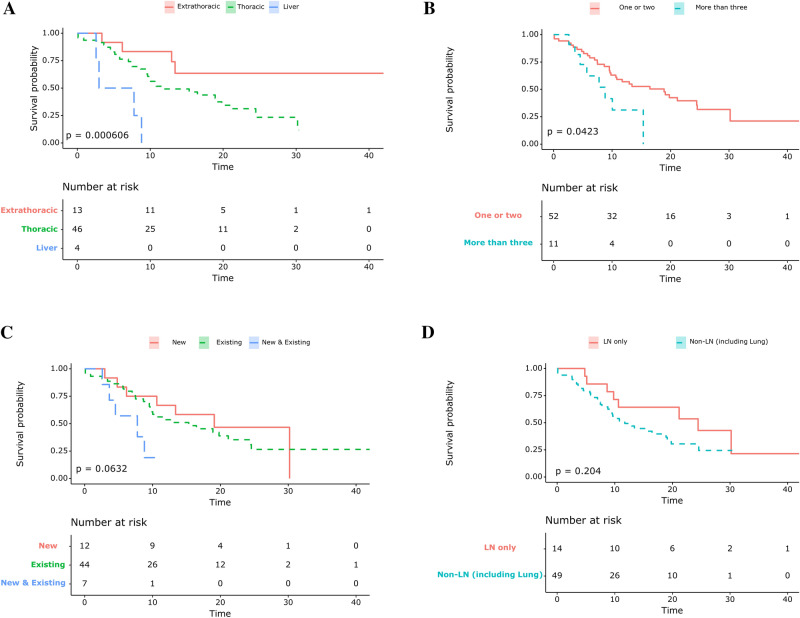
Although immune checkpoint inhibitors (ICIs) can induce durable responses in non-small-cell lung cancer (NSCLC) patients, a significant proportion of responders still experience progressive disease after a period of response. Limited data are available on the clinical patterns of acquired resistance (AR) to ICIs. Clinical and radiologic data from 125 NSCLC patients treated with anti-PD-1 or PD-L1 antibodies between 2011 and 2018 at two tertiary academic institutions were retrospectively reviewed. Overall, 63 (50.4%) patients experienced AR after ICI treatment in a median of 10.7 months. Among the 13 patients with a partial response with ICI, 12 (32.4%) had only lymph node progression. Most patients (n = 52, 82.5%) had one or two sites with progression (oligo-progression). The median overall survival (OS) after progression was significantly longer in the extrathoracic group than in the thoracic and liver progression groups (30.2 months [95% confidence interval (CI), 13.4 to not reached (NR)], 11.7 months [95% CI, 9.5-21.1], and 5.4 months [95% CI, 2.6-NR], respectively, P < 0.001). Patients with oligo-progression had significantly longer OS after AR than did the multi-progression patients (18.9 months [95% CI, 10.6-NR] vs. 8.8 months [95% CI, 5.7-NR], P = 0.04). No significant difference in progression-free survival was observed between the subsequent chemotherapy and the ICI after AR groups (P = 0.723). Patients with AR after ICI treatment had a unique progression pattern with oligo-progression and high rates of progression only in the lymph nodes. Local treatment and/or continuation of ICIs beyond AR might be an effective option.
尽管免疫检查点抑制剂(ICIs)可在非小细胞肺癌(NSCLC)患者中诱导持久反应,但相当一部分应答者在反应期后仍会出现疾病进展。关于ICI 获得性耐药(AR)的临床模式,数据有限。回顾性分析了 2011 年至 2018 年在两家三级学术机构接受抗 PD-1 或 PD-L1 抗体治疗的 125 例 NSCLC 患者的临床和影像学数据。总体而言,63 例(50.4%)患者在 ICI 治疗后中位时间 10.7 个月时出现 AR。在 13 例 ICI 部分缓解的患者中,12 例(32.4%)仅出现淋巴结进展。大多数患者(n=52,82.5%)有一个或两个部位进展(寡进展)。进展后总体生存(OS)在胸外组明显长于胸内和肝内进展组(30.2 个月[95%置信区间(CI),13.4-NR]、11.7 个月[95%CI,9.5-21.1]和 5.4 个月[95%CI,2.6-NR],P<0.001)。AR 后寡进展患者的 OS 明显长于多进展患者(18.9 个月[95%CI,10.6-NR] vs. 8.8 个月[95%CI,5.7-NR],P=0.04)。AR 后接受后续化疗和 ICI 患者的无进展生存期无显著差异(P=0.723)。ICI 治疗后 AR 患者具有独特的进展模式,寡进展且淋巴结进展率高。局部治疗和/或 AR 后继续使用 ICI 可能是一种有效的选择。