Department of Dermatology, Affiliated Hospital of Nanjing University of Chinese Medicine, Nanjing, Jiangsu, China (mainland).
First Clinical College, Nanjing University of Chinese Medicine, Nanjing, Jiangsu, China (mainland).
Med Sci Monit. 2021 Jan 29;27:e927421. doi: 10.12659/MSM.927421.
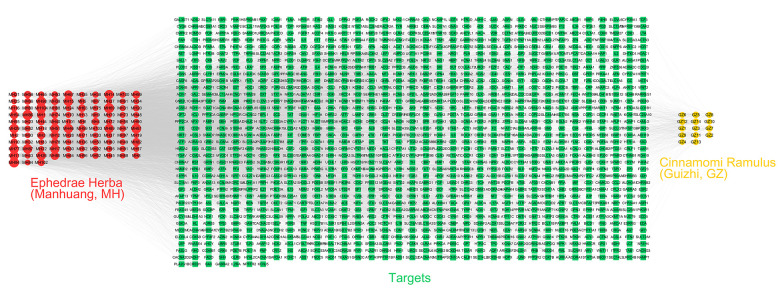
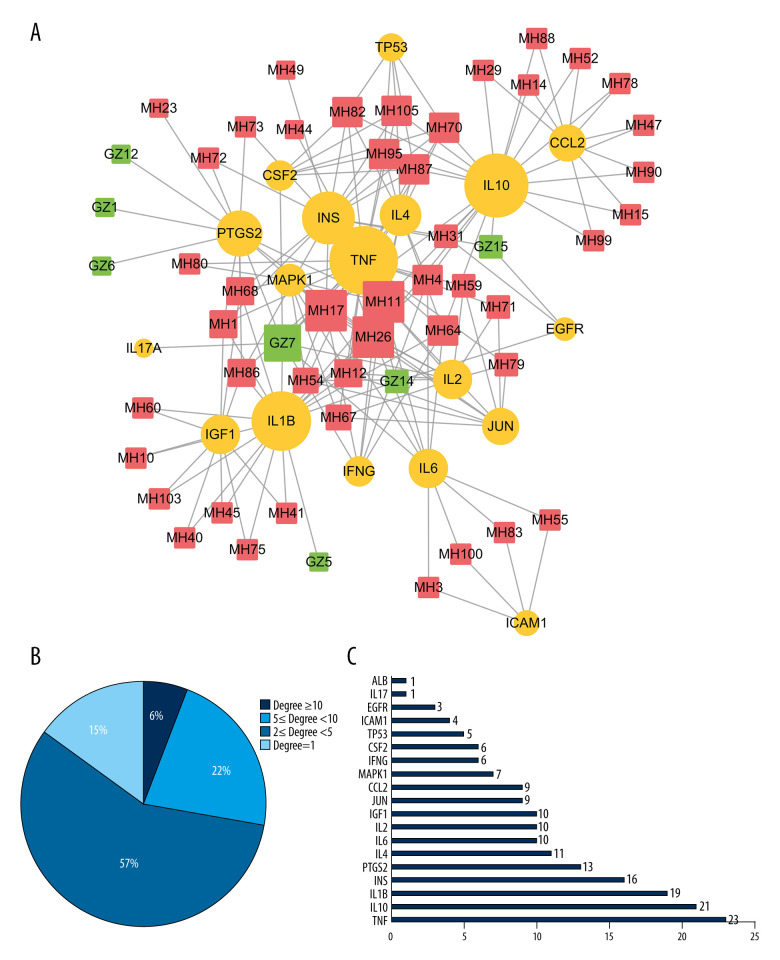
BACKGROUND This study explored the mechanism of action of Ephedrae Herba-Cinnamomi Ramulus couplet medicine (MGCM) at the pharmacological level in the treatment of psoriasis. MATERIAL AND METHODS The active ingredients in MGCM were mined through literature retrieval and the BATMAN-TCM database, and potential targets were predicted. In addition, targets associated with psoriasis were acquired using multiple disease-related databases. Thereafter, an interaction network between candidate MGCM targets and the known psoriasis-associated targets was constructed based on the protein-protein interaction (PPI) data, using the STRING database. Then, the topological parameter degree was determined for mining the core targets for MGCM in the treatment of psoriasis, which also represented the major hubs within the PPI network. In addition, the core networks of targets and ingredients were constructed using Cytoscape software to apply MGCM in the treatment for psoriasis. These core targets were then analyzed for Gene Ontology biological processes and Kyoto Encyclopedia of Genes and Genomes pathway enrichment using OmicShare. RESULTS The ingredient-target core network of MGCM for treating psoriasis was constructed; it contained 52 active ingredients and corresponded to 19 core targets. In addition, based on enrichment analysis, these core targets were majorly enriched for several biological processes (immuno-inflammatory responses, leukocyte differentiation, energy metabolism, angiogenesis, and programmed cell death) together with the relevant pathways (Janus kinase-signal transducer and activator of transcription, toll-like receptors, nuclear factor kappaB, vascular endothelial growth factor, and peroxisome proliferator-activated receptor), thus identifying the possible mechanism of action of MGCM in treating psoriasis. CONCLUSIONS The present network pharmacology study indicated that MGCM alleviates various pathological factors of psoriasis through multiple compounds, multiple targets, and multiple pathways.
本研究从药理水平探讨了麻黄-肉桂药对(MGCM)治疗银屑病的作用机制。
通过文献检索和 BATMAN-TCM 数据库挖掘 MGCM 的活性成分,预测潜在靶点。此外,还从多个疾病相关数据库中获取与银屑病相关的靶点。然后,基于 STRING 数据库的蛋白质-蛋白质相互作用(PPI)数据,构建候选 MGCM 靶点与已知银屑病相关靶点之间的相互作用网络。之后,使用 STRING 数据库的拓扑参数度来挖掘 MGCM 治疗银屑病的核心靶点,这些核心靶点也是 PPI 网络中的主要枢纽。此外,还使用 Cytoscape 软件构建了靶点和成分的核心网络,以应用 MGCM 治疗银屑病。然后,使用 OmicShare 对这些核心靶点进行基因本体生物过程和京都基因与基因组百科全书通路富集分析。
构建了 MGCM 治疗银屑病的成分-靶点核心网络,包含 52 种活性成分和对应 19 个核心靶点。此外,基于富集分析,这些核心靶点主要富集于免疫炎症反应、白细胞分化、能量代谢、血管生成和细胞程序性死亡等几个生物学过程,以及相关通路(Janus 激酶-信号转导和转录激活因子、 Toll 样受体、核因子 kappaB、血管内皮生长因子和过氧化物酶体增殖物激活受体),从而确定了 MGCM 治疗银屑病的可能作用机制。
本网络药理学研究表明,MGCM 通过多种化合物、多个靶点和多条途径缓解银屑病的各种病理因素。