Shadow Creek High School, Pearland, TX, United States.
Department of Community Medicine, Information and Health Decision Sciences, Faculty of Medicine, University of Porto, Porto, Portugal.
JMIR Public Health Surveill. 2022 Mar 3;8(3):e32364. doi: 10.2196/32364.
The emergence and media coverage of COVID-19 may have affected influenza search patterns, possibly affecting influenza surveillance results using Google Trends.
We aimed to investigate if the emergence of COVID-19 was associated with modifications in influenza search patterns in the United States.
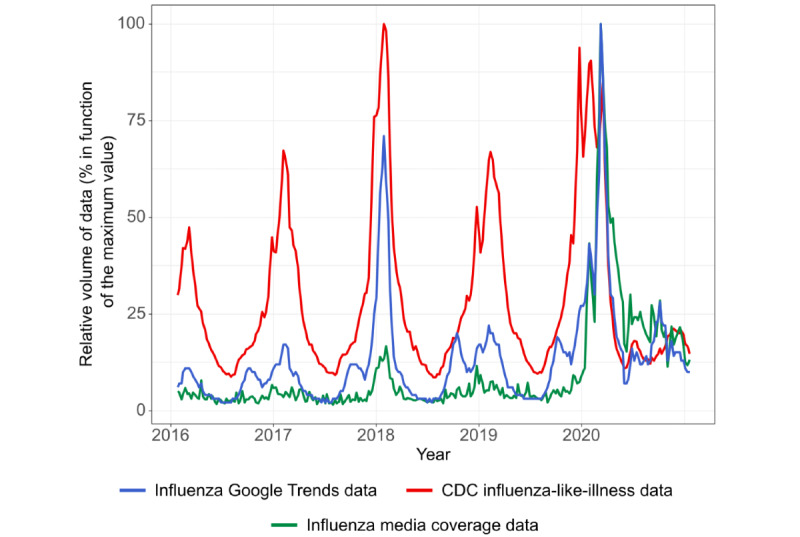
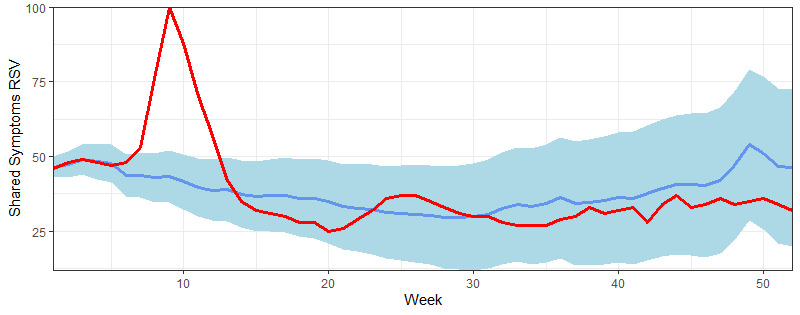
We retrieved US Google Trends data (relative number of searches for specified terms) for the topics influenza, Coronavirus disease 2019, and symptoms shared between influenza and COVID-19. We calculated the correlations between influenza and COVID-19 search data for a 1-year period after the first COVID-19 diagnosis in the United States (January 21, 2020 to January 20, 2021). We constructed a seasonal autoregressive integrated moving average model and compared predicted search volumes, using the 4 previous years, with Google Trends relative search volume data. We built a similar model for shared symptoms data. We also assessed correlations for the past 5 years between Google Trends influenza data, US Centers for Diseases Control and Prevention influenza-like illness data, and influenza media coverage data.
We observed a nonsignificant weak correlation (ρ= -0.171; P=0.23) between COVID-19 and influenza Google Trends data. Influenza search volumes for 2020-2021 distinctly deviated from values predicted by seasonal autoregressive integrated moving average models-for 6 weeks within the first 13 weeks after the first COVID-19 infection was confirmed in the United States, the observed volume of searches was higher than the upper bound of 95% confidence intervals for predicted values. Similar results were observed for shared symptoms with influenza and COVID-19 data. The correlation between Google Trends influenza data and CDC influenza-like-illness data decreased after the emergence of COVID-19 (2020-2021: ρ=0.643; 2019-2020: ρ=0.902), while the correlation between Google Trends influenza data and influenza media coverage volume remained stable (2020-2021: ρ=0.746; 2019-2020: ρ=0.707).
Relevant differences were observed between predicted and observed influenza Google Trends data the year after the onset of the COVID-19 pandemic in the United States. Such differences are possibly due to media coverage, suggesting limitations to the use of Google Trends as a flu surveillance tool.
COVID-19 的出现和媒体报道可能影响了流感搜索模式,这可能会影响使用 Google Trends 进行的流感监测结果。
我们旨在研究 COVID-19 的出现是否与美国流感搜索模式的变化有关。
我们检索了美国 Google Trends 数据(特定主题搜索的相对数量),包括流感、COVID-19 和流感与 COVID-19 之间共有的症状。我们计算了 COVID-19 在美国出现后的 1 年内流感和 COVID-19 搜索数据之间的相关性(2020 年 1 月 21 日至 2021 年 1 月 20 日)。我们构建了一个季节性自回归综合移动平均模型,并使用前 4 年的数据与 Google Trends 相对搜索量数据进行了预测搜索量的比较。我们为共享症状数据构建了一个类似的模型。我们还评估了过去 5 年中 Google Trends 流感数据、美国疾病控制与预防中心流感样疾病数据和流感媒体报道数据之间的相关性。
我们观察到 COVID-19 和流感 Google Trends 数据之间存在无统计学意义的弱相关性(ρ=-0.171;P=0.23)。2020-2021 年的流感搜索量明显偏离季节性自回归综合移动平均模型的预测值-在美国首次确认 COVID-19 感染后的前 13 周内的 6 周内,观察到的搜索量高于预测值 95%置信区间上限。与流感和 COVID-19 数据共享症状的结果类似。COVID-19 出现后,Google Trends 流感数据与美国疾病控制与预防中心流感样疾病数据之间的相关性下降(2020-2021:ρ=0.643;2019-2020:ρ=0.902),而 Google Trends 流感数据与流感媒体报道量之间的相关性保持稳定(2020-2021:ρ=0.746;2019-2020:ρ=0.707)。
在美国 COVID-19 大流行开始后的第二年,观察到与预测的流感 Google Trends 数据之间存在显著差异。这种差异可能是由于媒体报道所致,这表明 Google Trends 作为流感监测工具存在局限性。