Mangono Tichakunda, Smittenaar Peter, Caplan Yael, Huang Vincent S, Sutermaster Staci, Kemp Hannah, Sgaier Sema K
Surgo Ventures, Washington, DC, United States.
Department of Global Health & Population, Harvard T.H. Chan School of Public Health, Boston, MA, United States.
J Med Internet Res. 2021 May 3;23(5):e22933. doi: 10.2196/22933.
The COVID-19 pandemic has impacted people's lives at unprecedented speed and scale, including how they eat and work, what they are concerned about, how much they move, and how much they can earn. Traditional surveys in the area of public health can be expensive and time-consuming, and they can rapidly become outdated. The analysis of big data sets (such as electronic patient records and surveillance systems) is very complex. Google Trends is an alternative approach that has been used in the past to analyze health behaviors; however, most existing studies on COVID-19 using these data examine a single issue or a limited geographic area. This paper explores Google Trends as a proxy for what people are thinking, needing, and planning in real time across the United States.
We aimed to use Google Trends to provide both insights into and potential indicators of important changes in information-seeking patterns during pandemics such as COVID-19. We asked four questions: (1) How has information seeking changed over time? (2) How does information seeking vary between regions and states? (3) Do states have particular and distinct patterns in information seeking? (4) Do search data correlate with-or precede-real-life events?
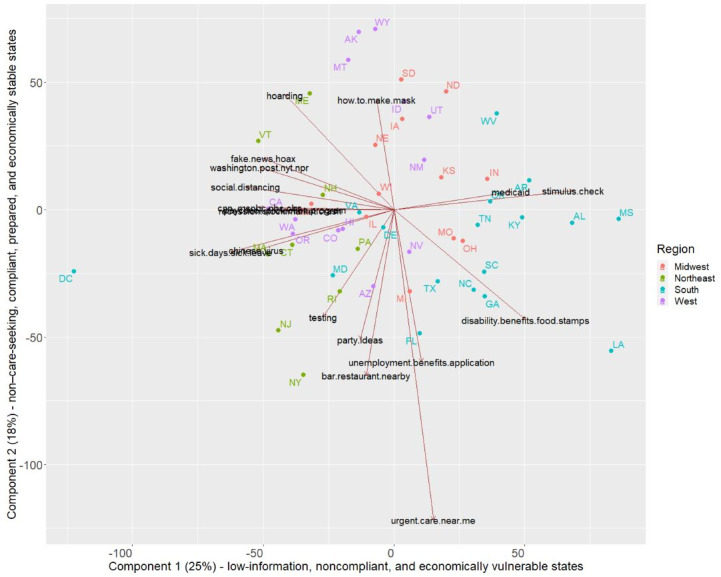
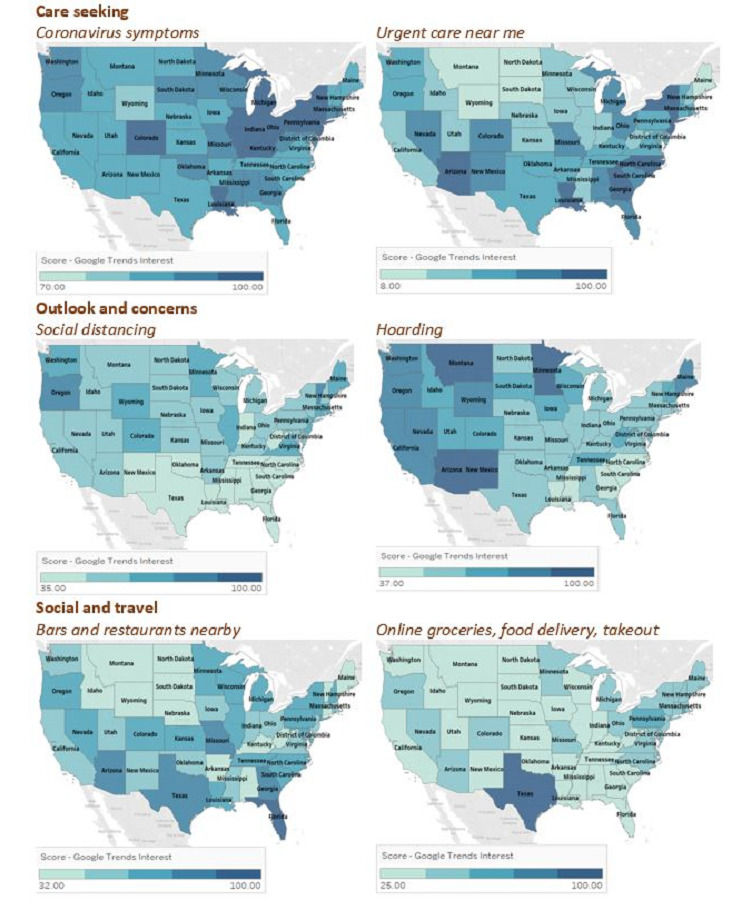
We analyzed searches on 38 terms related to COVID-19, falling into six themes: social and travel; care seeking; government programs; health programs; news and influence; and outlook and concerns. We generated data sets at the national level (covering January 1, 2016, to April 15, 2020) and state level (covering January 1 to April 15, 2020). Methods used include trend analysis of US search data; geographic analyses of the differences in search popularity across US states from March 1 to April 15, 2020; and principal component analysis to extract search patterns across states.
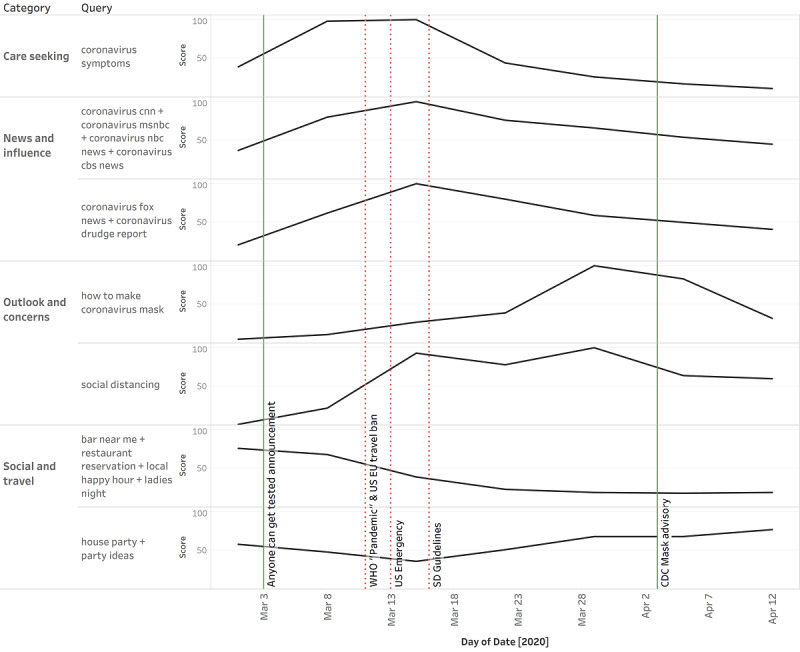
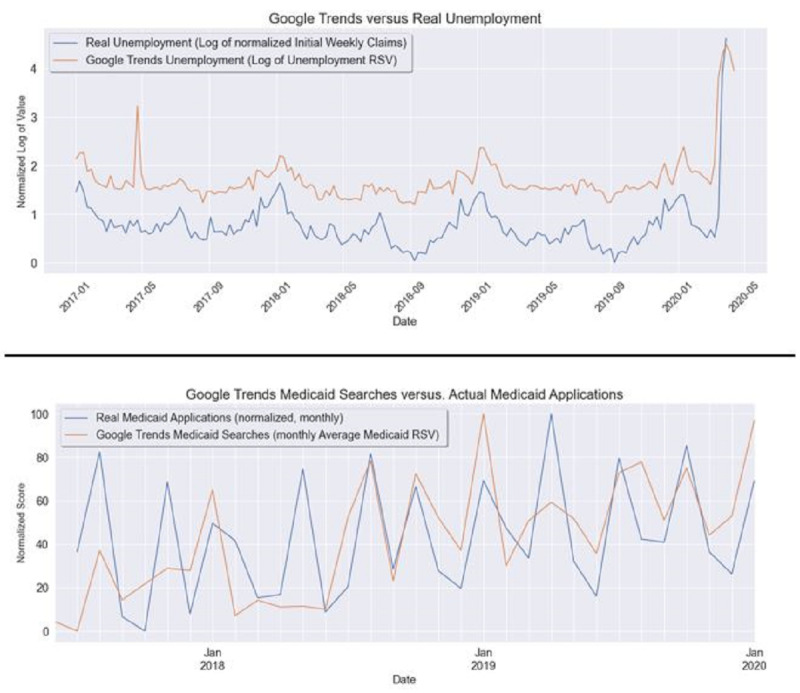
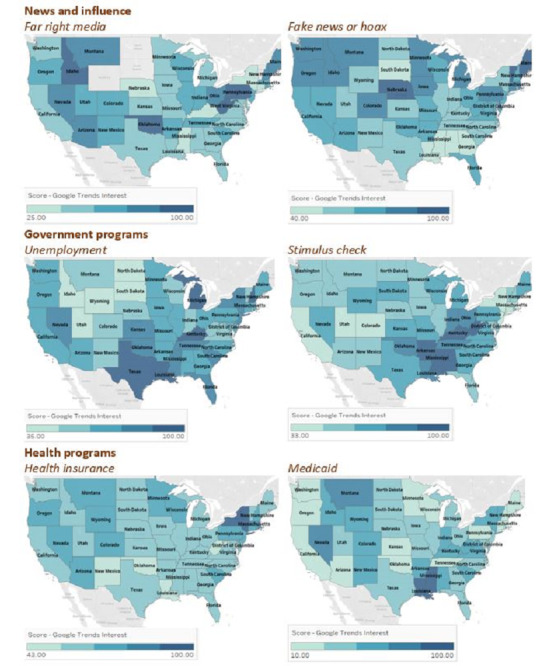
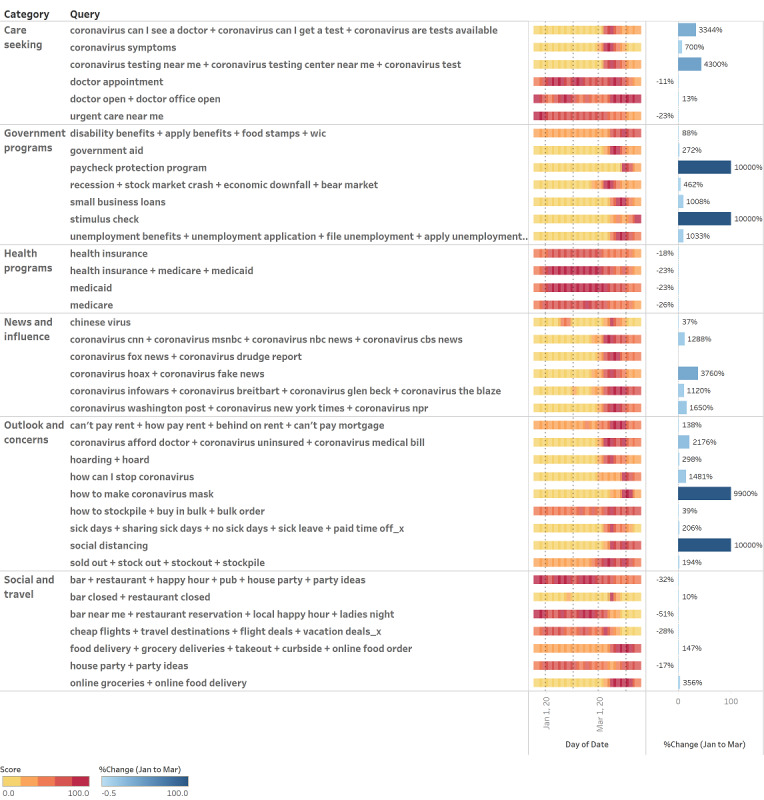
The data showed high demand for information, corresponding with increasing searches for coronavirus linked to news sources regardless of the ideological leaning of the news source. Changes in information seeking often occurred well in advance of action by the federal government. The popularity of searches for unemployment claims predicted the actual spike in weekly claims. The increase in searches for information on COVID-19 care was paralleled by a decrease in searches related to other health behaviors, such as urgent care, doctor's appointments, health insurance, Medicare, and Medicaid. Finally, concerns varied across the country; some search terms were more popular in some regions than in others.
COVID-19 is unlikely to be the last pandemic faced by the United States. Our research holds important lessons for both state and federal governments in a fast-evolving situation that requires a finger on the pulse of public sentiment. We suggest strategic shifts for policy makers to improve the precision and effectiveness of non-pharmaceutical interventions and recommend the development of a real-time dashboard as a decision-making tool.
新冠疫情以前所未有的速度和规模影响着人们的生活,包括他们的饮食和工作方式、所关心的事情、运动量以及收入情况。公共卫生领域的传统调查可能成本高昂且耗时,而且可能很快过时。对大数据集(如电子病历和监测系统)的分析非常复杂。谷歌趋势是一种过去曾用于分析健康行为的替代方法;然而,大多数现有的使用这些数据对新冠疫情的研究只考察单个问题或有限的地理区域。本文探讨谷歌趋势作为一种反映美国人实时想法、需求和计划的代理指标。
我们旨在利用谷歌趋势来洞察新冠疫情等大流行期间信息寻求模式的重要变化,并找出潜在指标。我们提出了四个问题:(1)信息寻求如何随时间变化?(2)不同地区和州之间的信息寻求有何差异?(3)各州在信息寻求方面是否有独特的模式?(4)搜索数据与现实生活事件是否相关或是否先于现实生活事件?
我们分析了与新冠疫情相关的38个术语的搜索情况,这些术语分为六个主题:社交与出行;寻求医疗;政府项目;健康项目;新闻与影响;前景与担忧。我们生成了国家层面(涵盖2016年1月1日至2020年4月15日)和州层面(涵盖2020年1月1日至4月15日)的数据集。使用的方法包括对美国搜索数据的趋势分析;对2020年3月1日至4月15日美国各州搜索热度差异的地理分析;以及用于提取各州搜索模式的主成分分析。
数据显示对信息的需求很高,这与无论新闻来源的意识形态倾向如何,与新闻来源相关的冠状病毒搜索量增加相对应。信息寻求的变化往往在联邦政府采取行动之前就已经发生。失业申请搜索量的增加预示着每周申请量的实际激增。与新冠疫情医疗信息搜索量的增加同时出现的是,与其他健康行为相关的搜索量减少,如紧急护理、预约医生、医疗保险、联邦医疗保险和医疗补助。最后,各地的担忧各不相同;一些搜索词在某些地区比在其他地区更受欢迎。
新冠疫情不太可能是美国面临的最后一次大流行。在快速演变的形势下,我们的研究为州和联邦政府提供了重要经验教训,这种形势需要密切关注公众情绪。我们建议政策制定者进行战略转变,以提高非药物干预措施的精准度和有效性,并建议开发一个实时仪表盘作为决策工具。