van der Graaf Peter, Cheetham Mandy, Redgate Sam, Humble Clare, Adamson Ashley
Department of Applied Health Professionals, School of Health and Life Sciences, Teesside University, Middlesbrough, UK.
Department of Nursing, Midwifery and Health, Faculty of Health and Life Sciences, Northumbria University, Newcastle upon Tyne, UK.
Health Res Policy Syst. 2021 Jan 29;19(1):12. doi: 10.1186/s12961-021-00677-2.
Co-production of research evidence is valued by local government to improve effective decision-making about public services in times of austerity. However, underlying structural issues of power (so-called 'dark shadows of co-production') challenge this ambition with limited evidence on how to embed research use sustainably. In this paper we reflect on mechanisms for increasing co-production in local government.
This paper presents findings from a Health Foundation funded research project that explored how a culture of evidence use to improve population health could be embedded in UK local government. Five linked work packages were undertaken using mixed methods. In this paper, we report the views of UK local authority staff who participated in four workshops (n = 54), informed by a rapid literature review and an online scoping survey.
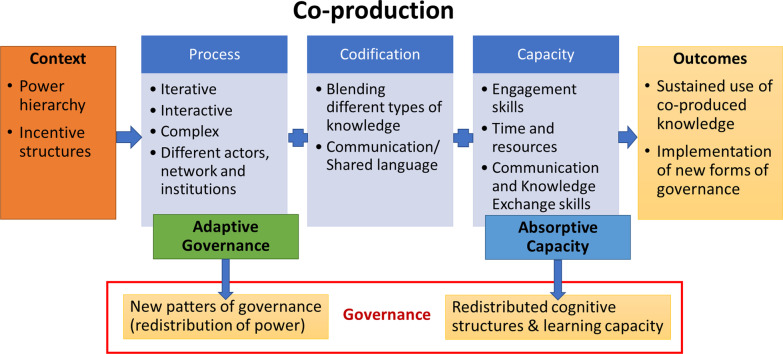
We identified five themes that facilitate public health evidence use in local government: (1) new governance arrangements to integrate national and local policies, (2) codifying research evidence through local system-wide approaches and (3) ongoing evaluation of programmes, and (4) overcoming political and cultural barriers by increasing absorptive capacity of Local Authorities to embed co-produced knowledge in their cognitive structures. This requires adaptive governance through relationship building between academic researchers and Local Authority staff and shared understanding of fragmented local policy making, which are supported by (5) collective spaces for reflection within local government.
Creating collective spaces for reflection in between government departments allows for iterative, interactive processes of co-production with external partners that support emergence of new governance structures to socially action the co-produced knowledge in context and build capacity for sustained evidence use.
在财政紧缩时期,地方政府重视研究证据的共同生产,以改善关于公共服务的有效决策。然而,潜在的权力结构问题(所谓的“共同生产的黑暗阴影”)对这一目标构成挑战,且关于如何可持续地嵌入研究应用的证据有限。在本文中,我们思考了在地方政府中增加共同生产的机制。
本文介绍了一项由健康基金会资助的研究项目的结果,该项目探讨了如何在英国地方政府中嵌入一种利用证据改善人群健康的文化。采用混合方法开展了五个相互关联的工作包。在本文中,我们报告了参与四个研讨会的英国地方当局工作人员的观点(n = 54),这些观点以快速文献综述和在线范围界定调查为依据。
我们确定了五个有助于地方政府利用公共卫生证据的主题:(1)整合国家和地方政策的新治理安排;(2)通过地方全系统方法编纂研究证据;(3)对项目进行持续评估;(4)通过提高地方当局的吸收能力,将共同生产的知识嵌入其认知结构,以克服政治和文化障碍。这需要通过学术研究人员与地方当局工作人员之间建立关系以及对分散的地方政策制定形成共同理解来进行适应性治理,而这得到了(5)地方政府内部反思的集体空间的支持。
在政府部门之间创建反思的集体空间,允许与外部伙伴进行迭代、互动的共同生产过程,这有助于形成新的治理结构,以便在实际环境中对共同生产的知识采取社会行动,并建立持续利用证据的能力。