Liao Sida, Meng Haoye, Li Junkang, Zhao Jun, Xu Yichi, Wang Aiyuan, Xu Wenjing, Peng Jiang, Lu Shibi
Institute of Orthopedics/ Beijing Key Laboratory of Regenerative Medicine in Orthopedics/ Key Laboratory of Musculoskeletal Trauma & War Injuries PLA, Chinese PLA General Hospital, Beijing, 100853, China.
J Orthop Translat. 2021 Jan 13;27:101-109. doi: 10.1016/j.jot.2020.10.005. eCollection 2021 Mar.
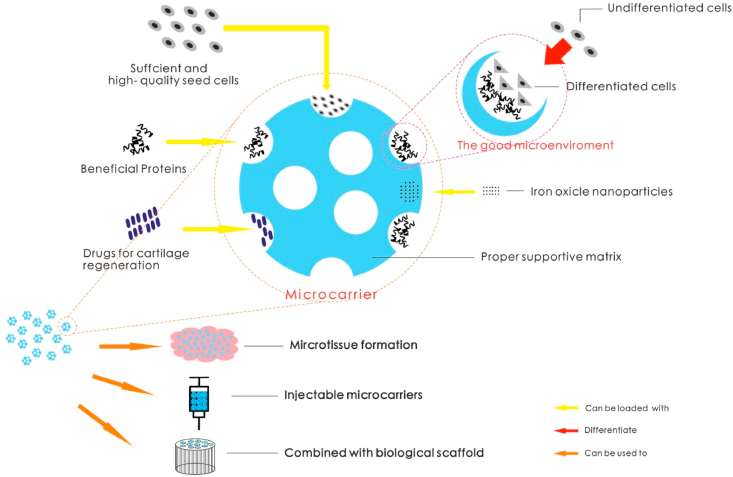
Articular cartilage regeneration is one of the challenges faced by orthopedic surgeons. Microcarrier applications have made great advances in cartilage tissue engineering in recent years and enable cost-effective cell expansion, thus providing permissive microenvironments for cells. In addition, microcarriers can be loaded with proteins, factors, and drugs for cartilage regeneration. Some microcarriers also have the advantages of injectability and targeted delivery. The application of microcarriers with these characteristics can overcome the limitations of traditional methods and provide additional advantages. In terms of the transformation potential, microcarriers have not only many advantages, such as providing sufficient and beneficial cells, factors, drugs, and microenvironments for cartilage regeneration, but also many application characteristics; for example, they can be injected to reduce invasiveness, transplanted after microtissue formation to increase efficiency, or combined with other stents to improve mechanical properties. Therefore, this technology has enormous potential for clinical transformation. In this review, we focus on recent advances in microcarriers for cartilage regeneration. We compare the characteristics of microcarriers with other methods for repairing cartilage defects, provide an overview of the advantages of microcarriers, discuss the potential of microcarrier systems, and present an outlook for future development.
We reviewed the advantages and recent advances of microcarriers for cartilage regeneration. This review could give many scholars a better understanding of microcarriers, which can provide doctors with potential methods for treating patients with cartilage injure.
关节软骨再生是骨科医生面临的挑战之一。近年来,微载体在软骨组织工程领域取得了巨大进展,能够实现经济高效的细胞扩增,从而为细胞提供适宜的微环境。此外,微载体可负载蛋白质、因子和药物用于软骨再生。一些微载体还具有可注射性和靶向递送的优势。具有这些特性的微载体的应用能够克服传统方法的局限性并带来额外优势。就转化潜力而言,微载体不仅具有诸多优势,比如为软骨再生提供充足且有益的细胞、因子、药物和微环境,还具备许多应用特性;例如,它们可通过注射以降低侵入性,在微组织形成后进行移植以提高效率,或者与其他支架结合以改善力学性能。因此,这项技术具有巨大的临床转化潜力。在本综述中,我们聚焦于用于软骨再生的微载体的最新进展。我们将微载体的特性与修复软骨缺损的其他方法进行比较,概述微载体的优势,讨论微载体系统的潜力,并对未来发展进行展望。
我们综述了用于软骨再生的微载体的优势和最新进展。这篇综述能够让众多学者更好地了解微载体,可为医生治疗软骨损伤患者提供潜在方法。