Bastiancich Chiara, Da Silva Anabela, Estève Marie-Anne
Aix-Marseille Univ, CNRS, INP, Inst Neurophysiopathol, Marseille, France.
Aix Marseille Univ, CNRS, Centrale Marseille, Institut Fresnel, Marseille, France.
Front Oncol. 2021 Jan 15;10:610356. doi: 10.3389/fonc.2020.610356. eCollection 2020.
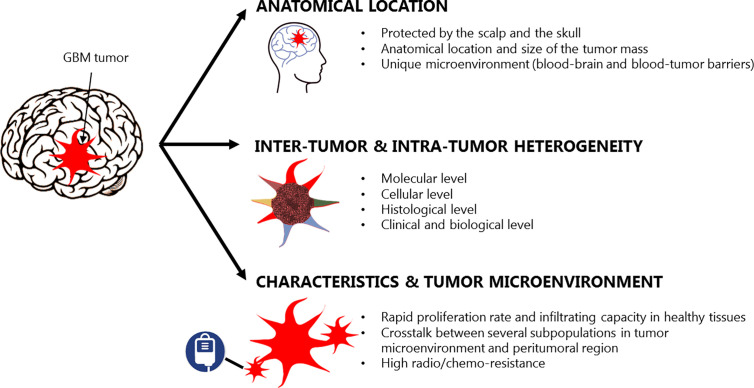
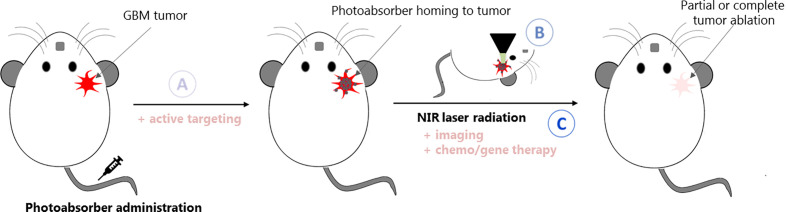
Glioblastoma (GBM) is a very aggressive primary malignant brain tumor and finding effective therapies is a pharmaceutical challenge and an unmet medical need. Photothermal therapy may be a promising strategy for the treatment of GBM, as it allows the destruction of the tumor using heat as a non-chemical treatment for disease bypassing the GBM heterogeneity limitations, conventional drug resistance mechanisms and side effects on peripheral healthy tissues. However, its development is hampered by the distinctive features of this tumor. Photoabsorbing agents such as nanoparticles need to reach the tumor site at therapeutic concentrations, crossing the blood-brain barrier upon systemic administration. Subsequently, a near infrared light irradiating the head must cross multiple barriers to reach the tumor site without causing any local damage. Its power intensity needs to be within the safety limit and its penetration depth should be sufficient to induce deep and localized hyperthermia and achieve tumor destruction. To properly monitor the therapy, imaging techniques that can accurately measure the increase in temperature within the brain must be used. In this review, we report and discuss recent advances in nanoparticle-mediated plasmonic photothermal therapy for GBM treatment and discuss the preclinical challenges commonly faced by researchers to develop and test such systems.
胶质母细胞瘤(GBM)是一种极具侵袭性的原发性恶性脑肿瘤,寻找有效的治疗方法是一项药学挑战,也是尚未满足的医疗需求。光热疗法可能是治疗GBM的一种有前景的策略,因为它可以利用热作为一种非化学的疾病治疗手段来破坏肿瘤,绕过GBM异质性限制、传统耐药机制以及对周围健康组织的副作用。然而,这种肿瘤的独特特征阻碍了其发展。诸如纳米颗粒之类的光吸收剂需要以治疗浓度到达肿瘤部位,在全身给药后穿过血脑屏障。随后,照射头部的近红外光必须穿过多个屏障才能到达肿瘤部位而不造成任何局部损伤。其功率强度需要在安全限度内,并且其穿透深度应足以诱导深部和局部热疗并实现肿瘤破坏。为了正确监测治疗效果,必须使用能够准确测量脑内温度升高的成像技术。在本综述中,我们报告并讨论了纳米颗粒介导的等离子体光热疗法在GBM治疗方面的最新进展,并讨论了研究人员在开发和测试此类系统时通常面临的临床前挑战。