Hauber Brett, Mange Brennan, Zhou Mo, Chaudhuri Shomesh, Benz Heather L, Caldwell Brittany, Ruiz John P, Saha Anindita, Ho Martin, Christopher Stephanie, Bardot Dawn, Sheehan Margaret, Donnelly Anne, McLaughlin Lauren, Gwinn Katrina, Lo Andrew, Sheldon Murray
RTI Health Solutions, Research Triangle Park, North Carolina.
FDA Center for Devices and Radiological Health, Silver Spring, Maryland.
MDM Policy Pract. 2021 Jan 18;6(1):2381468320978407. doi: 10.1177/2381468320978407. eCollection 2021 Jan-Jun.
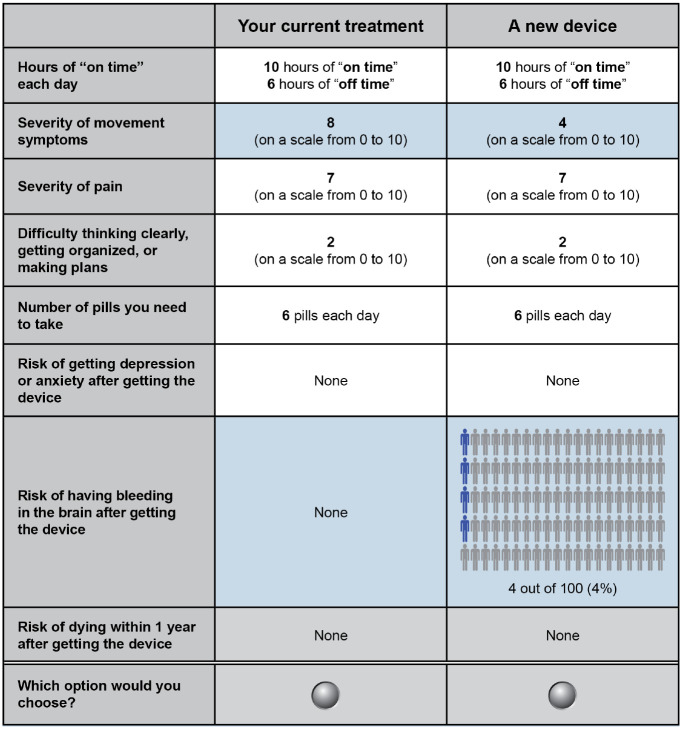
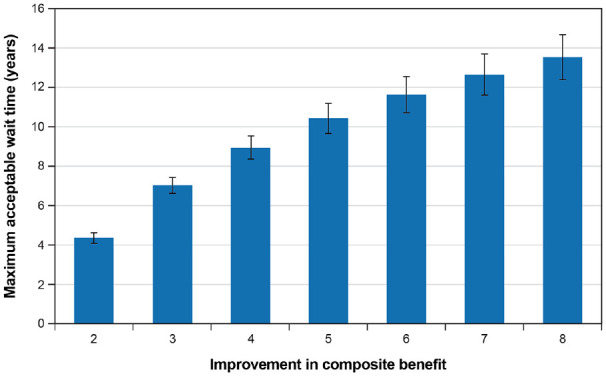
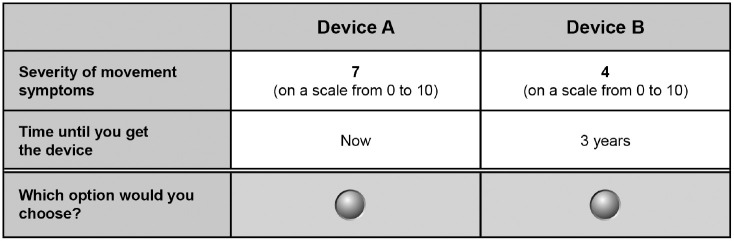
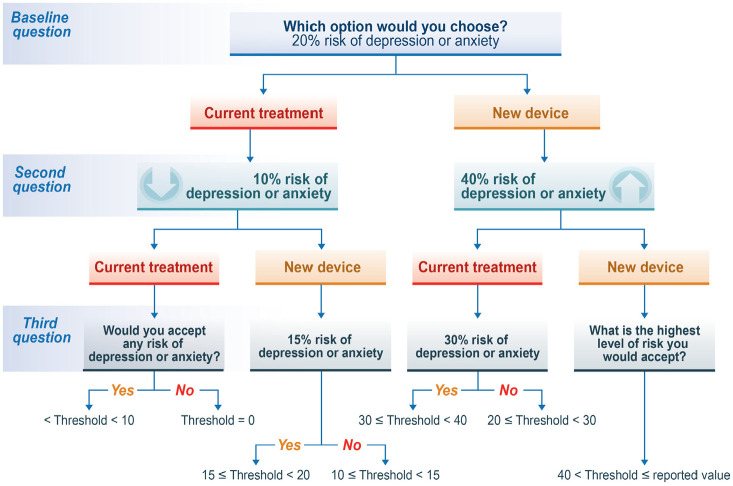
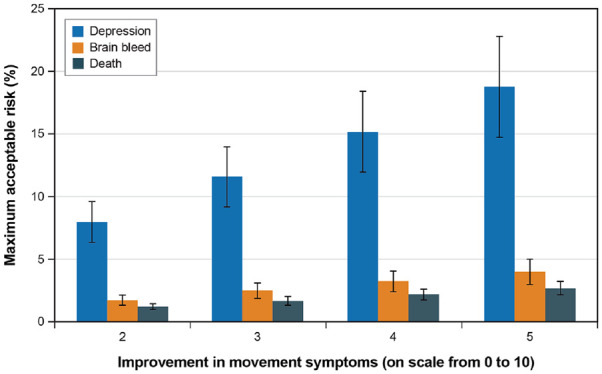
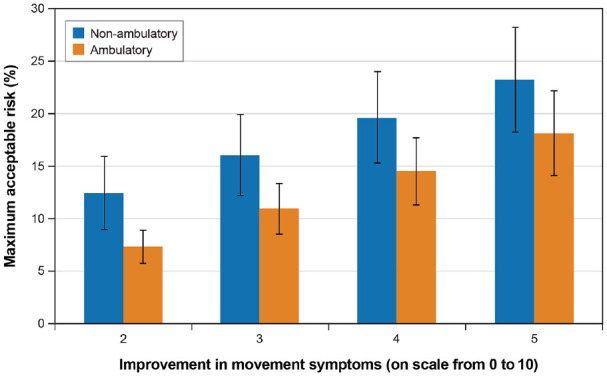
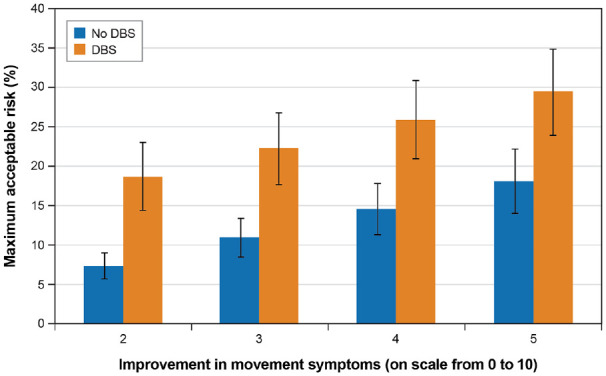
Parkinson's disease (PD) is neurodegenerative, causing motor, cognitive, psychological, somatic, and autonomic symptoms. Understanding PD patients' preferences for novel neurostimulation devices may help ensure that devices are delivered in a timely manner with the appropriate level of evidence. Our objective was to elicit preferences and willingness-to-wait for novel neurostimulation devices among PD patients to inform a model of optimal trial design. We developed and administered a survey to PD patients to quantify the maximum levels of risks that patients would accept to achieve potential benefits of a neurostimulation device. Threshold technique was used to quantify patients' risk thresholds for new or worsening depression or anxiety, brain bleed, or death in exchange for improvements in "on-time," motor symptoms, pain, cognition, and pill burden. The survey elicited patients' willingness to wait to receive treatment benefit. Patients were recruited through Fox Insight, an online PD observational study. A total of 2740 patients were included and a majority were White (94.6%) and had a 4-year college degree (69.8%). Risk thresholds increased as benefits increased. Threshold for depression or anxiety was substantially higher than threshold for brain bleed or death. Patient age, ambulation, and prior neurostimulation experience influenced risk tolerance. Patients were willing to wait an average of 4 to 13 years for devices that provide different levels of benefit. PD patients are willing to accept substantial risks to improve symptoms. Preferences are heterogeneous and depend on treatment benefit and patient characteristics. The results of this study may be useful in informing review of device applications and other regulatory decisions and will be input into a model of optimal trial design for neurostimulation devices.
帕金森病(PD)是一种神经退行性疾病,会引发运动、认知、心理、躯体和自主神经症状。了解帕金森病患者对新型神经刺激设备的偏好,可能有助于确保这些设备能及时交付,并具备适当的证据水平。我们的目标是了解帕金森病患者对新型神经刺激设备的偏好和等待意愿,以为最佳试验设计模型提供信息。我们开发并向帕金森病患者发放了一份调查问卷,以量化患者为实现神经刺激设备的潜在益处而愿意接受的最大风险水平。采用阈值技术来量化患者在新出现或加重的抑郁或焦虑、脑出血或死亡方面的风险阈值,以换取在“按时”、运动症状、疼痛、认知和药物负担方面的改善。该调查问卷还了解了患者等待接受治疗益处的意愿。患者通过在线帕金森病观察性研究“福克斯洞察”招募。总共纳入了2740名患者,其中大多数为白人(94.6%),拥有四年制大学学位(69.8%)。风险阈值随着益处的增加而升高。抑郁或焦虑的阈值远高于脑出血或死亡的阈值。患者年龄、行走能力和既往神经刺激经验会影响风险承受能力。对于能提供不同程度益处的设备,患者平均愿意等待4至13年。帕金森病患者愿意接受重大风险以改善症状。偏好存在异质性,且取决于治疗益处和患者特征。本研究结果可能有助于为设备应用审查及其他监管决策提供信息,并将输入到神经刺激设备的最佳试验设计模型中。