Department of Chemical Engineering, Faculty of Industrial Technology and Systems Engineering, Institut Teknologi Sepuluh Nopember, Surabaya 60111, Indonesia.
Department of Chemical Engineering, Widya Mandala Catholic University Surabaya, Kalijudan 37, Surabaya 60114, Indonesia.
Molecules. 2021 Jan 28;26(3):676. doi: 10.3390/molecules26030676.
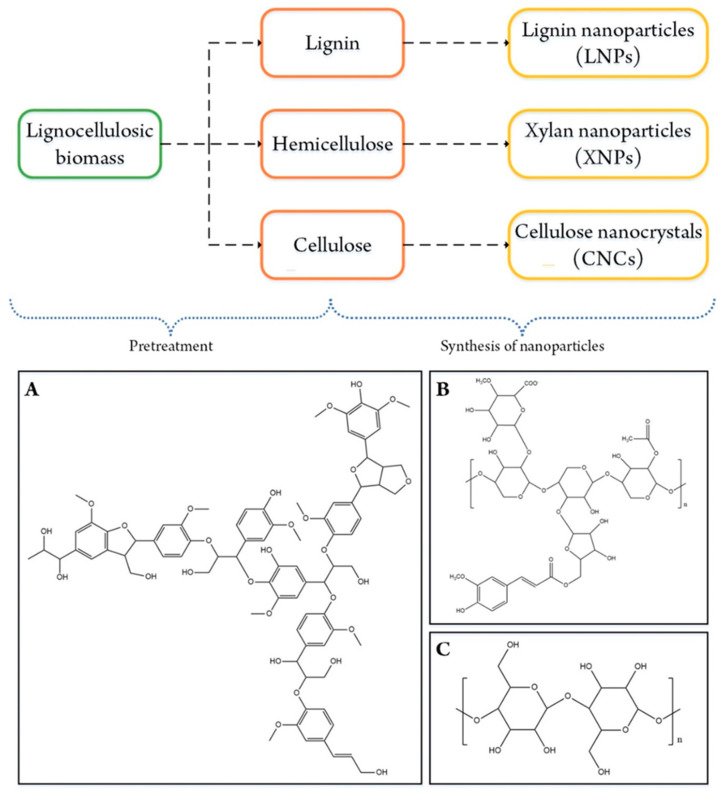
Due to their biocompatibility, biodegradability, and non-toxicity, lignocellulosic-derived nanoparticles are very potential materials for drug carriers in drug delivery applications. There are three main lignocellulosic-derived nanoparticles discussed in this review. First, lignin nanoparticles (LNPs) are an amphiphilic nanoparticle which has versatile interactions toward hydrophilic or hydrophobic drugs. The synthesis methods of LNPs play an important role in this amphiphilic characteristic. Second, xylan nanoparticles (XNPs) are a hemicellulose-derived nanoparticle, where additional pretreatment is needed to obtain a high purity xylan before the synthesis of XNPs. This process is quite long and challenging, but XNPs have a lot of potential as a drug carrier due to their stronger interactions with various drugs. Third, cellulose nanocrystals (CNCs) are a widely exploited nanoparticle, especially in drug delivery applications. CNCs have low cytotoxicity, therefore they are suitable for use as a drug carrier. The research possibilities for these three nanoparticles are still wide and there is potential in drug delivery applications, especially for enhancing their characteristics with further surface modifications adjusted to the drugs.
由于其生物相容性、生物可降解性和低毒性,木质纤维素衍生纳米颗粒是药物传递应用中药物载体的很有前途的材料。在这篇综述中讨论了三种主要的木质纤维素衍生纳米颗粒。首先,木质素纳米颗粒(LNPs)是一种两亲性纳米颗粒,对亲水性或疏水性药物具有多种相互作用。LNPs 的合成方法对这种两亲特性起着重要作用。其次,木聚糖纳米颗粒(XNPs)是一种半纤维素衍生的纳米颗粒,在合成 XNPs 之前需要额外的预处理来获得高纯度的木聚糖。这个过程相当漫长和具有挑战性,但由于 XNPs 与各种药物具有更强的相互作用,因此作为药物载体具有很大的潜力。第三,纤维素纳米晶体(CNCs)是一种广泛开发的纳米颗粒,特别是在药物传递应用中。CNCs 的细胞毒性低,因此适合用作药物载体。这三种纳米颗粒的研究可能性仍然很大,在药物传递应用中具有潜力,特别是通过进一步的表面修饰来增强其特性,以适应药物。