Brain Institute, Federal University of Rio Grande do Norte, Av. Sen. Salgado Filho, 3000 - Lagoa Nova, Natal, RN, 59078 970, Brazil.
BMC Psychol. 2021 Feb 1;9(1):21. doi: 10.1186/s40359-021-00520-x.
Psychological distress in University settings has grown and became a public health concern. In this context, contemplative practices such as mindfulness have been proposed as a strategy to help students on stress management.
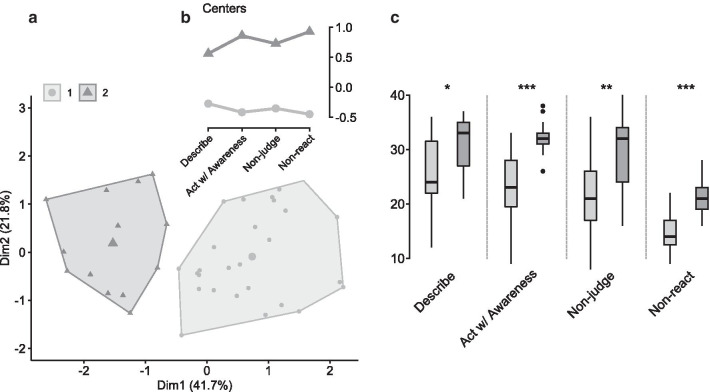
Forty university students (20 female), aged between 18 to 30 years (mean = 24.15; SD = 3.56), with no previous experience with meditation or yoga were recruited at the Federal University of Rio Grande do Norte and randomized to a mindfulness training (MT) or active control (AC) groups. We analyzed measures of anxiety, affect, stress, as well as state and trait mindfulness in order to evaluate the effects of trait mindfulness and a brief mindfulness intervention in forty healthy young students. Participants were classified as Low (n = 27, females = 13) or High (n = 13, females = 7) Trait Mindfulness by k-means clustering and compared between them using Wilcoxon sum rank test. Furthermore, the sample was randomly allocated to an AC (n = 20, females = 10) or a MT (n = 20, females = 10) group, and mixed analysis of variance was performed to analyze the effect of interventions. The mechanisms and role of trait mindfulness in the intervention was assessed by a moderated mediation analysis.
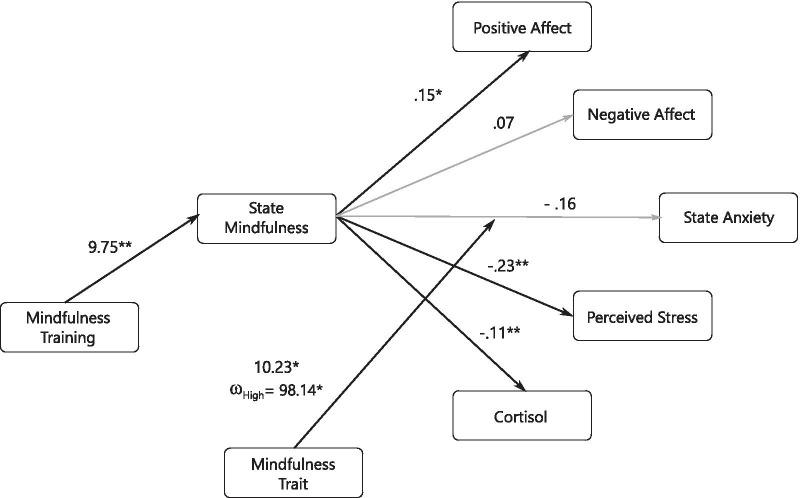
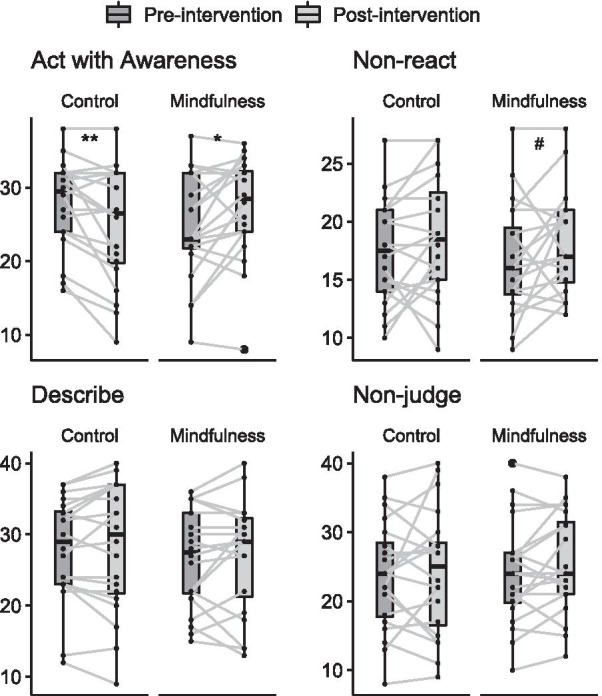
We found that High Trait individuals have lower anxiety trait, anxiety state and perceived stress levels. Only the MT group reduced their anxiety state and perceived stress after the intervention and increased their state mindfulness. Both groups reduced negative affect and cortisol, and no change was found in positive affect. Moderated mediation analysis showed that the training-induced change in state mindfulness mediated the increase in positive affect and the decrease in perceived stress and cortisol, regardless of trait mindfulness. For anxiety state the decrease only occurred in individuals with High Trait Mindfulness.
Together, these results suggest that higher trait mindfulness is associated with low levels of psychological distress and that a brief mindfulness-based intervention seems to be useful to reduce distress measures in university students.
ReBEC, U1111-1194-8661. Registered 28 March 2017-Retrospectively registered, http://www.ensaiosclinicos.gov.br/rg/RBR-7b8yh8.
大学环境中心理困扰日益加剧,已成为公共卫生关注的焦点。在这种情况下,冥想等沉思练习被提议作为帮助学生应对压力管理的一种策略。
我们招募了 40 名年龄在 18 至 30 岁之间(平均 24.15 岁;标准差 3.56)、没有冥想或瑜伽经验的大学生(20 名女性),并将他们随机分配到正念训练(MT)或主动对照(AC)组。我们分析了焦虑、情感、压力以及状态和特质正念的测量结果,以评估特质正念和简短正念干预对 40 名健康年轻学生的影响。参与者通过 k 均值聚类分为低(n=27,女性=13)或高(n=13,女性=7)特质正念组,并通过 Wilcoxon 总和秩检验进行比较。此外,样本被随机分配到 AC(n=20,女性=10)或 MT(n=20,女性=10)组,进行混合方差分析以分析干预的效果。通过调节中介分析评估特质正念在干预中的机制和作用。
我们发现,高特质个体的焦虑特质、焦虑状态和感知压力水平较低。只有 MT 组在干预后降低了焦虑状态和感知压力,并增加了状态正念。两组均降低了负性情绪和皮质醇,正性情绪没有变化。调节中介分析表明,状态正念的训练诱导变化介导了正性情绪的增加和感知压力和皮质醇的降低,而与特质正念无关。对于焦虑状态,只有高特质正念个体的焦虑状态降低。
综上所述,这些结果表明,较高的特质正念与较低的心理困扰水平相关,而简短的基于正念的干预似乎对降低大学生的困扰测量指标有用。
ReBEC,U1111-1194-8661。于 2017 年 3 月 28 日注册-回顾性注册,http://www.ensaiosclinicos.gov.br/rg/RBR-7b8yh8。