University Medical Center Utrecht, Netherlands.
Leiden University, Netherlands.
Neurorehabil Neural Repair. 2021 Mar;35(3):267-279. doi: 10.1177/1545968321989331. Epub 2021 Feb 3.
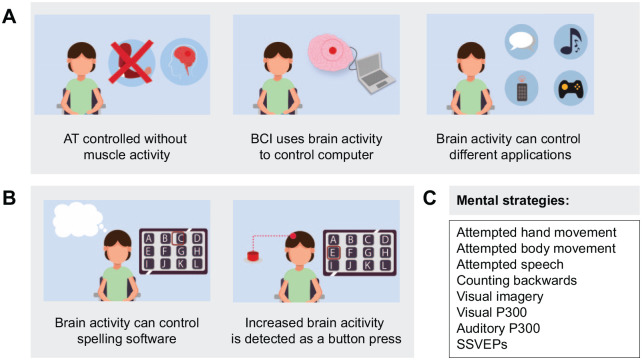
Brain-computer interfaces (BCIs) have been proposed as an assistive technology (AT) allowing people with locked-in syndrome (LIS) to use neural signals to communicate. To design a communication BCI (cBCI) that is fully accepted by the users, their opinion should be taken into consideration during the research and development process.
We assessed the preferences of prospective cBCI users regarding (1) the applications they would like to control with a cBCI, (2) the mental strategies they would prefer to use to control the cBCI, and (3) when during their clinical trajectory they would like to be informed about AT and cBCIs. Furthermore, we investigated if individuals diagnosed with progressive and sudden onset (SO) disorders differ in their opinion.
We interviewed 28 Dutch individuals with LIS during a 3-hour home visit using multiple-choice, ranking, and open questions. During the interview, participants were informed about BCIs and the possible mental strategies.
Participants rated (in)direct forms of communication, computer use, and environmental control as the most desired cBCI applications. In addition, active cBCI control strategies were preferred over reactive strategies. Furthermore, individuals with progressive and SO disorders preferred to be informed about AT and cBCIs at the moment they would need it.
We show that individuals diagnosed with progressive and SO disorders preferred, in general, the same applications, mental strategies, and time of information. By collecting the opinion of a large sample of individuals with LIS, this study provides valuable information to stakeholders in cBCI and other AT development.
脑机接口(BCIs)被提议作为一种辅助技术(AT),使闭锁综合征(LIS)患者能够使用神经信号进行交流。为了设计一个完全被用户接受的交流脑机接口(cBCI),在研究和开发过程中应该考虑到他们的意见。
我们评估了潜在的 cBCI 用户对以下方面的偏好:(1)他们希望使用 cBCI 控制的应用程序,(2)他们希望用于控制 cBCI 的心理策略,以及(3)他们希望在临床轨迹的哪个阶段获得关于 AT 和 cBCI 的信息。此外,我们还研究了患有进行性和突然发作(SO)疾病的个体在意见上是否存在差异。
我们使用多项选择、排序和开放式问题,在 3 小时的家庭访问中对 28 名荷兰 LIS 患者进行了访谈。在访谈过程中,参与者了解了 BCI 和可能的心理策略。
参与者对(非)直接形式的交流、计算机使用和环境控制的评分最高,认为这些是最希望的 cBCI 应用。此外,他们更喜欢主动的 cBCI 控制策略,而不是被动的策略。此外,患有进行性和 SO 疾病的个体希望在需要时获得关于 AT 和 cBCI 的信息。
我们表明,患有进行性和 SO 疾病的个体通常更喜欢相同的应用程序、心理策略和信息时间。通过收集大量 LIS 患者的意见,本研究为 cBCI 和其他 AT 开发的利益相关者提供了有价值的信息。