Bedir Deniz, Erhan Süleyman Erim
Erzurum Technical University, Erzurum, Turkey.
College of Physical Education and Sports, Tekirdağ Namık Kemal Üniversitesi, Tekirdağ, Turkey.
Front Psychol. 2021 Jan 22;11:2073. doi: 10.3389/fpsyg.2020.02073. eCollection 2020.
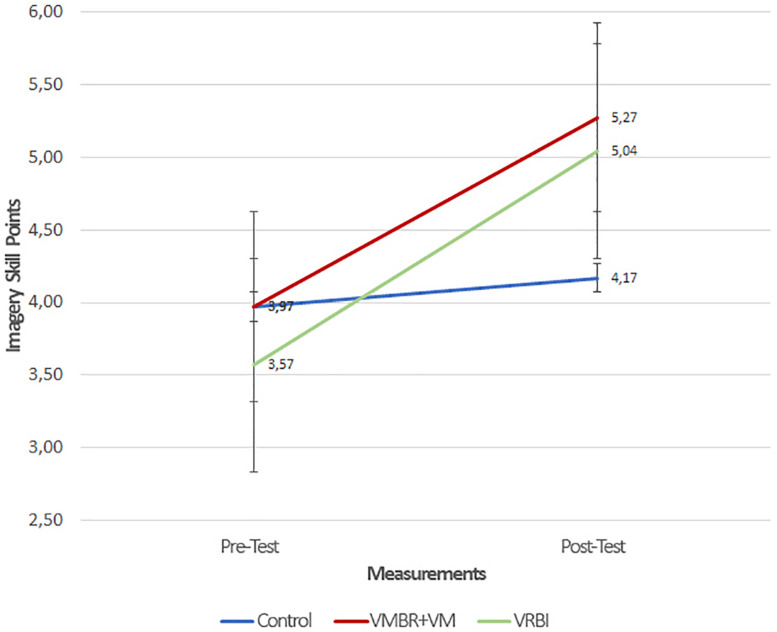
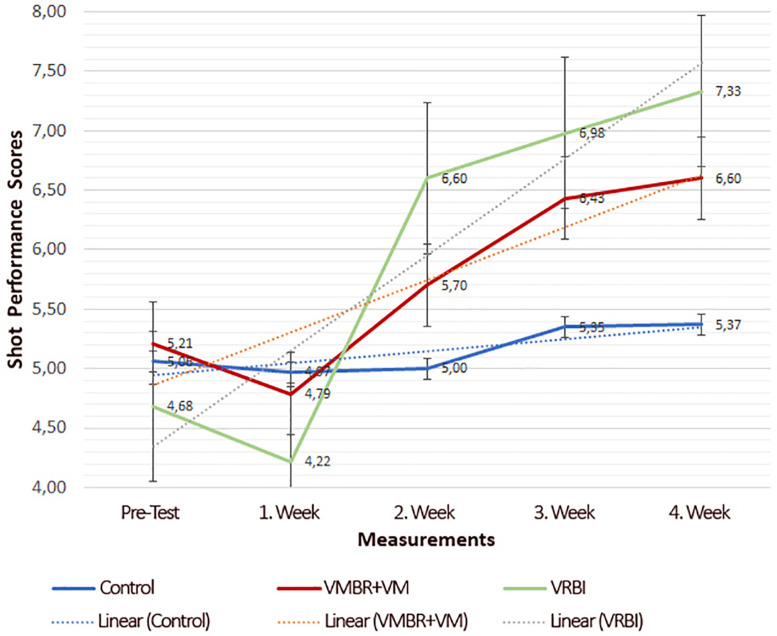
The aim of this study is the examination of the effect of virtual reality based imagery (VRBI) training programs on the shot performance and imagery skills of athletes and, and to conduct a comparison with Visual Motor Behavior Rehearsal and Video Modeling (VMBR + VM). In the research, mixed research method and sequential explanatory design were used. In the quantitative dimension of the study the semi-experimental model was used, and in the qualitative dimension the case study design was adopted. The research participants were selected from athletes who were involved in our target sports: curling ( = 14), bowling ( = 13), and archery ( = 7). All participants were randomly assigned to VMBR + VM ( = 11), VRBI ( = 12), and Control ( = 11) groups through the "Research Randomizer" program. The quantitative data of the study was: the weekly shot performance scores of the athletes and the data obtained from the "Movement Imagery Questionnaire-Revised." The qualitative data was obtained from the data collected from the semi-structured interview guide, which was developed by researchers and field experts. According to the results obtained from the study, there were statistically significant differences between the groups in terms of shot performance and imagery skills. VRBI training athletes showed more improvement in the 4-week period than the athletes in the VMBR + VM group, in terms of both shot performance and imagery skills. In addition, the VRBI group adapted to the imagery training earlier than the VMBR + VM group. As a result, it was seen that they showed faster development in shot performances. From these findings, it can be said that VRBI program is more efficient in terms of shot performance and imagery skills than VMBR + VM, which is the most used imaging training model.
本研究的目的是检验基于虚拟现实的意象(VRBI)训练计划对运动员击球表现和意象技能的影响,并与视觉运动行为演练和视频建模(VMBR + VM)进行比较。在该研究中,采用了混合研究方法和序列解释性设计。在研究的定量维度上使用了半实验模型,在定性维度上采用了案例研究设计。研究参与者从参与我们目标运动项目的运动员中选取:冰壶( = 14人)、保龄球( = 13人)和射箭( = 7人)。所有参与者通过“研究随机化器”程序被随机分配到VMBR + VM组( = 11人)、VRBI组( = 12人)和对照组( = 11人)。该研究的定量数据为:运动员的每周击球表现得分以及从“运动意象问卷修订版”获得的数据。定性数据来自研究人员和领域专家编制的半结构化访谈指南收集的数据。根据研究结果,在击球表现和意象技能方面,各小组之间存在统计学上的显著差异。在4周的时间里,VRBI训练的运动员在击球表现和意象技能方面比VMBR + VM组的运动员有更大的进步。此外,VRBI组比VMBR + VM组更早适应意象训练。结果发现,他们在击球表现上发展得更快。从这些发现可以看出,就击球表现和意象技能而言,VRBI计划比最常用的成像训练模型VMBR + VM更有效。