Stavropoulou Elisavet, Kantartzi Konstantia, Tsigalou Christina, Konstantinidis Theoharis, Romanidou Gioulia, Voidarou Chrysa, Bezirtzoglou Eugenia
Centre Hospitalier Universitaire Vaudois (CHUV), Lausanne, Switzerland.
Department of Infectious Diseases, Central Institute, Valais Hospital, Sion, Switzerland.
Front Med (Lausanne). 2021 Jan 21;7:620102. doi: 10.3389/fmed.2020.620102. eCollection 2020.
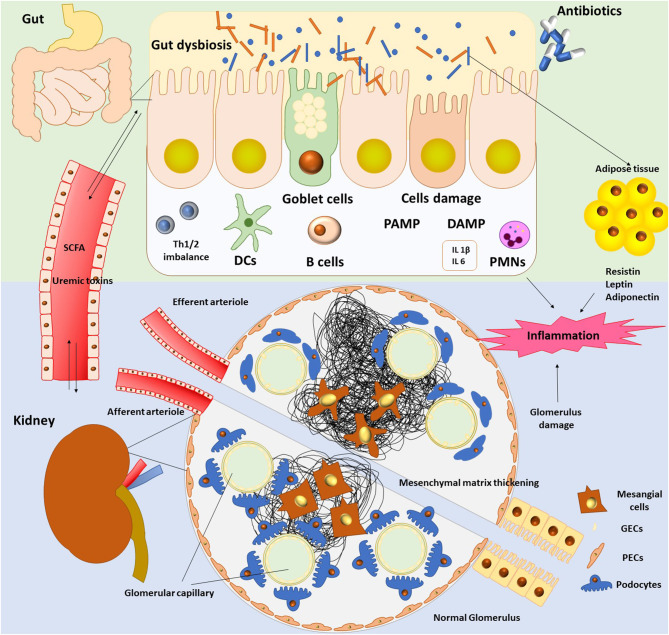
The recent new developments in technology with culture-independent techniques including genome sequencing methodologies shed light on the identification of microbiota bacterial species and their role in health and disease. Microbiome is actually reported as an important predictive tool for evaluating characteristic shifts in case of disease. Our present review states the development of different renal diseases and pathologies linked to the intestinal dysbiosis, which impacts on host homeostasis. The gastrointestinal-kidney dialogue provides intriguing features in the pathogenesis of several renal diseases. Without any doubt, investigation of this interconnection consists one of the most cutting-edge areas of research with potential implications on our health.
包括基因组测序方法在内的非培养技术在技术上的最新进展,为微生物群细菌种类的鉴定及其在健康和疾病中的作用提供了线索。微生物组实际上被报道为评估疾病情况下特征性变化的重要预测工具。我们目前的综述阐述了与肠道生态失调相关的不同肾脏疾病和病理状况的发展,这会影响宿主的内环境稳定。胃肠-肾脏对话在几种肾脏疾病的发病机制中具有有趣的特征。毫无疑问,对这种相互联系的研究是最前沿的研究领域之一,对我们的健康具有潜在影响。