Apte Nachiket, Dherange Parinita, Mustafa Usman, Ya'qoub Lina, Dawson Desiree, Higginbotham Kathleen, Boerma Marjan, Morin Daniel P, Gupta Dipti, McLarty Jerry, Mansour Richard, Dominic Paari
Department of Medicine and Center of Excellence for Cardiovascular Diseases & Sciences, Louisiana State University Health Sciences Center-Shreveport, Shreveport, LA, United States.
Ochsner-LSU Medical Center, Shreveport, LA, United States.
Front Cardiovasc Med. 2021 Jan 22;8:610915. doi: 10.3389/fcvm.2021.610915. eCollection 2021.
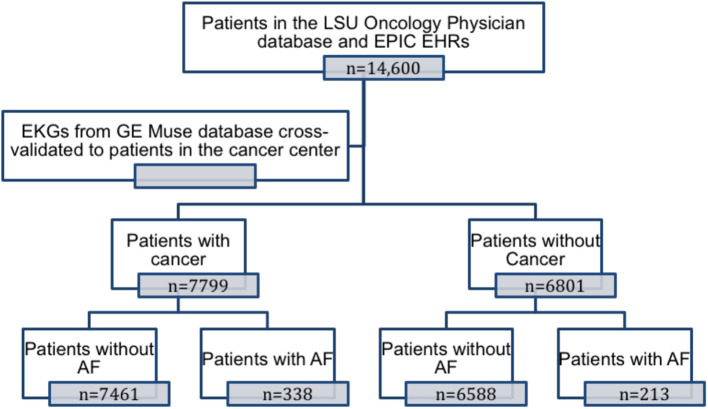
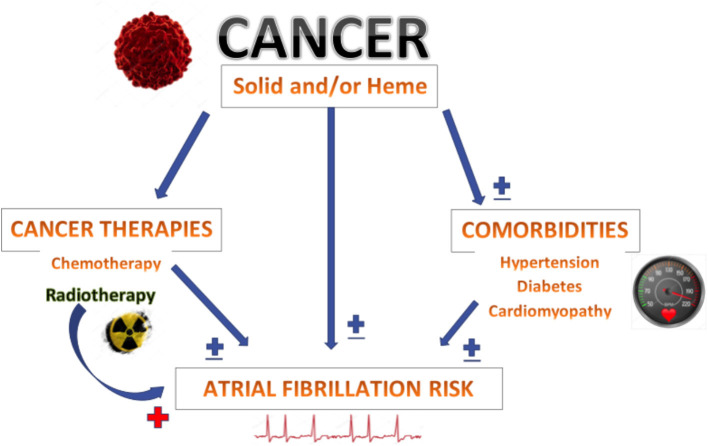
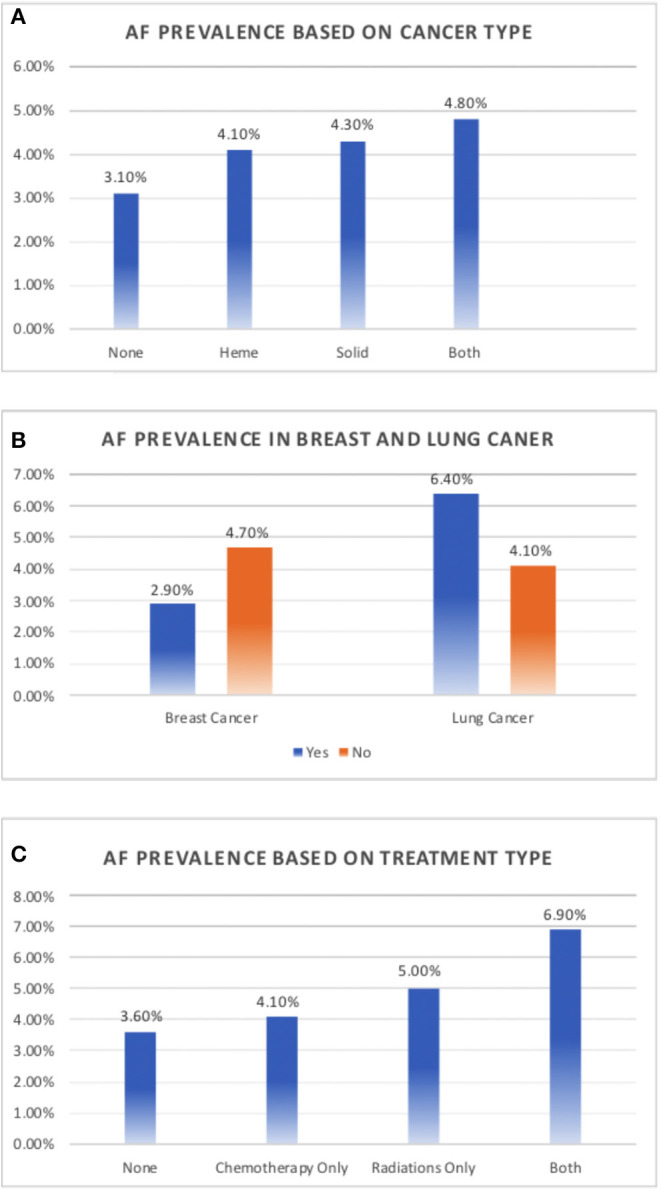
The association of atrial fibrillation (AF) with cancer and cancer types is inconclusive. Similarly, data regarding the association of AF with different cancer therapies are controversial. To study the association of AF with cancer subtypes and cancer therapies. We studied all patients aged 18-89 years who presented to the Feist Weiller Cancer Center, with or without a diagnosis of cancer, between January 2011 and February 2016. Electronic health records were systematically queried for baseline demographics and ICD-9 and ICD-10 codes for specific co-morbidities. Patients with a diagnosis of AF were tabulated based on cross-validation with the ECG database and/or by recorded history. We assessed the prevalence and risk of AF based on cancer diagnosis, specific cancer type, and cancer therapy. A total of 14,600 patients were analyzed. Compared to non-cancer patients ( = 6,801), cancer patients ( = 7,799) had a significantly higher prevalence of AF (4.3 vs. 3.1%; < 0.001). However, following correction for covariates in a multivariable logistic regression model, malignancy was not found to be an independent risk factor for AF ( = 0.32). While patients with solid tumors had a numerically higher prevalence of AF than those with hematological malignancies (4.3 vs. 4.1%), tumor type was not independently associated with AF ( = 0.13). AF prevalence was higher in patients receiving chemotherapy (4.1%), radiation therapy (5.1%), or both (6.9%) when compared to patients not receiving any therapy (3.6%, = 0.01). On multivariable logistic regression, radiation therapy remained an independent risk factor for AF for the entire study population ( = 0.03) as well as for the cancer population ( < 0.01). Radiation therapy for cancer is an independent risk factor for AF. The known association between cancer and AF may be mediated, at least in part, by the effects of radiation therapy.
心房颤动(AF)与癌症及癌症类型之间的关联尚无定论。同样,关于AF与不同癌症治疗方法之间关联的数据也存在争议。为了研究AF与癌症亚型及癌症治疗方法之间的关联,我们对2011年1月至2016年2月期间就诊于费斯特·韦勒癌症中心的所有18 - 89岁患者进行了研究,这些患者无论是否被诊断患有癌症。我们系统查询了电子健康记录中的基线人口统计学数据以及特定合并症的ICD - 9和ICD - 10编码。根据与心电图数据库的交叉验证和/或记录的病史,将诊断为AF的患者制成表格。我们基于癌症诊断、特定癌症类型和癌症治疗方法评估了AF的患病率和风险。总共分析了14,600名患者。与非癌症患者(n = 6,801)相比,癌症患者(n = 7,799)的AF患病率显著更高(4.3%对3.1%;P < 0.001)。然而,在多变量逻辑回归模型中对协变量进行校正后,未发现恶性肿瘤是AF的独立危险因素(P = 0.32)。虽然实体瘤患者的AF患病率在数值上高于血液系统恶性肿瘤患者(4.3%对4.1%),但肿瘤类型与AF并无独立关联(P = 0.13)。与未接受任何治疗的患者(3.6%,P = 0.01)相比,接受化疗(4.1%)、放疗(5.1%)或两者都接受(6.9%)的患者AF患病率更高。在多变量逻辑回归分析中,放疗仍然是整个研究人群(P = 0.03)以及癌症人群(P < 0.01)发生AF的独立危险因素。癌症放疗是AF的独立危险因素。癌症与AF之间已知的关联可能至少部分是由放疗的作用介导的。