Bipolar and Depressive Disorders Unit, Hospital Clinic, University of Barcelona, Institute of Neuroscience, IDIBAPS, CIBERSAM, 170, Villarroel St., 08037, Barcelona, Catalonia, Spain.
Bipolar and Depressive Disorders Unit, Hospital Clinic, University of Barcelona, Institute of Neuroscience, IDIBAPS, CIBERSAM, 170, Villarroel St., 08037, Barcelona, Catalonia, Spain; Barcelona Clinic Schizophrenia Unit, Hospital Clinic of Barcelona, Department of Medicine, Institut de Neurociències, Universitat de Barcelona, IDIBAPS, CIBERSAM, 170, Villarroel St., 08037, Barcelona, Spain.
J Affect Disord. 2021 Mar 15;283:156-164. doi: 10.1016/j.jad.2021.01.055. Epub 2021 Jan 29.
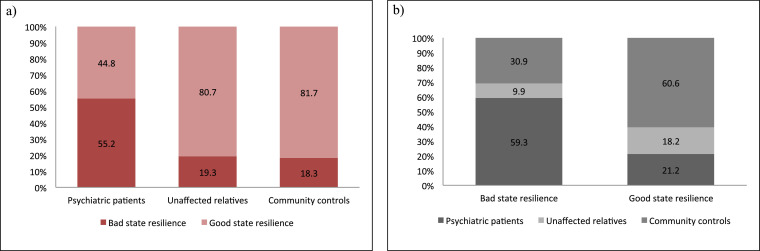
Resilience is a process that allows recovery from or adaptation to adversities. The aim of this study was to evaluate state resilience during the COVID-19 pandemic in psychiatric patients (PP), unaffected relatives (UR) and community controls (CC).
This study is part of the Barcelona ResIlience Survey for Mental Health COVID-19 (BRIS-MHC) project. Logistic regression models were performed to identify mental health outcomes associated with bad state resilience and predictors of good state resilience. The association between state resilience and specific affective temperaments as well as their influence on the association between depressive symptoms and state resilience were verified.
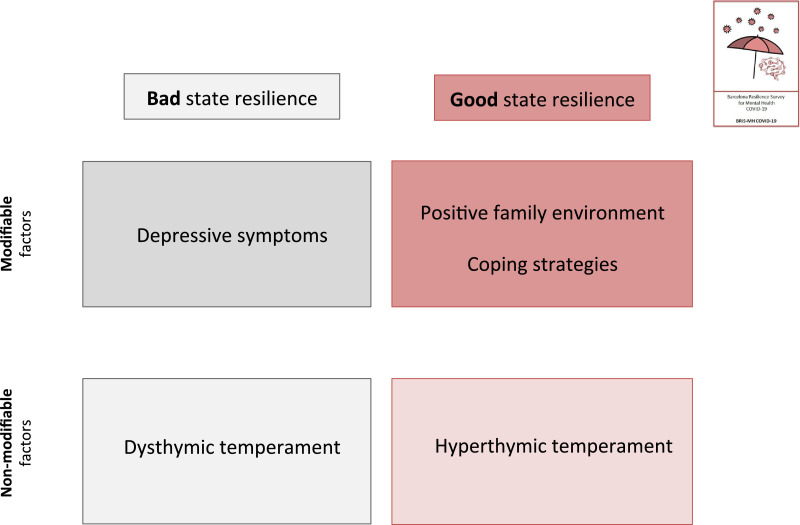
The study recruited 898 participants that took part in the survey. The presence of depressive symptoms was a predictor of bad state resilience in PP (β=0.110, OR=1.117, p=0.028). No specific mental health outcome was associated with bad state resilience in UR and CC. Predictors of good state resilience in PP were having pursued hobbies/conducted home tasks (β=1.261, OR=3.528, p=0.044) and level of organization in the family (β=0.986, OR=2.682, p=0.008). Having a controlling family was inversely associated with good state resilience in CC (β=-1.004, OR=0.367, p=0.012). The association between bad state resilience and depressive symptoms was partially mediated by affective temperaments.
Participants self-reported their psychiatric diagnoses, their relatives' diagnoses or the absence of a psychiatric disorder, as well as their psychiatric symptoms.
Enhancing resilience and coping strategies in the face of the COVID-19 pandemic might have important implications in terms of mental health outcomes.
韧性是一种从逆境中恢复或适应的过程。本研究旨在评估 COVID-19 大流行期间精神科患者(PP)、未受影响的亲属(UR)和社区对照(CC)的状态韧性。
本研究是巴塞罗那 COVID-19 心理健康韧性调查(BRIS-MHC)项目的一部分。采用逻辑回归模型来确定与不良状态韧性相关的心理健康结果以及良好状态韧性的预测因素。验证了状态韧性与特定情感气质之间的关系,以及它们对抑郁症状与状态韧性之间关系的影响。
该研究招募了 898 名参与调查的参与者。抑郁症状的存在是 PP 状态韧性不良的预测因素(β=0.110,OR=1.117,p=0.028)。UR 和 CC 中,没有特定的心理健康结果与不良状态韧性相关。PP 中良好状态韧性的预测因素是从事爱好/进行家庭任务(β=1.261,OR=3.528,p=0.044)和家庭组织水平(β=0.986,OR=2.682,p=0.008)。在 CC 中,具有控制性家庭与良好状态韧性呈负相关(β=-1.004,OR=0.367,p=0.012)。不良状态韧性与抑郁症状之间的关系部分通过情感气质来介导。
参与者自我报告了他们的精神科诊断、他们亲属的诊断或没有精神科疾病,以及他们的精神科症状。
在 COVID-19 大流行期间增强韧性和应对策略可能对心理健康结果具有重要意义。