• 文献检索
  • 文档翻译
  • 深度研究
  • 学术资讯
  • Suppr Zotero 插件Zotero 插件
  • 邀请有礼
  • 套餐&价格
  • 历史记录
应用&插件
Suppr Zotero 插件Zotero 插件浏览器插件Mac 客户端Windows 客户端微信小程序
定价
高级版会员购买积分包购买API积分包
服务
文献检索文档翻译深度研究API 文档MCP 服务
关于我们
关于 Suppr公司介绍联系我们用户协议隐私条款
关注我们

Suppr 超能文献

核心技术专利:CN118964589B侵权必究
粤ICP备2023148730 号-1Suppr @ 2026

文献检索

告别复杂PubMed语法,用中文像聊天一样搜索,搜遍4000万医学文献。AI智能推荐,让科研检索更轻松。

立即免费搜索

文件翻译

保留排版,准确专业,支持PDF/Word/PPT等文件格式,支持 12+语言互译。

免费翻译文档

深度研究

AI帮你快速写综述,25分钟生成高质量综述,智能提取关键信息,辅助科研写作。

立即免费体验

使用CF和ABC非奇异分数阶导数对冠状病毒病COVID-19动态进行数学建模。

Mathematical modeling of coronavirus disease COVID-19 dynamics using CF and ABC non-singular fractional derivatives.

作者信息

Panwar Virender Singh, Sheik Uduman P S, Gómez-Aguilar J F

机构信息

Department of Mathematics and Actuarial Science B.S. Abdur Rahman Crescent Institute of Science and Technology, 600048, India.

CONACyT-Tecnológico Nacional de México/CENIDET. Interior Internado Palmira S/N, Col. Palmira, C.P. 62490, Cuernavaca, Morelos, México.

出版信息

Chaos Solitons Fractals. 2021 Apr;145:110757. doi: 10.1016/j.chaos.2021.110757. Epub 2021 Feb 4.

DOI:10.1016/j.chaos.2021.110757
PMID:33558794
原文链接:https://pmc.ncbi.nlm.nih.gov/articles/PMC7859658/
Abstract

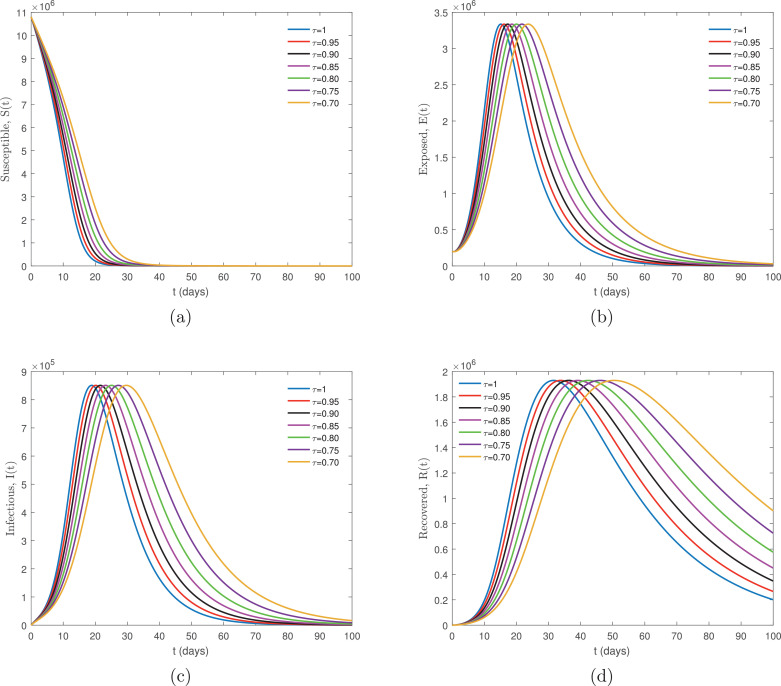
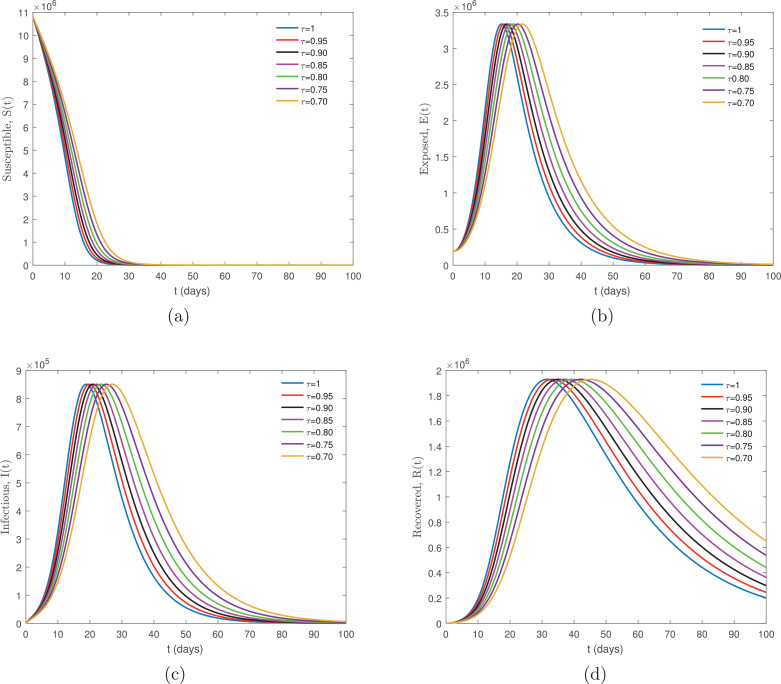
In this article, Coronavirus Disease COVID-19 transmission dynamics were studied to examine the utility of the SEIR compartmental model, using two non-singular kernel fractional derivative operators. This method was used to evaluate the complete memory effects within the model. The Caputo-Fabrizio (CF) and Atangana-Baleanu models were used predicatively, to demonstrate the possible long-term trajectories of COVID-19. Thus, the expression of the basic reproduction number using the next generating matrix was derived. We also investigated the local stability of the equilibrium points. Additionally, we examined the existence and uniqueness of the solution for both extensions of these models. Comparisons of these two epidemic modeling approaches (i.e. CF and ABC fractional derivative) illustrated that, for non-integer value. The ABC approach had a significant effect on the dynamics of the epidemic and provided new perspective for its utilization as a tool to advance research in disease transmission dynamics for critical COVID-19 cases. Concurrently, the CF approach demonstrated promise for use in mild cases. Furthermore, the integer value results of both approaches were identical.

摘要

在本文中,利用两个非奇异核分数阶导数算子研究了新型冠状病毒肺炎(COVID-19)的传播动力学,以检验SEIR compartmental模型的效用。该方法用于评估模型中的完全记忆效应。Caputo-Fabrizio(CF)模型和Atangana-Baleanu模型被用于预测,以展示COVID-19可能的长期轨迹。因此,推导了使用下一代生成矩阵的基本再生数表达式。我们还研究了平衡点的局部稳定性。此外,我们研究了这两种模型扩展的解的存在性和唯一性。这两种流行病建模方法(即CF和ABC分数阶导数)的比较表明,对于非整数值,ABC方法对疫情动态有显著影响,并为其作为推进COVID-19重症病例疾病传播动力学研究的工具提供了新视角。同时,CF方法在轻症病例中显示出应用前景。此外,两种方法的整数值结果相同。
https://cdn.ncbi.nlm.nih.gov/pmc/blobs/f102/7859658/99831c8489b1/gr2_lrg.jpg
https://cdn.ncbi.nlm.nih.gov/pmc/blobs/f102/7859658/55f8f7a7518d/gr1_lrg.jpg
https://cdn.ncbi.nlm.nih.gov/pmc/blobs/f102/7859658/99831c8489b1/gr2_lrg.jpg
https://cdn.ncbi.nlm.nih.gov/pmc/blobs/f102/7859658/55f8f7a7518d/gr1_lrg.jpg
https://cdn.ncbi.nlm.nih.gov/pmc/blobs/f102/7859658/99831c8489b1/gr2_lrg.jpg

相似文献

1
Mathematical modeling of coronavirus disease COVID-19 dynamics using CF and ABC non-singular fractional derivatives.使用CF和ABC非奇异分数阶导数对冠状病毒病COVID-19动态进行数学建模。
Chaos Solitons Fractals. 2021 Apr;145:110757. doi: 10.1016/j.chaos.2021.110757. Epub 2021 Feb 4.
2
Solution of a dynamical memory effect COVID-19 infection system with leaky vaccination efficacy by non-singular kernel fractional derivatives.具有漏接种疗效的 COVID-19 感染系统的动态记忆效应的非奇异核分数导数解。
Math Biosci Eng. 2022 Feb 28;19(5):4341-4367. doi: 10.3934/mbe.2022201.
3
Complex mathematical SIR model for spreading of COVID-19 virus with Mittag-Leffler kernel.具有米塔格-莱夫勒核的COVID-19病毒传播的复杂数学SIR模型。
Adv Differ Equ. 2021;2021(1):319. doi: 10.1186/s13662-021-03470-1. Epub 2021 Jul 3.
4
A study on fractional HBV model through singular and non-singular derivatives.一项关于通过奇异和非奇异导数的分数阶乙肝病毒模型的研究。
Eur Phys J Spec Top. 2022;231(10):1885-1904. doi: 10.1140/epjs/s11734-022-00460-6. Epub 2022 Mar 2.
5
Analysis of SIQR type mathematical model under Atangana-Baleanu fractional differential operator.SIQR 型数学模型在 Atangana-Baleanu 分数阶微分算子下的分析。
Comput Methods Biomech Biomed Engin. 2023 Jan;26(1):98-112. doi: 10.1080/10255842.2022.2047954. Epub 2022 Mar 10.
6
On study of fractional order epidemic model of COVID-19 under non-singular Mittag-Leffler kernel.基于非奇异米塔格-莱夫勒核的COVID-19分数阶流行模型研究
Results Phys. 2021 Jul;26:104402. doi: 10.1016/j.rinp.2021.104402. Epub 2021 Jun 12.
7
Theoretical and numerical analysis of COVID-19 pandemic model with non-local and non-singular kernels.具有非局部和非奇异核的 COVID-19 大流行模型的理论和数值分析。
Sci Rep. 2022 Oct 28;12(1):18178. doi: 10.1038/s41598-022-21372-4.
8
Fractional modeling of blood ethanol concentration system with real data application.基于实际数据应用的血液乙醇浓度系统的分数阶建模
Chaos. 2019 Jan;29(1):013143. doi: 10.1063/1.5082907.
9
A mathematical study on a fractional COVID-19 transmission model within the framework of nonsingular and nonlocal kernel.在非奇异和非局部核框架下的分数阶COVID-19传播模型的数学研究
Chaos Solitons Fractals. 2021 Nov;152:111427. doi: 10.1016/j.chaos.2021.111427. Epub 2021 Sep 20.
10
Two-strain epidemic model involving fractional derivative with Mittag-Leffler kernel.具有米塔格-莱夫勒核的分数阶导数的两菌株流行模型。
Chaos. 2018 Dec;28(12):123121. doi: 10.1063/1.5074084.

引用本文的文献

1
Mathematical model of the lumpy skin disease using Caputo fractional-order derivative via invariant point technique.基于不变点技术利用卡普托分数阶导数的牛结节性皮肤病数学模型
Sci Rep. 2025 Mar 17;15(1):9112. doi: 10.1038/s41598-025-92884-y.
2
The role of a vaccine booster for a fractional order model of the dynamic of COVID-19: a case study in Thailand.新冠疫情动态分数阶模型中疫苗加强针的作用:泰国的一个案例研究
Sci Rep. 2025 Jan 7;15(1):1162. doi: 10.1038/s41598-024-80390-6.
3
Fractional order epidemiological model of SARS-CoV-2 dynamism involving Alzheimer's disease.

本文引用的文献

1
COVID-19 epidemic outside China: 34 founders and exponential growth.中国境外的 COVID-19 疫情:34 名创始人及指数级增长。
J Investig Med. 2021 Jan;69(1):52-55. doi: 10.1136/jim-2020-001491. Epub 2020 Oct 6.
2
A discrete stochastic model of the COVID-19 outbreak: Forecast and control.一个 COVID-19 爆发的离散随机模型:预测和控制。
Math Biosci Eng. 2020 Mar 16;17(4):2792-2804. doi: 10.3934/mbe.2020153.
3
Modelling and predicting the spatio-temporal spread of cOVID-19 in Italy.建模并预测 COVID-19 在意大利的时空传播。
涉及阿尔茨海默病的新型冠状病毒动态变化的分数阶流行病学模型
Healthc Anal (N Y). 2022 Nov;2:100114. doi: 10.1016/j.health.2022.100114. Epub 2022 Oct 1.
4
Analysis of mathematical model involving nonlinear systems of Caputo-Fabrizio fractional differential equation.涉及卡普托-法布里齐奥分数阶微分方程非线性系统的数学模型分析
Bound Value Probl. 2023;2023(1):44. doi: 10.1186/s13661-023-01730-5. Epub 2023 Apr 19.
5
Global stability and analysing the sensitivity of parameters of a multiple-susceptible population model of SARS-CoV-2 emphasising vaccination drive.强调疫苗接种推动的新冠病毒多易感人群模型的全局稳定性及参数敏感性分析
Math Comput Simul. 2023 Jan;203:741-766. doi: 10.1016/j.matcom.2022.07.012. Epub 2022 Jul 23.
6
A fractional-order model with different strains of COVID-19.一种针对不同新冠病毒毒株的分数阶模型。
Physica A. 2022 Oct 1;603:127813. doi: 10.1016/j.physa.2022.127813. Epub 2022 Jun 23.
7
Optimal control and cost-effectiveness analysis for a COVID-19 model with individual protection awareness.具有个体防护意识的COVID-19模型的最优控制与成本效益分析
Physica A. 2022 Oct 1;603:127804. doi: 10.1016/j.physa.2022.127804. Epub 2022 Jun 22.
8
Fractal-fractional operator for COVID-19 (Omicron) variant outbreak with analysis and modeling.用于新冠病毒(奥密克戎)变种爆发的分形-分数阶算子及分析与建模
Results Phys. 2022 Aug;39:105630. doi: 10.1016/j.rinp.2022.105630. Epub 2022 May 30.
9
Mathematical modeling and stability analysis of the COVID-19 with quarantine and isolation.新冠疫情防控措施下的数学建模与稳定性分析
Results Phys. 2022 Mar;34:105284. doi: 10.1016/j.rinp.2022.105284. Epub 2022 Feb 8.
10
Modeling and optimal control of mutated COVID-19 (Delta strain) with imperfect vaccination.不完全接种疫苗情况下变异新冠病毒(德尔塔毒株)的建模与最优控制
Chaos Solitons Fractals. 2022 Mar;156:111825. doi: 10.1016/j.chaos.2022.111825. Epub 2022 Jan 31.
BMC Infect Dis. 2020 Sep 23;20(1):700. doi: 10.1186/s12879-020-05415-7.
4
An efficient spectral collocation method for the dynamic simulation of the fractional epidemiological model of the Ebola virus.一种用于埃博拉病毒分数阶流行病学模型动态模拟的高效谱配置方法。
Chaos Solitons Fractals. 2020 Nov;140:110174. doi: 10.1016/j.chaos.2020.110174. Epub 2020 Aug 6.
5
Dynamic models for Coronavirus Disease 2019 and data analysis.2019年冠状病毒病的动态模型与数据分析
Math Methods Appl Sci. 2020 May 15;43(7):4943-4949. doi: 10.1002/mma.6345. Epub 2020 Mar 24.
6
A mathematical model for the novel coronavirus epidemic in Wuhan, China.中国武汉新型冠状病毒疫情的数学模型。
Math Biosci Eng. 2020 Mar 11;17(3):2708-2724. doi: 10.3934/mbe.2020148.
7
Modeling the epidemic dynamics and control of COVID-19 outbreak in China.中国新冠疫情爆发的流行动力学建模与防控
Quant Biol. 2020;8(1):11-19. doi: 10.1007/s40484-020-0199-0. Epub 2020 Mar 11.
8
Transmission potential and severity of COVID-19 in South Korea.韩国 COVID-19 的传播潜力和严重程度。
Int J Infect Dis. 2020 Apr;93:339-344. doi: 10.1016/j.ijid.2020.03.031. Epub 2020 Mar 18.
9
Analysis of COVID-19 infection spread in Japan based on stochastic transition model.基于随机转移模型的日本 COVID-19 感染传播分析。
Biosci Trends. 2020 May 21;14(2):134-138. doi: 10.5582/bst.2020.01482. Epub 2020 Mar 19.
10
The positive impact of lockdown in Wuhan on containing the COVID-19 outbreak in China.封城对中国控制新冠肺炎疫情的积极影响。
J Travel Med. 2020 May 18;27(3). doi: 10.1093/jtm/taaa037.