• 文献检索
  • 文档翻译
  • 深度研究
  • 学术资讯
  • Suppr Zotero 插件Zotero 插件
  • 邀请有礼
  • 套餐&价格
  • 历史记录
应用&插件
Suppr Zotero 插件Zotero 插件浏览器插件Mac 客户端Windows 客户端微信小程序
定价
高级版会员购买积分包购买API积分包
服务
文献检索文档翻译深度研究API 文档MCP 服务
关于我们
关于 Suppr公司介绍联系我们用户协议隐私条款
关注我们

Suppr 超能文献

核心技术专利:CN118964589B侵权必究
粤ICP备2023148730 号-1Suppr @ 2026

文献检索

告别复杂PubMed语法,用中文像聊天一样搜索,搜遍4000万医学文献。AI智能推荐,让科研检索更轻松。

立即免费搜索

文件翻译

保留排版,准确专业,支持PDF/Word/PPT等文件格式,支持 12+语言互译。

免费翻译文档

深度研究

AI帮你快速写综述,25分钟生成高质量综述,智能提取关键信息,辅助科研写作。

立即免费体验

中国境外的 COVID-19 疫情:34 名创始人及指数级增长。

COVID-19 epidemic outside China: 34 founders and exponential growth.

机构信息

Ministry of Education Key Laboratory of Contemporary Anthropology, Human Phenome Institute, School of Life Sciences, Fudan University, Shanghai, China.

Institute for Six-sector Economy, Fudan University, Shanghai, China.

出版信息

J Investig Med. 2021 Jan;69(1):52-55. doi: 10.1136/jim-2020-001491. Epub 2020 Oct 6.

DOI:10.1136/jim-2020-001491
PMID:33023916
原文链接:https://pmc.ncbi.nlm.nih.gov/articles/PMC7803885/
Abstract

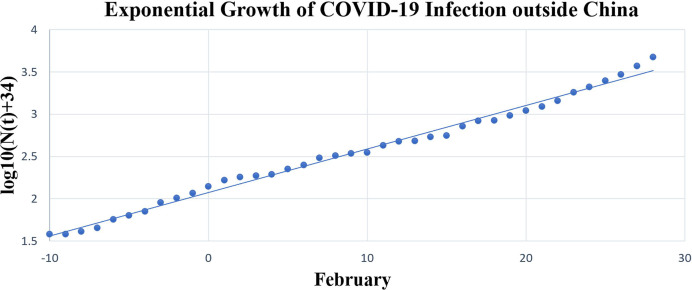
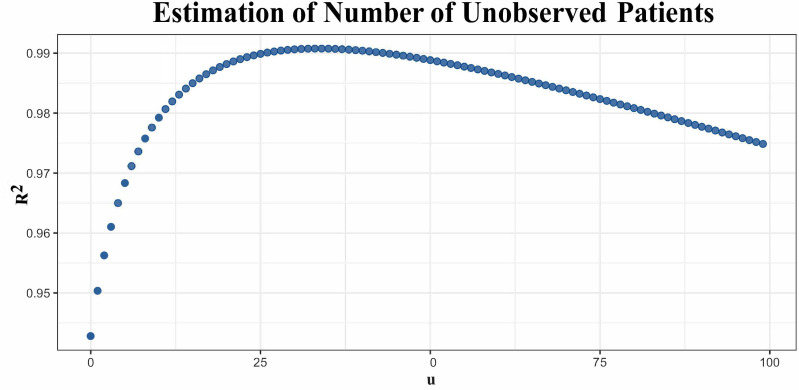
COVID-19 raised tension both within China and internationally. Here, we used mathematical modeling to predict the trend of patient diagnosis outside China in future, with the aim of easing anxiety regarding the emergent situation. According to all diagnosis number from WHO website and combining with the transmission mode of infectious diseases, the mathematical model was fitted to predict future trend of outbreak. Daily diagnosis numbers from countries outside China were downloaded from WHO situation reports. The data used for this analysis were collected from January 21, 2020 and currently end at February 28, 2020. A simple regression model was developed based on these numbers, as follows: [Formula: see text], where [Formula: see text] is the total diagnosed patient till the i-th day and t=1 at February 1, 2020. Based on this model, we estimate that there were approximately 34 undetected founder patients at the beginning of the spread of COVID-19 outside China. The global trend was approximately exponential, with an increase rate of 10-fold every 19 days. Through establishment of this model, we call for worldwide strong public health actions, with reference to the experiences learned from China and Singapore.

摘要

新冠疫情在中国境内外都引起了紧张局势。在这里,我们使用数学模型来预测未来中国境外的患者诊断趋势,旨在缓解对紧急情况的焦虑。根据世界卫生组织网站上的所有诊断数量,并结合传染病的传播模式,对数学模型进行了拟合,以预测疫情的未来趋势。从世界卫生组织的情况报告中下载了中国境外国家的每日诊断数量。本分析中使用的数据收集于 2020 年 1 月 21 日,截止到 2020 年 2 月 28 日。根据这些数字建立了一个简单的回归模型,如下所示:[公式:见正文],其中[公式:见正文]是第 i 天之前累计诊断的患者总数,t=1 为 2020 年 2 月 1 日。根据该模型,我们估计在中国境外 COVID-19 传播初期,大约有 34 名未被发现的初始患者。全球趋势大致呈指数增长,每 19 天增加 10 倍。通过建立这个模型,我们呼吁全世界采取强有力的公共卫生措施,借鉴中国和新加坡的经验。
https://cdn.ncbi.nlm.nih.gov/pmc/blobs/8632/7803885/2cc78eb4df15/jim-2020-001491f02.jpg
https://cdn.ncbi.nlm.nih.gov/pmc/blobs/8632/7803885/6831f1f1ea0d/jim-2020-001491f01.jpg
https://cdn.ncbi.nlm.nih.gov/pmc/blobs/8632/7803885/2cc78eb4df15/jim-2020-001491f02.jpg
https://cdn.ncbi.nlm.nih.gov/pmc/blobs/8632/7803885/6831f1f1ea0d/jim-2020-001491f01.jpg
https://cdn.ncbi.nlm.nih.gov/pmc/blobs/8632/7803885/2cc78eb4df15/jim-2020-001491f02.jpg

相似文献

1
COVID-19 epidemic outside China: 34 founders and exponential growth.中国境外的 COVID-19 疫情:34 名创始人及指数级增长。
J Investig Med. 2021 Jan;69(1):52-55. doi: 10.1136/jim-2020-001491. Epub 2020 Oct 6.
2
A simple transmission dynamics model for predicting the evolution of COVID-19 under control measures in China.一种简单的传染病动力学模型,用于预测中国采取控制措施后 COVID-19 的演变情况。
Epidemiol Infect. 2021 Feb 10;149:e43. doi: 10.1017/S0950268821000339.
3
A report on COVID-19 epidemic in Pakistan using SEIR fractional model.巴基斯坦 COVID-19 疫情报告:使用 SEIR 分数阶模型。
Sci Rep. 2020 Dec 17;10(1):22268. doi: 10.1038/s41598-020-79405-9.
4
The spatiotemporal estimation of the risk and the international transmission of COVID-19: a global perspective.COVID-19 风险的时空估计及国际传播:全球视角。
Sci Rep. 2020 Nov 18;10(1):20021. doi: 10.1038/s41598-020-77242-4.
5
Modeling the trend of coronavirus disease 2019 and restoration of operational capability of metropolitan medical service in China: a machine learning and mathematical model-based analysis.基于机器学习和数学模型的分析:预测 2019 年冠状病毒病趋势及恢复中国大都市医疗服务运营能力。
Glob Health Res Policy. 2020 May 6;5:20. doi: 10.1186/s41256-020-00145-4. eCollection 2020.
6
Predictive model with analysis of the initial spread of COVID-19 in India.预测模型分析印度 COVID-19 的初始传播情况。
Int J Med Inform. 2020 Nov;143:104262. doi: 10.1016/j.ijmedinf.2020.104262. Epub 2020 Aug 25.
7
The spatial transmission of SARS-CoV-2 in China under the prevention and control measures at the early outbreak.疫情初期防控措施下新型冠状病毒在中国的空间传播。
Arch Public Health. 2021 Jan 13;79(1):8. doi: 10.1186/s13690-021-00529-z.
8
Evaluation of the number of undiagnosed infected in an outbreak using source of infection measurements.利用感染源测量评估暴发中未诊断感染的数量。
Sci Rep. 2021 Feb 11;11(1):3601. doi: 10.1038/s41598-021-82691-6.
9
Using the absolute advantage coefficient (AAC) to measure the strength of damage hit by COVID-19 in India on a growth-share matrix.利用绝对优势系数(AAC)在增长-份额矩阵上衡量新冠疫情对印度造成的损害程度。
Eur J Med Res. 2021 Jun 24;26(1):61. doi: 10.1186/s40001-021-00528-4.
10
Spread trend of COVID-19 epidemic outbreak in China: using exponential attractor method in a spatial heterogeneous SEIQR model.中国 COVID-19 疫情爆发的传播趋势:使用空间异质 SEIQR 模型中的指数吸引子方法。
Math Biosci Eng. 2020 Apr 13;17(4):3062-3087. doi: 10.3934/mbe.2020174.

引用本文的文献

1
Can the number of confirmed COVID-19 cases be predicted more accurately by including lifestyle data? An exploratory study for data-driven prediction of COVID-19 cases in metropolitan cities using deep learning models.纳入生活方式数据能否更准确地预测新冠确诊病例数?一项使用深度学习模型对大城市新冠病例进行数据驱动预测的探索性研究。
Digit Health. 2025 Jan 26;11:20552076251314528. doi: 10.1177/20552076251314528. eCollection 2025 Jan-Dec.
2
Predicting the growth and trend of COVID-19 pandemic using machine learning and cloud computing.利用机器学习和云计算预测新冠疫情的发展与趋势。
Internet Things (Amst). 2020 Sep;11:100222. doi: 10.1016/j.iot.2020.100222. Epub 2020 May 12.
3

本文引用的文献

1
Forecasting the Spreading of COVID-19 across Nine Countries from Europe, Asia, and the American Continents Using the ARIMA Models.使用自回归积分滑动平均(ARIMA)模型预测新冠病毒在欧洲、亚洲和美洲九个国家的传播情况。
Microorganisms. 2020 Jul 30;8(8):1158. doi: 10.3390/microorganisms8081158.
2
Early epidemiological assessment of the transmission potential and virulence of coronavirus disease 2019 (COVID-19) in Wuhan City, China, January-February, 2020.2020 年 1 月至 2 月中国武汉市 2019 年冠状病毒病(COVID-19)传播潜力和毒力的早期流行病学评估。
BMC Med. 2020 Jul 15;18(1):217. doi: 10.1186/s12916-020-01691-x.
3
Time series forecasting of COVID-19 transmission in Canada using LSTM networks.
CPPE-5: Medical Personal Protective Equipment Dataset.
CPPE - 5:医用个人防护装备数据集。
SN Comput Sci. 2023;4(3):263. doi: 10.1007/s42979-023-01748-7. Epub 2023 Mar 16.
4
COVID-19 Detection Mechanism in Vehicles Using a Deep Extreme Machine Learning Approach.基于深度极限机器学习方法的车辆中COVID-19检测机制
Diagnostics (Basel). 2023 Jan 11;13(2):270. doi: 10.3390/diagnostics13020270.
5
A sustainable advanced artificial intelligence-based framework for analysis of COVID-19 spread.一个用于分析新冠病毒传播的基于可持续先进人工智能的框架。
Environ Dev Sustain. 2022 Aug 16:1-16. doi: 10.1007/s10668-022-02584-0.
6
Enabling Artificial Intelligence for Genome Sequence Analysis of COVID-19 and Alike Viruses.为 COVID-19 及类似病毒的基因组序列分析启用人工智能。
Interdiscip Sci. 2022 Jun;14(2):504-519. doi: 10.1007/s12539-021-00465-0. Epub 2021 Aug 6.
7
Data Empowerment of Decision-Makers in an Era of a Pandemic: Intersection of "Classic" and Artificial Intelligence in the Service of Medicine.数据赋能决策者应对大流行时代:“经典”与人工智能在医学服务中的交汇
J Med Internet Res. 2021 Sep 10;23(9):e24295. doi: 10.2196/24295.
8
Impact of COVID-19 on older adults and role of long-term care facilities during early stages of epidemic in Italy.COVID-19 对老年人的影响以及意大利疫情早期长期护理机构的作用。
Sci Rep. 2021 Jun 15;11(1):12530. doi: 10.1038/s41598-021-91992-9.
9
Mathematical modeling of coronavirus disease COVID-19 dynamics using CF and ABC non-singular fractional derivatives.使用CF和ABC非奇异分数阶导数对冠状病毒病COVID-19动态进行数学建模。
Chaos Solitons Fractals. 2021 Apr;145:110757. doi: 10.1016/j.chaos.2021.110757. Epub 2021 Feb 4.
10
Patterns of the COVID-19 pandemic spread around the world: exponential versus power laws.新冠疫情在全球传播的模式:指数增长与幂律分布。
J R Soc Interface. 2020 Sep;17(170):20200518. doi: 10.1098/rsif.2020.0518. Epub 2020 Sep 30.
使用长短期记忆网络对加拿大新冠病毒传播进行时间序列预测。
Chaos Solitons Fractals. 2020 Jun;135:109864. doi: 10.1016/j.chaos.2020.109864. Epub 2020 May 8.
4
Mathematical modeling of COVID-19 transmission dynamics with a case study of Wuhan.基于武汉案例研究的新冠病毒传播动力学数学建模
Chaos Solitons Fractals. 2020 Jun;135:109846. doi: 10.1016/j.chaos.2020.109846. Epub 2020 Apr 27.
5
Prediction for the spread of COVID-19 in India and effectiveness of preventive measures.预测 COVID-19 在印度的传播情况和预防措施的效果。
Sci Total Environ. 2020 Aug 1;728:138762. doi: 10.1016/j.scitotenv.2020.138762. Epub 2020 Apr 20.
6
A framework for identifying regional outbreak and spread of COVID-19 from one-minute population-wide surveys.一种通过全人群一分钟调查来识别新冠病毒病区域暴发和传播情况的框架。
Nat Med. 2020 May;26(5):634-638. doi: 10.1038/s41591-020-0857-9.
7
Outbreak of novel coronavirus (COVID-19): What is the role of radiologists?新型冠状病毒(COVID-19)疫情爆发:放射科医生的作用是什么?
Eur Radiol. 2020 Jun;30(6):3266-3267. doi: 10.1007/s00330-020-06748-2. Epub 2020 Feb 18.
8
Nowcasting and forecasting the potential domestic and international spread of the 2019-nCoV outbreak originating in Wuhan, China: a modelling study.实时预测和预报源自中国武汉的 2019-nCoV 疫情在国内和国际的潜在传播:一项建模研究。
Lancet. 2020 Feb 29;395(10225):689-697. doi: 10.1016/S0140-6736(20)30260-9. Epub 2020 Jan 31.
9
Preliminary estimation of the basic reproduction number of novel coronavirus (2019-nCoV) in China, from 2019 to 2020: A data-driven analysis in the early phase of the outbreak.2019 年至 2020 年中国新型冠状病毒(2019-nCoV)基本繁殖数的初步估计:疫情早期的基于数据的分析。
Int J Infect Dis. 2020 Mar;92:214-217. doi: 10.1016/j.ijid.2020.01.050. Epub 2020 Jan 30.
10
Genomic characterisation and epidemiology of 2019 novel coronavirus: implications for virus origins and receptor binding.新冠病毒的基因组特征和流行病学:对病毒起源和受体结合的影响。
Lancet. 2020 Feb 22;395(10224):565-574. doi: 10.1016/S0140-6736(20)30251-8. Epub 2020 Jan 30.