
用于预测射血分数保留的急性心力衰竭首次发作后早期再入院的实用风险评分。
A Practical Risk Score for Prediction of Early Readmission after a First Episode of Acute Heart Failure with Preserved Ejection Fraction.
作者信息
Zamfirescu Marilena-Brîndușa, Ghilencea Liviu Nicolae, Popescu Mihaela-Roxana, Bejan Gabriel Cristian, Ghiordanescu Ileana Maria, Popescu Andreea-Catarina, Myerson Saul G, Dorobanțu Maria
机构信息
Cardiothoracic Pathology Department, Carol Davila University of Medicine and Pharmacy, 020021 Bucharest, Romania.
Department of Cardiology, Elias Emergency University Hospital, "Carol Davila" University of Medicine and Pharmacy, 011227 Bucharest, Romania.
出版信息
Diagnostics (Basel). 2021 Jan 29;11(2):198. doi: 10.3390/diagnostics11020198.
BACKGROUND
The first admission for acute heart failure with preserved ejection fraction (HFpEF) drastically influences the short-term prognosis. Baseline characteristics may predict repeat hospitalization or death in these patients.
METHODS
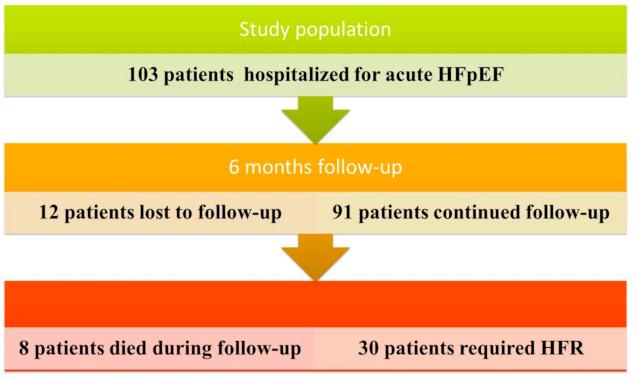
A 103 patient-cohort, admitted for the first acute HFpEF episode, was monitored for six months. Baseline characteristics were recorded and their relation to the primary outcome of heart failure readmission (HFR) and secondary outcome of all-cause mortality was assessed.
RESULTS
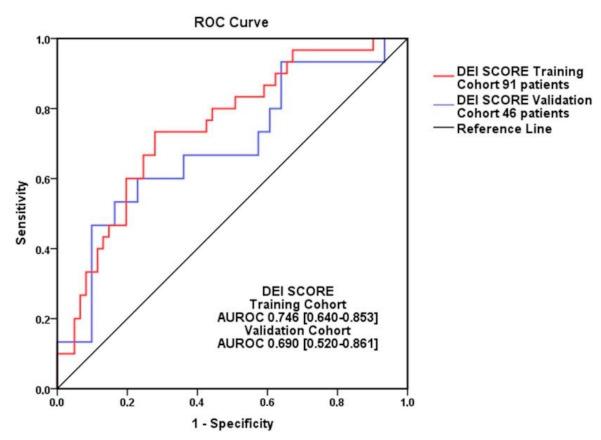
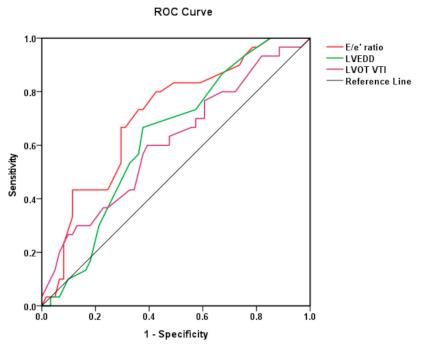
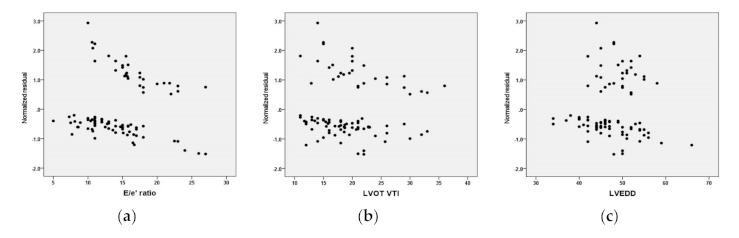
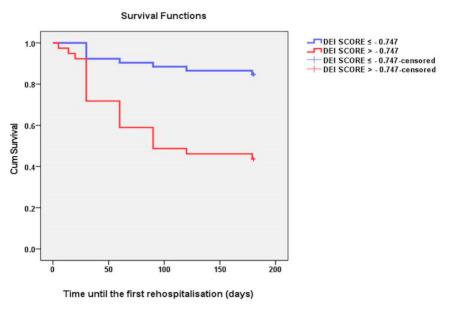
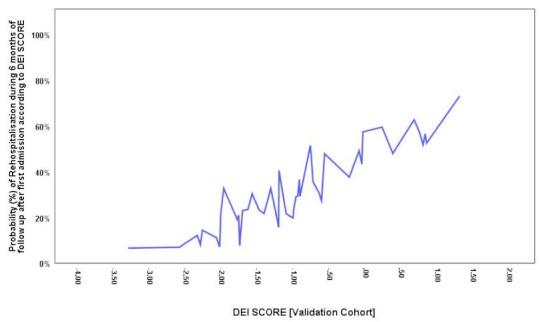
We identified six independent determinants for HFR: estimated glomerular filtration rate (eGFR) ( = 0.07), hemoglobin ( = 0.04), left ventricle end-diastolic diameter (LVEDD) ( = 0.07), E/e' ratio ( = 0.004), left ventricle outflow tract velocity-time integral (LVOT VTI) ( = 0.045), and diabetes mellitus ( = 0.06). Three of the variables were used to generate a risk score for HFR: LVED, /e', LVOT VT - Score = 28.763 4.558 × log (LVED (mm)) 1.961 × log (e' ratio) 1.759 × log (LVOT VT (cm)). Our model predicts a relative amount of 20.50% of HFR during the first 6 months after the first acute hospitalization within the general population with HFpEF with a DEI Score over -0.747.
CONCLUSIONS
We have identified three echocardiographic parameters (LVEDD, E/e', and LVOT VTI) that predict HFR following an initial acute HFpEF hospitalization. The prognostic DEI score demonstrated good accuracy.
背景
射血分数保留的急性心力衰竭(HFpEF)首次入院对短期预后有重大影响。基线特征可能预测这些患者再次住院或死亡情况。
方法
对103例因首次急性HFpEF发作入院的患者队列进行了6个月的监测。记录基线特征,并评估其与心力衰竭再入院(HFR)的主要结局及全因死亡率的次要结局之间的关系。
结果
我们确定了HFR的六个独立决定因素:估计肾小球滤过率(eGFR)(=0.07)、血红蛋白(=0.04)、左心室舒张末期内径(LVEDD)(=0.07)、E/e'比值(=0.004)、左心室流出道速度时间积分(LVOT VTI)(=0.045)和糖尿病(=0.06)。其中三个变量用于生成HFR风险评分:LVED、E/e'、LVOT VT - 评分=28.763 - 4.558×log(LVED(mm)) - 1.961×log(E/e'比值) - 1.759×log(LVOT VT(cm))。我们的模型预测,在首次急性住院后的前6个月内,HFpEF总体人群中,DEI评分超过 - 0.747的患者发生HFR的相对比例为
20.50%。
结论
我们确定了三个超声心动图参数(LVEDD、E/e'和LVOT VTI),可预测首次急性HFpEF住院后的HFR。预后DEI评分显示出良好的准确性。


 Zotero 插件