Wei Holly, Hardin Sonya Renae, Watson Jean
College of Nursing at East Carolina University, Greenville, NC, USA.
University of Louisville School of Nursing, Louisville, KY, USA.
Int J Nurs Sci. 2020 Nov 24;8(1):130-135. doi: 10.1016/j.ijnss.2020.11.003. eCollection 2021 Jan 10.
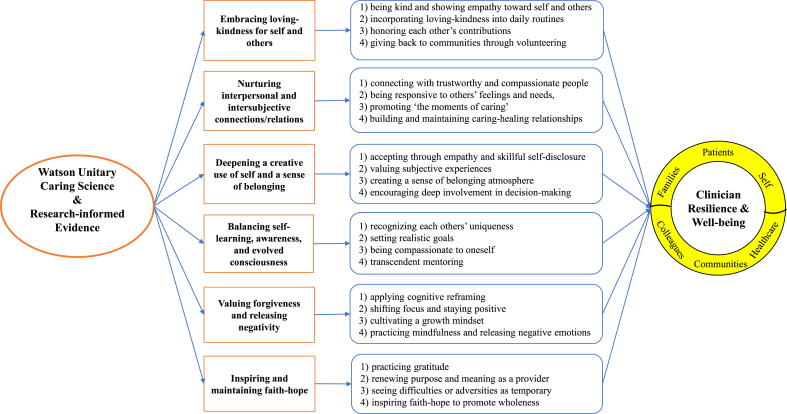
Resilience is the psychological capability to recover from difficulties quickly. Healthcare professionals are especially vulnerable to job-related stress and burnout. Unitary Caring Science is the framework for Watson's Human Caring Theory, providing a philosophy of practice in healthcare. With the high rates of clinician burnout and psychological issues, it will be significant to unify the human caring theory with research-informed psychological and neuroscience evidence to develop clinicians' resilience-building strategies. The purpose of this article is to introduce a Unitary Caring Science Resilience Model and explain the science behind the core strategies based on Unitary Caring Science philosophy and the psychological and neuroscience research. This model includes six strategies: loving-kindness for self and others; interpersonal and intersubjective connections/relations; a creative use of self and sense of belonging; self-learning, self-awareness, and an evolved self-consciousness; and releasing negativity; and maintaining faith-hope. The caring-theory guided resilience-building strategies are proven to alleviate the depletion of clinicians' energy and emotions. Healthcare practices are challenging but rewarding. Clinicians can be emotionally, psychologically, and physically exhausted if they always consider themselves 'giving' and 'doing' institutional tasks without a sense of purpose or fulfillment. The practice can be rewarding if it becomes more aligned with clinicians' value to serve humanity. Through the unitary caring science resilience strategies, clinicians can build resilience as an antidote to clinician burnout and depletion.
复原力是指迅速从困难中恢复的心理能力。医疗保健专业人员特别容易受到与工作相关的压力和职业倦怠的影响。整体关怀科学是沃森人文关怀理论的框架,为医疗保健提供了一种实践哲学。鉴于临床医生职业倦怠和心理问题的高发率,将人文关怀理论与基于研究的心理学和神经科学证据相结合,以制定临床医生的复原力建设策略具有重要意义。本文旨在介绍一个整体关怀科学复原力模型,并基于整体关怀科学哲学以及心理学和神经科学研究,解释核心策略背后的科学原理。该模型包括六种策略:对自己和他人的仁爱;人际和主体间的联系/关系;对自我的创造性运用和归属感;自我学习、自我意识和进化的自我意识;释放消极情绪;以及保持信念和希望。以关怀理论为指导的复原力建设策略已被证明可以缓解临床医生的精力和情感耗竭。医疗实践具有挑战性,但也有回报。如果临床医生总是在没有目标感或成就感的情况下,认为自己只是在“给予”和“执行”机构任务,他们可能会在情感、心理和身体上感到疲惫。如果医疗实践能更符合临床医生服务人类的价值观,那么它就会有回报。通过整体关怀科学复原力策略,临床医生可以培养复原力,以应对职业倦怠和精力耗竭。