Stress Research Institute, Department of Psychology, Stockholm University, Stockholm, Sweden.
Department of Psychology, University of Eastern Finland, Joensuu, Finland.
Ann Behav Med. 2021 Jul 22;55(8):779-790. doi: 10.1093/abm/kaaa116.
The influence of individual and home neighborhood socioeconomic status (SES) on health-related behaviors have been widely studied, but the majority of these studies have neglected the possible impact of the workplace neighborhood SES.
To examine within-individual associations between home and work place neighborhood SES and health-related behaviors in employed individuals.
We used participants from the Swedish Longitudinal Occupational Survey of Health who responded to a minimum of two surveys between 2012 and 2018. Data included 12,932 individuals with a total of 35,332 observations. We used fixed-effects analysis with conditional logistic regression to examine within-individual associations of home, workplace, as well as time-weighted home and workplace neighborhood SES index, with self-reported obesity, physical activity, smoking, excessive alcohol consumption, sedentary lifestyle, and disturbed sleep.
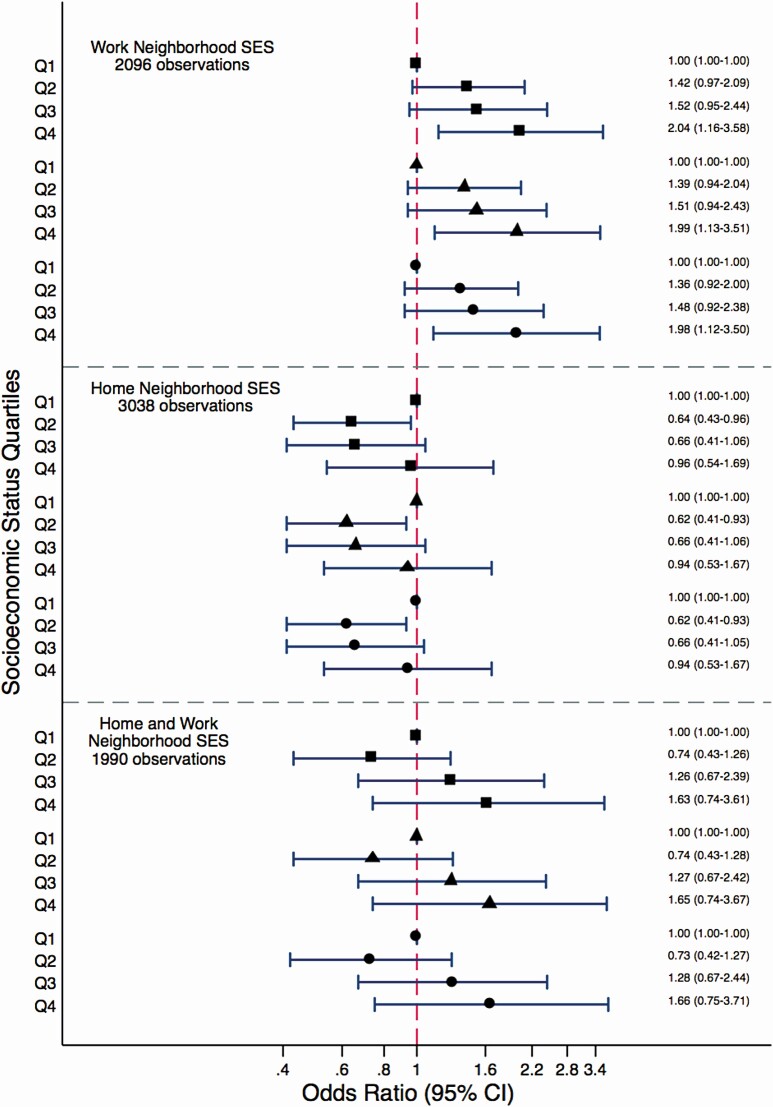
After adjustment for covariates, participants were more likely to engage in risky alcohol consumption when they worked in a workplace that was located in the highest SES area compared to time when they worked in a workplace that was located in the lowest SES area (adjusted odds ratios 1.98; 95% confidence interval: 1.12 to 3.49). There was an indication of an increased risk of obesity when individuals worked in the highest compared to the time when they worked in the lowest neighborhood SES area (1.71; 1.02-2.87). No associations were observed for the other outcomes.
These within-individual comparisons suggest that workplace neighborhood SES might have a role in health-related behaviors, particularly alcohol consumption.
个体和家庭社区社会经济地位(SES)对健康相关行为的影响已得到广泛研究,但这些研究大多忽略了工作场所社区 SES 可能产生的影响。
在就业人群中,检验家庭和工作场所社区 SES 与健康相关行为之间的个体内关联。
我们使用了瑞典职业健康纵向调查的参与者,这些参与者在 2012 年至 2018 年期间至少参加了两次调查。数据包括 12932 名参与者,共计 35332 次观察。我们使用固定效应分析和条件逻辑回归,检验家庭、工作场所以及家庭和工作场所社区 SES 指数的个体内关联,这些指数与自我报告的肥胖、身体活动、吸烟、过量饮酒、久坐不动的生活方式和睡眠障碍有关。
调整协变量后,与在 SES 最低的工作场所工作相比,参与者在 SES 最高的工作场所工作时更有可能进行危险的饮酒行为(调整后的优势比 1.98;95%置信区间:1.12 至 3.49)。当个体在 SES 最高的社区工作时,与在 SES 最低的社区工作时相比,肥胖的风险有增加的迹象(1.71;1.02 至 2.87)。对于其他结果,未观察到关联。
这些个体内比较表明,工作场所社区 SES 可能在健康相关行为方面发挥作用,特别是在饮酒行为方面。