Hübner Sariel, Kantar Michael B
Galilee Research Institute (MIGAL), Tel-Hai College, Qiryat Shemona, Israel.
Department of Tropical Plant and Soil Sciences, University of Hawai'i at Mânoa, Honolulu, HI, United States.
Front Plant Sci. 2021 Jan 27;12:626565. doi: 10.3389/fpls.2021.626565. eCollection 2021.
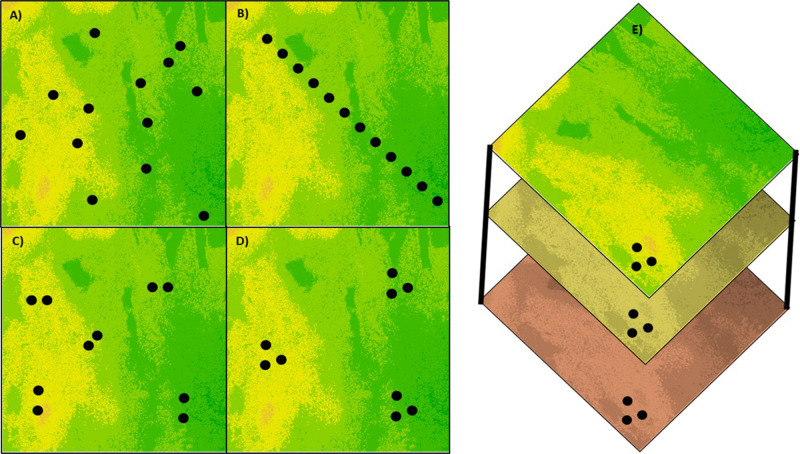
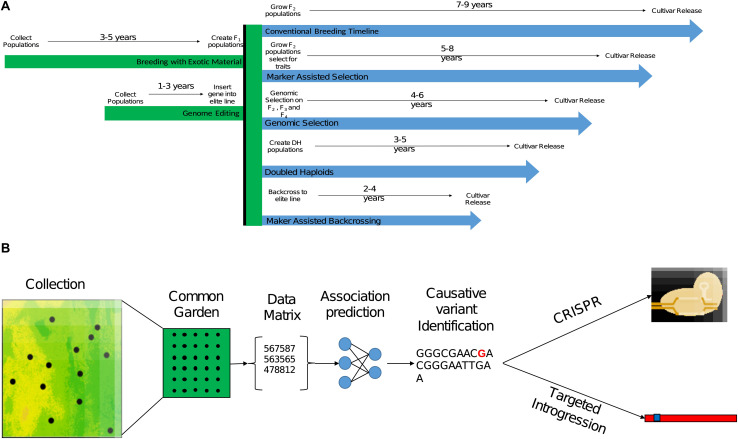
The diversity observed among crop wild relatives (CWRs) and their ability to flourish in unfavorable and harsh environments have drawn the attention of plant scientists and breeders for many decades. However, it is also recognized that the benefit gained from using CWRs in breeding is a potential rose between thorns of detrimental genetic variation that is linked to the trait of interest. Despite the increased interest in CWRs, little attention was given so far to the statistical, analytical, and technical considerations that should guide the sampling design, the germplasm characterization, and later its implementation in breeding. Here, we review the entire process of sampling and identifying beneficial genetic variation in CWRs and the challenge of using it in breeding. The ability to detect beneficial genetic variation in CWRs is strongly affected by the sampling design which should be adjusted to the spatial and temporal variation of the target species, the trait of interest, and the analytical approach used. Moreover, linkage disequilibrium is a key factor that constrains the resolution of searching for beneficial alleles along the genome, and later, the ability to deplete linked deleterious genetic variation as a consequence of genetic drag. We also discuss how technological advances in genomics, phenomics, biotechnology, and data science can improve the ability to identify beneficial genetic variation in CWRs and to exploit it in strive for higher-yielding and sustainable crops.
几十年来,作物野生近缘种(CWRs)所表现出的多样性及其在不利和恶劣环境中蓬勃生长的能力一直吸引着植物科学家和育种家的关注。然而,人们也认识到,在育种中使用CWRs所获得的益处是与目标性状相关的有害遗传变异这一棘手问题中的潜在亮点。尽管对CWRs的兴趣日益增加,但迄今为止,对于指导采样设计、种质特征鉴定以及随后在育种中的应用的统计、分析和技术考量却很少有人关注。在此,我们回顾了在CWRs中采样和鉴定有益遗传变异的整个过程以及在育种中使用它所面临的挑战。在CWRs中检测有益遗传变异的能力受到采样设计的强烈影响,采样设计应根据目标物种的时空变异、目标性状以及所使用的分析方法进行调整。此外,连锁不平衡是一个关键因素,它限制了在基因组中搜索有益等位基因的分辨率,以及随后由于遗传累赘而消除连锁有害遗传变异的能力。我们还讨论了基因组学、表型组学、生物技术和数据科学方面的技术进步如何能够提高在CWRs中鉴定有益遗传变异并将其用于培育高产和可持续作物的能力。