Department of Clinical and Experimental Sciences, University of Brescia.
Department of Mental Health and Addiction Services, ASST Spedali Civili of Brescia, Brescia, Italy.
Curr Opin Psychiatry. 2021 May 1;34(3):203-210. doi: 10.1097/YCO.0000000000000702.
The coronavirus disease 19 (COVID-19) pandemic is having a critical impact on healthcare systems across the world, as well as on mental health in the general population; however, evidence regarding the impact of the COVID-19 pandemic on people living with schizophrenia and on the onset of psychotic symptoms is currently emerging.
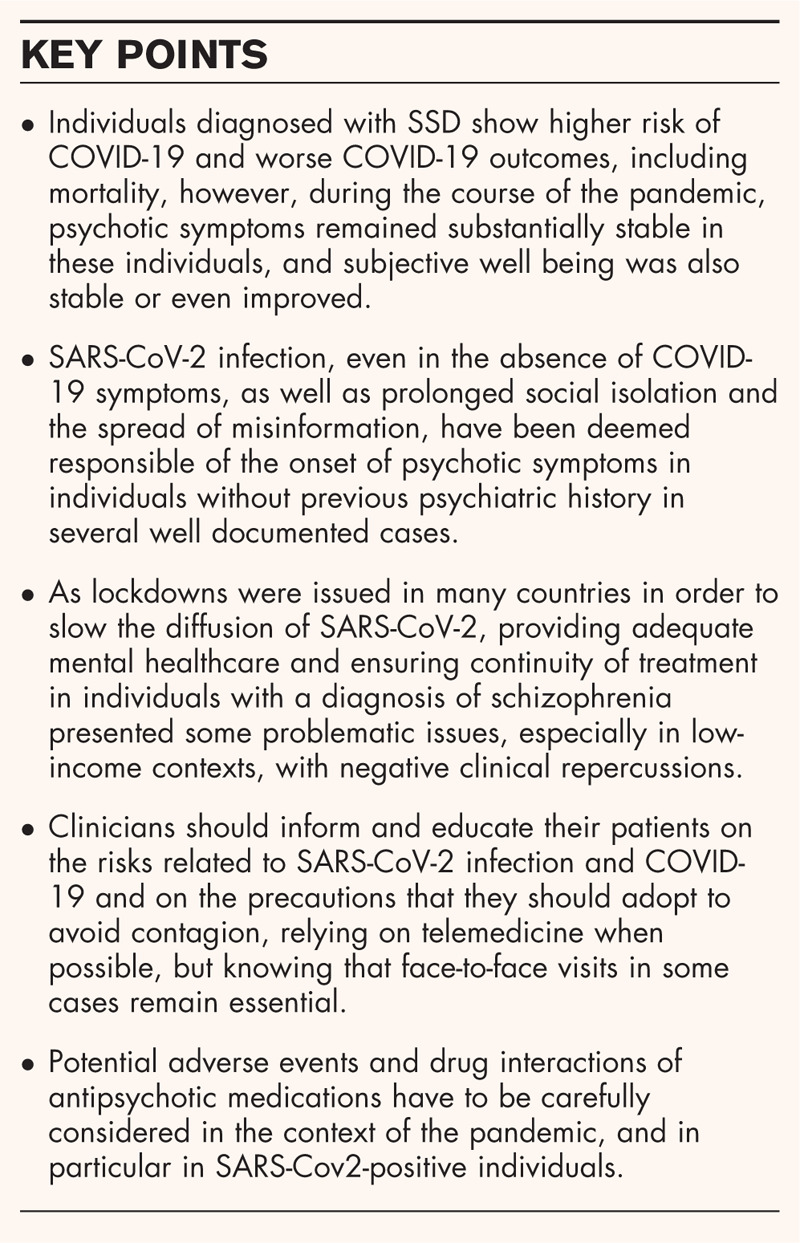
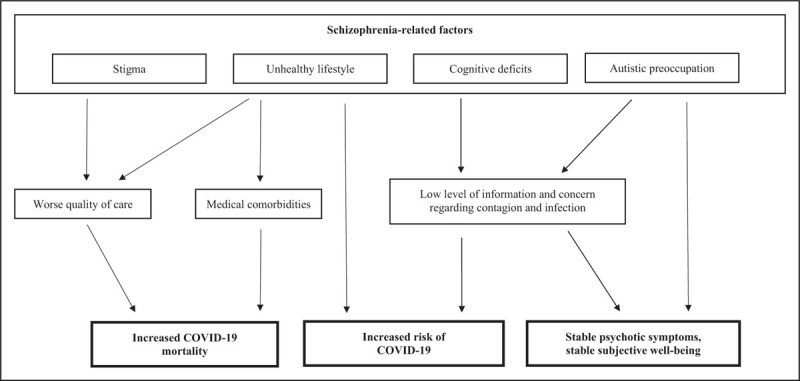
People living with schizophrenia are at an increased risk of COVID-19 and present worse COVID-19-related outcomes, including mortality. They show low levels of information and of concern regarding the possibility of contagion and infection but presented substantially stable levels of psychotic symptoms and even increased subjective well being during the pandemic. SARS-CoV-2, as well as the prolonged social isolation and the spread of misinformation, appear to be responsible in some cases for the onset of psychotic symptoms.
Clinicians should inform and educate their patients on the risks related to SARS-CoV-2 infection and COVID-19 and on the precautions that they should adopt to avoid contagion. Particular attention should be devoted to maintaining the continuity of care, especially in frail patients. Telemedicine might represent a valid support, but face-to-face visits in some cases remain essential. The hypothesis of a direct role of viral infection on the onset of psychotic disorders is currently debated, as viral involvement of central nervous system appears to be rather infrequent in COVID-19.
新型冠状病毒病(COVID-19)大流行对全球医疗保健系统以及普通人群的心理健康产生了重大影响;然而,目前有关 COVID-19 大流行对精神分裂症患者的影响以及精神病症状发作的证据正在出现。
精神分裂症患者感染 COVID-19 的风险增加,COVID-19 相关结局较差,包括死亡率。他们对感染和传染的可能性的了解和关注程度较低,但在大流行期间,精神病症状的水平基本稳定,甚至主观幸福感增加。SARS-CoV-2 以及长时间的社会隔离和错误信息的传播,在某些情况下似乎导致了精神病症状的发作。
临床医生应告知和教育患者有关 SARS-CoV-2 感染和 COVID-19 的风险,以及他们应采取的预防感染的措施。特别应注意保持护理的连续性,尤其是在体弱患者中。远程医疗可能是一种有效的支持,但在某些情况下面对面就诊仍然是必要的。病毒感染在精神病发作中的直接作用的假设目前仍存在争议,因为 COVID-19 中中枢神经系统的病毒受累似乎很少见。