• 文献检索
  • 文档翻译
  • 深度研究
  • 学术资讯
  • Suppr Zotero 插件Zotero 插件
  • 邀请有礼
  • 套餐&价格
  • 历史记录
应用&插件
Suppr Zotero 插件Zotero 插件浏览器插件Mac 客户端Windows 客户端微信小程序
定价
高级版会员购买积分包购买API积分包
服务
文献检索文档翻译深度研究API 文档MCP 服务
关于我们
关于 Suppr公司介绍联系我们用户协议隐私条款
关注我们

Suppr 超能文献

核心技术专利:CN118964589B侵权必究
粤ICP备2023148730 号-1Suppr @ 2026

文献检索

告别复杂PubMed语法,用中文像聊天一样搜索,搜遍4000万医学文献。AI智能推荐,让科研检索更轻松。

立即免费搜索

文件翻译

保留排版,准确专业,支持PDF/Word/PPT等文件格式,支持 12+语言互译。

免费翻译文档

深度研究

AI帮你快速写综述,25分钟生成高质量综述,智能提取关键信息,辅助科研写作。

立即免费体验

技术支持的非传统进食障碍精神健康服务改革:参与式设计研究。

Technology-Enabled Reform in a Nontraditional Mental Health Service for Eating Disorders: Participatory Design Study.

机构信息

University of Sydney, Sydney, Australia.

Innowell, Sydney, Australia.

出版信息

J Med Internet Res. 2021 Feb 16;23(2):e19532. doi: 10.2196/19532.

DOI:10.2196/19532
PMID:33591283
原文链接:https://pmc.ncbi.nlm.nih.gov/articles/PMC7925150/
Abstract

BACKGROUND

The recent Australian National Agenda for Eating Disorders highlights the role technology can play in improving accessibility and service development through web-based prevention, early access pathways, self-help, and recovery assistance. However, engagement with the eating disorders community to co-design, build, and evaluate these much-needed technology solutions through participatory design processes has been lacking and, until recently, underresourced.

OBJECTIVE

This study aims to customize and configure a technology solution for a nontraditional (web-based, phone, email) mental health service that provides support for eating disorders and body image issues through the use of participatory design processes.

METHODS

Participants were recruited chiefly through the Butterfly National Helpline 1800 ED HOPE (Butterfly's National Helpline), an Australian-wide helpline supporting anyone concerned by an eating disorder or body image issue. Participants included individuals with lived experience of eating disorders and body image issues, their supportive others (such as family, health professionals, support workers), and staff of the Butterfly Foundation. Participants took part in participatory design workshops, running up to four hours, which were held nationally in urban and regional locations. The workshop agenda followed an established process of discovery, evaluation, and prototyping. Workshop activities included open and prompted discussion, reviewing working prototypes, creating descriptive artifacts, and developing user journeys. Workshop artifacts were used in a knowledge translation process, which identified key learnings to inform user journeys, user personas, and the customization and configuration of the InnoWell Platform for Butterfly's National Helpline. Further, key themes were identified using thematic techniques and coded in NVivo 12 software.

RESULTS

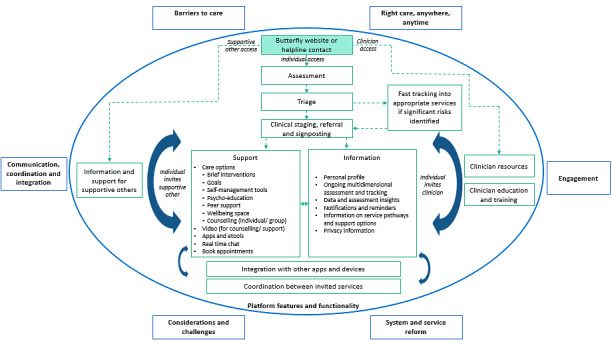
Six participatory design workshops were held, of which 45 participants took part. Participants highlighted that there is a critical need to address some of the barriers to care, particularly in regional and rural areas. The workshops highlighted seven overarching qualitative themes: identified barriers to care within the current system; need for people to be able to access the right care anywhere, anytime; recommendations for the technological solution (ie, InnoWell Platform features and functionality); need for communication, coordination, and integration of a technological solution embedded in Butterfly's National Helpline; need to consider engagement and tone within the technological solution; identified challenges and areas to consider when implementing a technological solution in the Helpline; and potential outcomes of the technological solution embedded in the Helpline relating to system and service reform. Ultimately, this technology solution should ensure that the right care is provided to individuals the first time.

CONCLUSIONS

Our findings highlight the value of actively engaging stakeholders in participatory design processes for the customization and configuration of new technologies. End users can highlight the critical areas of need, which can be used as a catalyst for reform through the implementation of these technologies in nontraditional services.
https://cdn.ncbi.nlm.nih.gov/pmc/blobs/3015/7925150/c53c9ea5b115/jmir_v23i2e19532_fig6.jpg
https://cdn.ncbi.nlm.nih.gov/pmc/blobs/3015/7925150/9dfb60d1f08d/jmir_v23i2e19532_fig1.jpg
https://cdn.ncbi.nlm.nih.gov/pmc/blobs/3015/7925150/2d88b936ad32/jmir_v23i2e19532_fig2.jpg
https://cdn.ncbi.nlm.nih.gov/pmc/blobs/3015/7925150/675598d5191a/jmir_v23i2e19532_fig3.jpg
https://cdn.ncbi.nlm.nih.gov/pmc/blobs/3015/7925150/49a20b968c88/jmir_v23i2e19532_fig4.jpg
https://cdn.ncbi.nlm.nih.gov/pmc/blobs/3015/7925150/7768b1a3230b/jmir_v23i2e19532_fig5.jpg
https://cdn.ncbi.nlm.nih.gov/pmc/blobs/3015/7925150/c53c9ea5b115/jmir_v23i2e19532_fig6.jpg
https://cdn.ncbi.nlm.nih.gov/pmc/blobs/3015/7925150/9dfb60d1f08d/jmir_v23i2e19532_fig1.jpg
https://cdn.ncbi.nlm.nih.gov/pmc/blobs/3015/7925150/2d88b936ad32/jmir_v23i2e19532_fig2.jpg
https://cdn.ncbi.nlm.nih.gov/pmc/blobs/3015/7925150/675598d5191a/jmir_v23i2e19532_fig3.jpg
https://cdn.ncbi.nlm.nih.gov/pmc/blobs/3015/7925150/49a20b968c88/jmir_v23i2e19532_fig4.jpg
https://cdn.ncbi.nlm.nih.gov/pmc/blobs/3015/7925150/7768b1a3230b/jmir_v23i2e19532_fig5.jpg
https://cdn.ncbi.nlm.nih.gov/pmc/blobs/3015/7925150/c53c9ea5b115/jmir_v23i2e19532_fig6.jpg
摘要

背景

最近的澳大利亚国家饮食失调议程强调了技术在通过基于网络的预防、早期介入途径、自助和康复援助来提高可及性和服务发展方面可以发挥的作用。然而,通过参与式设计过程来共同设计、构建和评估这些急需的技术解决方案,与饮食失调社区的参与度一直很低,而且直到最近,资源也很匮乏。

目的

本研究旨在通过参与式设计过程,为非传统(基于网络、电话、电子邮件)心理健康服务定制和配置一种技术解决方案,为饮食失调和身体形象问题提供支持。

方法

参与者主要通过蝴蝶全国热线 1800 ED HOPE(Butterfly's National Helpline)招募,这是一个澳大利亚范围内的热线,为任何关注饮食失调或身体形象问题的人提供支持。参与者包括有饮食失调和身体形象问题经历的个人,他们的支持人员(如家人、卫生专业人员、支持人员),以及蝴蝶基金会的工作人员。参与者参加了长达四个小时的参与式设计研讨会,这些研讨会在城市和地区地点举行。研讨会的议程遵循了一个既定的发现、评估和原型制作过程。研讨会的活动包括公开和提示性讨论、审查工作原型、创建描述性工件以及开发用户旅程。研讨会的工件用于知识转化过程,以确定关键的学习成果,为用户旅程、用户角色和 InnoWell 平台为蝴蝶全国热线的定制和配置提供信息。此外,还使用主题技术识别了关键主题,并在 NVivo 12 软件中进行了编码。

结果

共举办了六次参与式设计研讨会,其中 45 人参加。参与者强调,解决当前系统中一些护理障碍至关重要,特别是在农村和偏远地区。研讨会突出了七个总体定性主题:当前系统中存在的护理障碍;人们随时随地获得正确护理的需求;对技术解决方案的建议(即 InnoWell 平台的功能和功能);将技术解决方案嵌入蝴蝶全国热线所需的沟通、协调和整合;考虑技术解决方案中的参与度和语气;在热线中实施技术解决方案时需要考虑的挑战和领域;以及嵌入热线的技术解决方案在系统和服务改革方面的潜在结果。最终,这个技术解决方案应该确保第一次就能为个人提供正确的护理。

结论

我们的研究结果强调了积极让利益相关者参与参与式设计过程,为新技术的定制和配置提供了价值。最终用户可以突出关键需求领域,这可以作为通过在非传统服务中实施这些技术来推动改革的催化剂。

相似文献

1
Technology-Enabled Reform in a Nontraditional Mental Health Service for Eating Disorders: Participatory Design Study.技术支持的非传统进食障碍精神健康服务改革:参与式设计研究。
J Med Internet Res. 2021 Feb 16;23(2):e19532. doi: 10.2196/19532.
2
Technology-Enabled Solutions for Australian Mental Health Services Reform: Impact Evaluation.澳大利亚心理健康服务改革的技术支持解决方案:影响评估。
JMIR Form Res. 2020 Nov 19;4(11):e18759. doi: 10.2196/18759.
3
Technology-Enabled Mental Health Service Reform for Open Arms - Veterans and Families Counselling: Participatory Design Study.为“张开双臂——退伍军人及家属咨询服务”开展的心理健康服务技术改革:参与式设计研究
JMIR Form Res. 2019 Sep 19;3(3):e13662. doi: 10.2196/13662.
4
Informing the Future of Integrated Digital and Clinical Mental Health Care: Synthesis of the Outcomes From Project Synergy.为综合数字与临床心理健康护理的未来提供信息:协同项目成果综述
JMIR Ment Health. 2022 Mar 9;9(3):e33060. doi: 10.2196/33060.
5
Understanding Technology Preferences and Requirements for Health Information Technologies Designed to Improve and Maintain the Mental Health and Well-Being of Older Adults: Participatory Design Study.了解旨在改善和维持老年人心理健康与幸福感的健康信息技术的技术偏好和需求:参与式设计研究
JMIR Aging. 2021 Jan 6;4(1):e21461. doi: 10.2196/21461.
6
Using Participatory Design Methodologies to Co-Design and Culturally Adapt the Spanish Version of the Mental Health eClinic: Qualitative Study.运用参与式设计方法共同设计心理健康电子诊所的西班牙语版本并进行文化调适:定性研究。
J Med Internet Res. 2019 Aug 2;21(8):e14127. doi: 10.2196/14127.
7
Optimising the integration of technology-enabled solutions to enhance primary mental health care: a service mapping study.优化技术支持解决方案的整合,以加强初级心理健康保健:一项服务映射研究。
BMC Health Serv Res. 2021 Jan 15;21(1):68. doi: 10.1186/s12913-021-06069-0.
8
Involving End Users in Adapting a Spanish Version of a Web-Based Mental Health Clinic for Young People in Colombia: Exploratory Study Using Participatory Design Methodologies.让终端用户参与改编面向哥伦比亚年轻人的西班牙语版网络心理健康诊所:使用参与式设计方法的探索性研究
JMIR Ment Health. 2020 Feb 8;7(2):e15914. doi: 10.2196/15914.
9
Co-designing the InnoWell Platform to deliver the right mental health care first time to regional youth.共同设计 InnoWell 平台,以首次为地区青年提供正确的心理健康护理。
Aust J Rural Health. 2020 Apr;28(2):190-194. doi: 10.1111/ajr.12617. Epub 2020 Apr 12.
10
Technology-Enabled Person-Centered Mental Health Services Reform: Strategy for Implementation Science.以技术为支撑的以人为本的心理健康服务改革:实施科学策略
JMIR Ment Health. 2019 Sep 19;6(9):e14719. doi: 10.2196/14719.

引用本文的文献

1
Mixed methods systematic review of consumer engagement in rural health practice, research, and education.农村医疗卫生实践、研究与教育中消费者参与情况的混合方法系统评价。
Health Promot Int. 2025 Jul 1;40(4). doi: 10.1093/heapro/daaf140.
2
Key Components of Participatory Design Workshops for Digital Health Solutions: Nominal Group Technique and Feasibility Study.数字健康解决方案参与式设计研讨会的关键组成部分:名义群体技术与可行性研究。
J Healthc Inform Res. 2025 May 14;9(3):359-379. doi: 10.1007/s41666-025-00199-4. eCollection 2025 Sep.
3
Service models in eating disorders: a scoping review.

本文引用的文献

1
Technology-Enabled Solutions for Australian Mental Health Services Reform: Impact Evaluation.澳大利亚心理健康服务改革的技术支持解决方案:影响评估。
JMIR Form Res. 2020 Nov 19;4(11):e18759. doi: 10.2196/18759.
2
Co-designing the InnoWell Platform to deliver the right mental health care first time to regional youth.共同设计 InnoWell 平台,以首次为地区青年提供正确的心理健康护理。
Aust J Rural Health. 2020 Apr;28(2):190-194. doi: 10.1111/ajr.12617. Epub 2020 Apr 12.
3
Involving End Users in Adapting a Spanish Version of a Web-Based Mental Health Clinic for Young People in Colombia: Exploratory Study Using Participatory Design Methodologies.
饮食失调的服务模式:一项范围综述。
J Eat Disord. 2025 May 19;13(1):85. doi: 10.1186/s40337-025-01252-8.
4
The use of personas to involve consumers in healthcare co-design: a scoping review.运用人物角色让消费者参与医疗保健协同设计:一项范围综述
BMC Health Serv Res. 2025 May 6;25(1):649. doi: 10.1186/s12913-025-12786-7.
5
Developing Digital Mental Health Tools With Culturally Diverse Parents and Young People: Qualitative User-Centered Design Study.与文化背景多样的父母和年轻人共同开发数字心理健康工具:以用户为中心的定性设计研究。
JMIR Pediatr Parent. 2025 Apr 22;8:e65163. doi: 10.2196/65163.
6
Peer Perspectives on Challenges Encountered During a Multi-Site Digital Mental Health Intervention Project.多中心数字心理健康干预项目中遇到的挑战的同行观点
Adm Policy Ment Health. 2025 Apr 19. doi: 10.1007/s10488-025-01441-2.
7
A Framework for the Human-Centered Design of Service Processes Enabled by Medical Devices: A Case Study of Wearable Devices for Parkinson's Disease.医疗器械支持的以人为中心的服务流程设计框架:以帕金森病可穿戴设备为例。
Int J Environ Res Public Health. 2024 Oct 16;21(10):1367. doi: 10.3390/ijerph21101367.
8
Co-Production of a Flexibly Delivered Relapse Prevention Tool to Support the Self-Management of Long-Term Mental Health Conditions: Co-Design and User Testing Study.共同制作一个灵活交付的复发预防工具,以支持长期心理健康状况的自我管理:共同设计与用户测试研究。
JMIR Form Res. 2024 Feb 23;8:e49110. doi: 10.2196/49110.
9
The Involvement of Service Users and People With Lived Experience in Mental Health Care Innovation Through Design: Systematic Review.通过设计让服务使用者和有亲身经历者参与精神卫生保健创新:系统评价
JMIR Ment Health. 2023 Jul 25;10:e46590. doi: 10.2196/46590.
10
Using Digital Technologies to Facilitate Care Coordination Between Youth Mental Health Services: A Guide for Implementation.利用数字技术促进青少年心理健康服务之间的护理协调:实施指南
Front Health Serv. 2021 Nov 18;1:745456. doi: 10.3389/frhs.2021.745456. eCollection 2021.
让终端用户参与改编面向哥伦比亚年轻人的西班牙语版网络心理健康诊所:使用参与式设计方法的探索性研究
JMIR Ment Health. 2020 Feb 8;7(2):e15914. doi: 10.2196/15914.
4
Project Synergy: co-designing technology-enabled solutions for Australian mental health services reform.项目协同:为澳大利亚精神卫生服务改革共同设计技术赋能的解决方案。
Med J Aust. 2019 Oct;211 Suppl 7:S3-S39. doi: 10.5694/mja2.50349.
5
Technology-Enabled Mental Health Service Reform for Open Arms - Veterans and Families Counselling: Participatory Design Study.为“张开双臂——退伍军人及家属咨询服务”开展的心理健康服务技术改革:参与式设计研究
JMIR Form Res. 2019 Sep 19;3(3):e13662. doi: 10.2196/13662.
6
Validation of the InnoWell Platform: Protocol for a Clinical Trial.InnoWell平台的验证:一项临床试验方案
JMIR Res Protoc. 2019 May 31;8(5):e13955. doi: 10.2196/13955.
7
Early Psychosis Service User Views on Digital Technology: Qualitative Analysis.早期精神病服务使用者对数字技术的看法:定性分析
JMIR Ment Health. 2018 Oct 31;5(4):e10091. doi: 10.2196/10091.
8
Developing a Mental Health eClinic to Improve Access to and Quality of Mental Health Care for Young People: Using Participatory Design as Research Methodologies.开发心理健康电子诊所以改善年轻人获得心理健康护理的机会和护理质量:采用参与式设计作为研究方法
J Med Internet Res. 2018 May 28;20(5):e188. doi: 10.2196/jmir.9716.
9
Youth Codesign of a Mobile Phone App to Facilitate Self-Monitoring and Management of Mood Symptoms in Young People With Major Depression, Suicidal Ideation, and Self-Harm.青少年共同设计一款手机应用程序,以促进重度抑郁症、自杀意念和自我伤害的青少年对情绪症状的自我监测和管理。
JMIR Ment Health. 2018 Jan 23;5(1):e9. doi: 10.2196/mental.9041.
10
Transdiagnostic stepped care in mental health.心理健康中的跨诊断阶梯式护理。
Public Health Res Pract. 2017 Apr 27;27(2):2721712. doi: 10.17061/phrp2721712.