Department of Epidemiology and Biostatistics, School of Public Health, Zhejiang University, Hangzhou, 310058, Zhejiang, China.
Putuo District People's Hospital, Zhoushan, 316100, Zhejiang, China.
BMC Cardiovasc Disord. 2021 Feb 16;21(1):97. doi: 10.1186/s12872-021-01905-x.
To investigate the ability of body shape index (ABSI), body roundness index (BRI), waist circumference (WC), body mass index (BMI), waist-to-hip ratio (WHR), waist-to-height ratio (WHtR), and body adiposity index (BAI) for predicting non-adipose cardio-metabolic risk.
A total of 17,360 Chinese subjects aged 18-95 years old who escaped cardiovascular disease (CVD) or diabetes were recruited in the cross-sectional study. Anthropometric and biochemical parameters were assessed. Receiver operating characteristic curve (ROC) and multinomial logistic regression were conducted to examine the association of anthropometric indicators with cardio-metabolic risk factors.
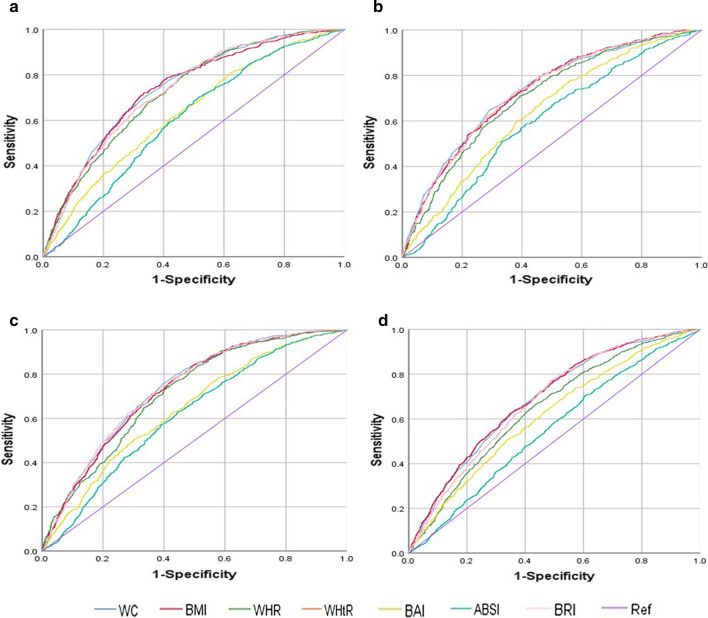
The mean age of subjects were 53.7(13.1) years, 41.6 % were males. The areas under the curve (AUC) demonstrated that WC, BMI, WHR, WHtR and BRI were able to predict high cardio-metabolic risk (AUC > 0.70). Meanwhile, multinomial logistic regression showed BRI was significantly associated with high cardio-metabolic risk (OR 3.27, 95% CI 3.01-3.55). The optimal cut-off values of BRI for high cardio-metabolic risk were (< 60 y: 3.49 vs. ≥60 y: 3.46) in males and (< 60 y: 3.47 vs. ≥60 y: 3.60) in females.
WC, BMI WHR, and WHtR were potential obesity indicators in discriminating high cardio-metabolic risk, while BAI or ABSI was not. Moreover, BRI revealed superior predictive capacity and significant association with accumulated cardio-metabolic risk factors.
研究身体形态指数(ABSI)、体圆度指数(BRI)、腰围(WC)、体重指数(BMI)、腰臀比(WHR)、腰高比(WHtR)和体脂指数(BAI)预测非脂肪性心血管代谢风险的能力。
本横断面研究共纳入 17360 名年龄在 18-95 岁、无心血管疾病(CVD)或糖尿病的中国受试者。评估了人体测量和生化参数。采用受试者工作特征曲线(ROC)和多变量逻辑回归分析评估了各种人体测量指标与心血管代谢危险因素的相关性。
受试者的平均年龄为 53.7(13.1)岁,其中 41.6%为男性。曲线下面积(AUC)表明,WC、BMI、WHR、WHtR 和 BRI 均能预测高心血管代谢风险(AUC>0.70)。同时,多变量逻辑回归显示 BRI 与高心血管代谢风险显著相关(OR 3.27,95%CI 3.01-3.55)。BRI 预测高心血管代谢风险的最佳截断值为男性(<60 岁:3.49 比≥60 岁:3.46)和女性(<60 岁:3.47 比≥60 岁:3.60)。
WC、BMI、WHR 和 WHtR 是区分高心血管代谢风险的潜在肥胖指标,而 BAI 或 ABSI 则不是。此外,BRI 显示出更高的预测能力,并与累积心血管代谢危险因素有显著关联。