L&T Opthalmic Pathology, Vision Research Foundation, Sankara Nethralaya; Centre for Biotechnology, Anna University, Chennai, India.
L&T Opthalmic Pathology, Vision Research Foundation, Sankara Nethralaya, Chennai, India.
Indian J Ophthalmol. 2021 Mar;69(3):647-654. doi: 10.4103/ijo.IJO_470_20.
Age-related macular degeneration (AMD) is one of the leading causes of irreversible central vision loss in the elderly population. The current study aims to find non-invasive prognostic biomarkers in the urine specimens of the AMD patients.
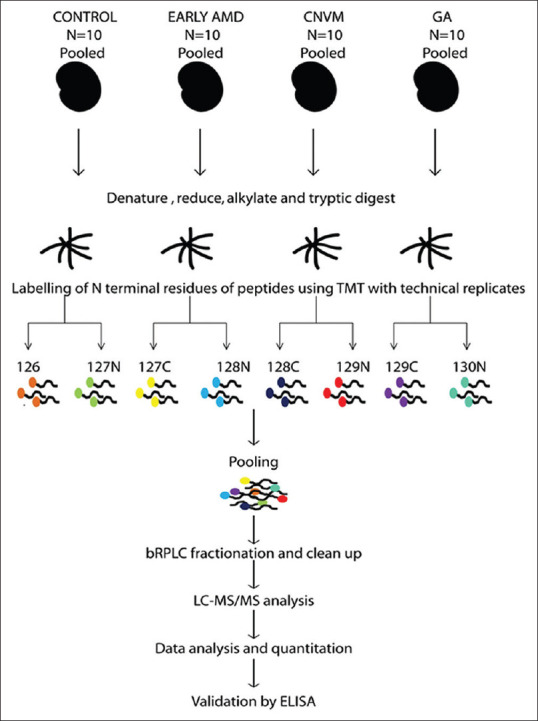
Peripheral blood and urine samples were collected from 23 controls and 61 AMD patients. Genomic DNA was extracted from the buffy coat of peripheral blood. Allele specific PCR was used to assay SNPs in complement factor H (CFH), complement component 3 (C3). Comparative proteomic analysis of urine samples from early AMD, choroidal neovascular membrane (CNVM), geographic atrophy (GA), and healthy controls was performed using isobaric labelling followed by mass spectrometry. Validation was performed using enzyme-linked immunosorbent assay (ELISA).
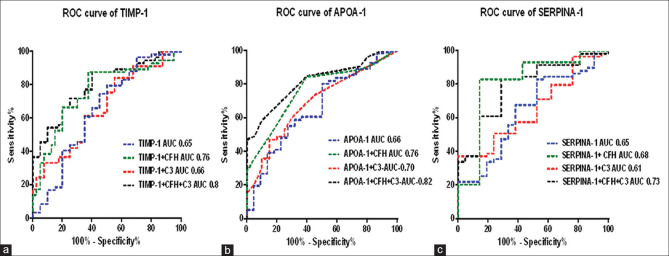
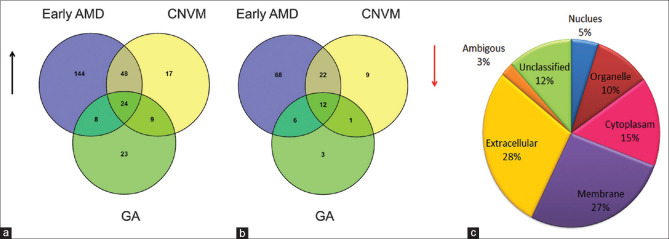
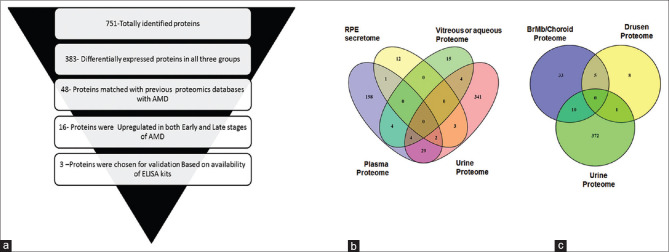
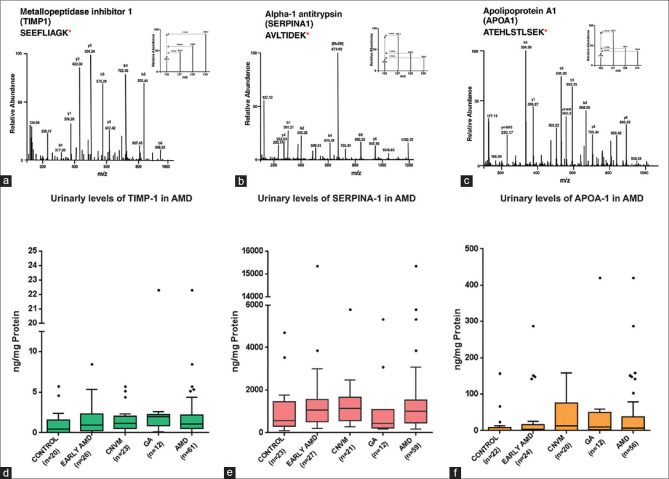
Comparative proteomic analysis of urine samples identified 751 proteins, of which 383 proteins were found to be differentially expressed in various groups of AMD patients. Gene ontology classification of differentially expressed proteins revealed the majority of them were involved in catalytic functions and binding activities. Pathway analysis showed cell adhesion molecule pathways (CAMs), Complement and coagulation cascades, to be significantly deregulated in AMD. Upon validation by ELISA, SERPINA-1 (Alpha1 antitrypsin), TIMP-1 (Tissue inhibitor of matrix metaloprotease-1), APOA-1 (Apolipoprotein A-1) were significantly over-expressed in AMD (n = 61) patients compared to controls (n = 23). A logistic model of APOA-1 in combination with CFH and C3 polymorphisms predicted the risk of developing AMD with 82% accuracy.
This study gives us a preliminary data on non-invasive predictive biomarkers for AMD, which can be further validated in a large cohort and translated for diagnostic use.
年龄相关性黄斑变性(AMD)是老年人中导致不可逆性中心视力丧失的主要原因之一。本研究旨在寻找 AMD 患者尿液标本中的非侵入性预后生物标志物。
收集 23 名对照者和 61 名 AMD 患者的外周血和尿液样本。从外周血白细胞层提取基因组 DNA。采用等位基因特异性 PCR 检测补体因子 H(CFH)、补体成分 3(C3)的 SNP。采用同位素标记相对和绝对定量技术(iTRAQ)联合质谱技术对早期 AMD、脉络膜新生血管膜(CNVM)、地图状萎缩(GA)和健康对照者的尿液样本进行比较蛋白质组学分析。采用酶联免疫吸附试验(ELISA)进行验证。
尿液样本比较蛋白质组学分析鉴定出 751 种蛋白质,其中 383 种蛋白质在不同 AMD 患者组中表达差异。差异表达蛋白的基因本体论分类显示,大多数蛋白参与催化功能和结合活性。通路分析显示,细胞黏附分子途径(CAMs)、补体和凝血级联反应在 AMD 中明显失调。通过 ELISA 验证,SERPINA-1(α1 抗胰蛋白酶)、TIMP-1(基质金属蛋白酶抑制剂 1)、APOA-1(载脂蛋白 A-1)在 AMD(n = 61)患者中明显过表达,与对照组(n = 23)相比。APOA-1 与 CFH 和 C3 多态性的逻辑模型预测 AMD 发病风险的准确率为 82%。
本研究为 AMD 的非侵入性预测生物标志物提供了初步数据,可进一步在大样本队列中验证,并转化为诊断用途。