Aix Marseille Univ, INSERM, INS, Inst Neurosci Syst, Marseille, France.
Assistance Publique - Hôpitaux de Marseille, Hôpital de la Timone, CEMEREM, Pôle d'Imagerie Médicale, CHU, Marseille, France.
PLoS Comput Biol. 2021 Feb 17;17(2):e1008689. doi: 10.1371/journal.pcbi.1008689. eCollection 2021 Feb.
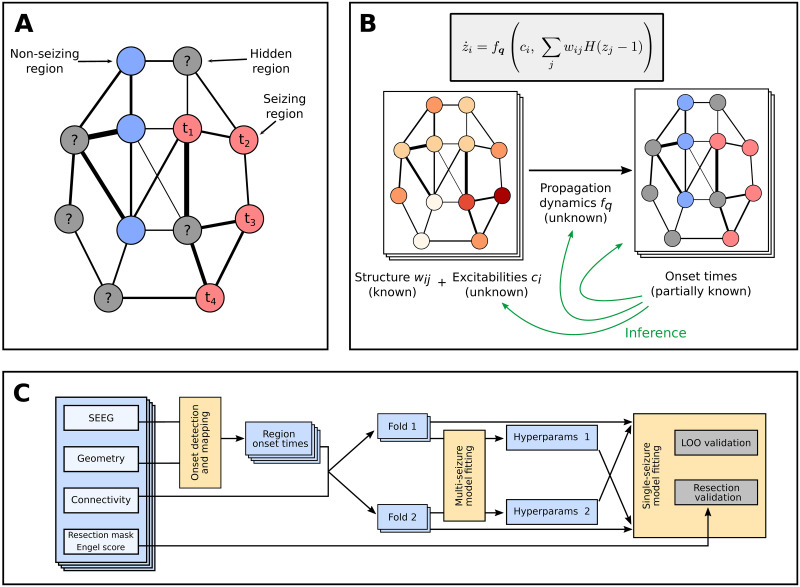
Surgical interventions in epileptic patients aimed at the removal of the epileptogenic zone have success rates at only 60-70%. This failure can be partly attributed to the insufficient spatial sampling by the implanted intracranial electrodes during the clinical evaluation, leading to an incomplete picture of spatio-temporal seizure organization in the regions that are not directly observed. Utilizing the partial observations of the seizure spreading through the brain network, complemented by the assumption that the epileptic seizures spread along the structural connections, we infer if and when are the unobserved regions recruited in the seizure. To this end we introduce a data-driven model of seizure recruitment and propagation across a weighted network, which we invert using the Bayesian inference framework. Using a leave-one-out cross-validation scheme on a cohort of 45 patients we demonstrate that the method can improve the predictions of the states of the unobserved regions compared to an empirical estimate that does not use the structural information, yet it is on the same level as the estimate that takes the structure into account. Furthermore, a comparison with the performed surgical resection and the surgery outcome indicates a link between the inferred excitable regions and the actual epileptogenic zone. The results emphasize the importance of the structural connectome in the large-scale spatio-temporal organization of epileptic seizures and introduce a novel way to integrate the patient-specific connectome and intracranial seizure recordings in a whole-brain computational model of seizure spread.
针对癫痫患者的手术干预旨在切除致痫区,但成功率仅为 60-70%。这种失败部分归因于在临床评估期间植入的颅内电极的空间采样不足,导致在未直接观察到的区域中对时空发作组织的不完全了解。利用通过脑网络传播的发作的部分观察结果,并补充假设癫痫发作沿着结构连接传播,我们推断是否以及何时招募未观察到的区域参与发作。为此,我们引入了一种跨加权网络的发作招募和传播的基于数据的模型,我们使用贝叶斯推断框架对其进行反转。在 45 名患者的队列中使用留一交叉验证方案,我们证明该方法可以提高对未观察区域状态的预测,与不使用结构信息的经验估计相比有所改进,但与考虑结构的估计相当。此外,与实际进行的手术切除和手术结果进行比较表明,推断的兴奋区域与实际的致痫区之间存在联系。结果强调了结构连接组在癫痫发作的大规模时空组织中的重要性,并引入了一种新方法,可以将患者特定的连接组和颅内发作记录整合到发作传播的全脑计算模型中。