Jankelová Nadežda, Joniaková Zuzana, Blštáková Jana, Skorková Zuzana, Procházková Katarína
Department of Management, Faculty of Business Management, University of Economics in Bratislava, Bratislava, Slovakia.
Risk Manag Healthc Policy. 2021 Feb 12;14:561-573. doi: 10.2147/RMHP.S288171. eCollection 2021.
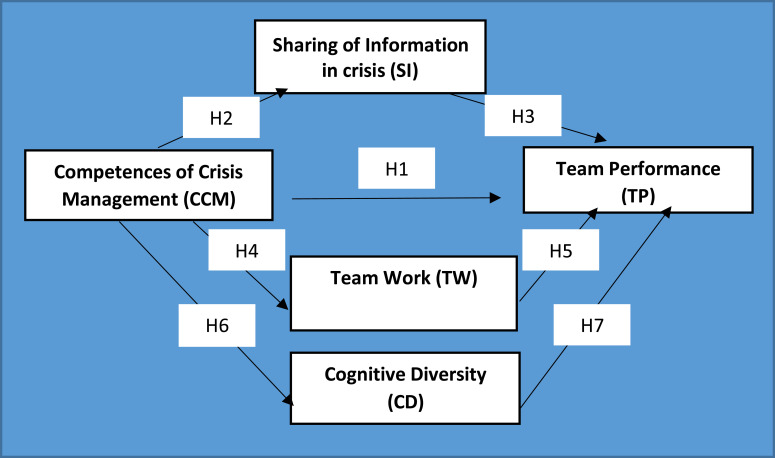
The fast and shocking onset of the crisis caused by the COVID-19 virus created the need for a complete crisis management of healthcare facilities to manage the current stage of the crisis. The purpose of our research is to examine the relations between the competences of crisis management in healthcare facilities and the performance of employees, measured during the acute stage of the crisis by their feeling of satisfaction, safety and creation of conditions for work, whereby we assume that these variables are mutually interlinked by the sharing of information, teamwork and cognitive diversity of the work teams.
A questionnaire survey was created and used based on a sample of 216 mid-level managers of health care facilities in Slovakia, which took place during the first month after the outbreak of the crisis (during the month of March/April 2020). The Baron and Kenny mediator model has been used for research purposes and the Freedman-Schatzkin test has been used to test the mediator effect. Regression analysis has been used to verify the hypotheses. The control variables were the size of the healthcare facility based on the number of employees, gender and age of the manager, his position in the management hierarchy and the duration of practice in a management position. The ANOVA analysis of variance was used to analyze multiple dependencies. The level of significance was 5%. The research sample consisted of 216 managers at different types of healthcare facilities.
The hypothesis for the dependency between the crisis competences of management and performance of teams during the acute stage of the crisis, facilitated by sharing information, teamwork and cognitive diversity of crisis management was confirmed. It is a multilateral incomplete mediation, where almost two thirds of the total effect are facilitated by mediators, of which the sharing of information has the greatest effect (35%).
Based on our mediation model, healthcare facilities, which strive to implement crisis management during the acute stage of the crisis, should place emphasis especially on reliable background information and the fast sharing of information, supporting the performance of healthcare teams. The strategies for achieving these goals should also include education focused on the development of managerial competences.
由新冠病毒引发的危机迅速且令人震惊地爆发,这使得医疗保健机构需要进行全面的危机管理,以应对当前阶段的危机。我们研究的目的是考察医疗保健机构危机管理能力与员工绩效之间的关系,在危机急性期通过员工的满意度、安全感以及工作条件的创造来衡量绩效,我们假设这些变量通过信息共享、团队合作和工作团队的认知多样性相互关联。
基于斯洛伐克216名医疗保健机构中层管理人员的样本创建并使用了问卷调查,调查在危机爆发后的第一个月(2020年3月/4月)进行。研究采用了Baron和Kenny中介模型,并用Freedman-Schatzkin检验来测试中介效应。使用回归分析来验证假设。控制变量包括基于员工数量的医疗保健机构规模、管理人员的性别和年龄、其在管理层级中的职位以及担任管理职位的时长。使用方差分析(ANOVA)来分析多重相关性。显著性水平为5%。研究样本由不同类型医疗保健机构的216名管理人员组成。
关于危机管理能力与危机急性期团队绩效之间的依存关系的假设得到证实,这种关系通过信息共享、团队合作和危机管理的认知多样性来促进。这是一种多边不完全中介,其中近三分之二的总效应由中介因素促成,其中信息共享的影响最大(35%)。
基于我们的中介模型,在危机急性期努力实施危机管理的医疗保健机构应特别强调可靠的背景信息和信息的快速共享,以支持医疗团队的绩效。实现这些目标的策略还应包括专注于管理能力发展的教育。