Zou Junyong, Guo Shijie, Xiong Meng Ting, Xu Yingchun, Shao Jiale, Tong Zhongkai, Zhang Peng, Pan Long, Peng Aimei, Li Xuan
Department of Respiratory Medicine, Shanghai 10th People's Hospital, Tongji University School of Medicine, Shanghai 200072, China.
Department of Respiratory Medicine, Hwamei Hospital, University of Chinese Academy of Sciences, Ningbo 315010, China.
J Cancer. 2021 Jan 15;12(6):1575-1582. doi: 10.7150/jca.49681. eCollection 2021.
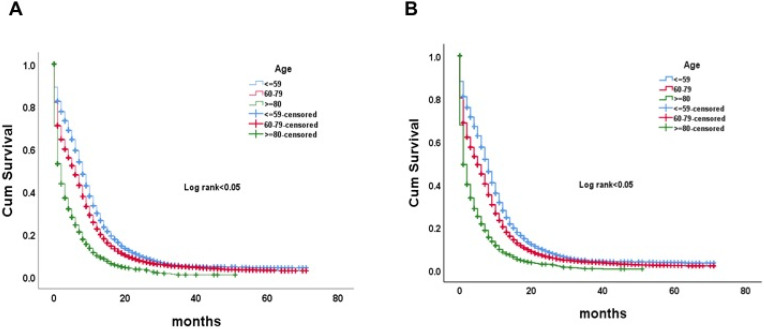
Small cell lung cancer (SCLC) represents about 13% of lung cancer cases, which is highly invasive and has a high mortality rate, with the 5-year overall survival (OS) rate being only 6.3%. Age at diagnosis of advanced SCLC is much older, but studies describing the ageing factor for distant metastasis patterns and prognosis of extensive-stage SCLC (ES-SCLC) are limited. Using the Surveillance, Epidemiology, and End Results (SEER) registry, we identified 18,682 patients with ES-SCLC (9,089 women and 9,053 men) who had complete clinical information between 2008 and 2015. Patients were classified into three groups (older group: ≥80 yrs, middle-aged group: 60-79 yrs, and younger group: ≤59 yrs). The role of different age at diagnosis of ES-SCLC (especially older group) in metastasis patterns was investigated, and OS and cancer-specific survival (CSS) of different age groups of metastatic ES-SCLC was assessed. The most metastasis of ES-SCLC patients in the three groups was multiorgan metastases (MOM) metastasis (71.2%, 70.3% and 66.3%, respectively), the most single organ metastasis in the younger group was the lung (3.3%), the middle-aged group and the older group were the brain (3.5%, 3.1%, respectively). The analysis revealed that older patients were less likely to have MOM, but more likely to have all organs metastases than other two groups (p<0.001). Older group had the worst OS (p<0.001) and CSS (p<0.001). Furthermore, Radiotherapy and chemotherapy can improve survival (p<0.001), but the rate of radiotherapy and chemotherapy in older patients is lower than that in middle-aged and younger patients (50.4% vs 38.6% vs 20.7%, p<0.05). Compared with other two group, older group (odds ratios, ORs) for lung, all organ metastases, and MOM were 0.43 (95% CI 0.27-0.67), 1.77 (95% CI 1.55-2.03), 0.68 (95% CI 0.6-0.77), respectively. The mortality risk is highest with MOM and all organs metastasis followed by brain, lung, bone and liver metastases in elderly ES-SCLC patients. These results will be helpful for pre-treatment evaluation regarding the prognosis of ES-SCLC patients.
小细胞肺癌(SCLC)约占肺癌病例的13%,具有高度侵袭性且死亡率高,5年总生存率仅为6.3%。晚期SCLC的诊断年龄要大得多,但描述广泛期小细胞肺癌(ES-SCLC)远处转移模式和预后的衰老因素的研究有限。利用监测、流行病学和最终结果(SEER)登记处的数据,我们确定了2008年至2015年间有完整临床信息的18682例ES-SCLC患者(9089例女性和9053例男性)。患者被分为三组(老年组:≥80岁,中年组:60-79岁,青年组:≤59岁)。研究了ES-SCLC不同诊断年龄(尤其是老年组)在转移模式中的作用,并评估了转移性ES-SCLC不同年龄组的总生存期(OS)和癌症特异性生存期(CSS)。三组ES-SCLC患者中最常见的转移是多器官转移(MOM)转移(分别为71.2%、70.3%和66.3%),青年组最常见的单器官转移是肺(3.3%),中年组和老年组是脑(分别为3.5%、3.1%)。分析显示,老年患者发生MOM的可能性较小,但与其他两组相比,发生所有器官转移的可能性更大(p<0.001)。老年组的OS(p<0.001)和CSS(p<0.001)最差。此外,放疗和化疗可提高生存率(p<0.001),但老年患者的放疗和化疗率低于中年和青年患者(50.4%对38.6%对20.7%,p<0.05)。与其他两组相比,老年组发生肺转移、所有器官转移和MOM的比值比(OR)分别为0.43(95%CI 0.27-0.67)、1.77(95%CI 1.55-2.03)、0.68(95%CI 0.6-0.77)。在老年ES-SCLC患者中,MOM和所有器官转移的死亡风险最高,其次是脑、肺、骨和肝转移。这些结果将有助于对ES-SCLC患者的预后进行治疗前评估。