Centre for Nature-based Climate Solutions, and Department of Biological Sciences, National University of Singapore, 14 Science Drive 4, Singapore, 117543, Singapore.
School of Biological Sciences, The University of Adelaide, Adelaide, SA, 5005, Australia.
Nat Commun. 2021 Feb 24;12(1):1271. doi: 10.1038/s41467-021-21560-2.
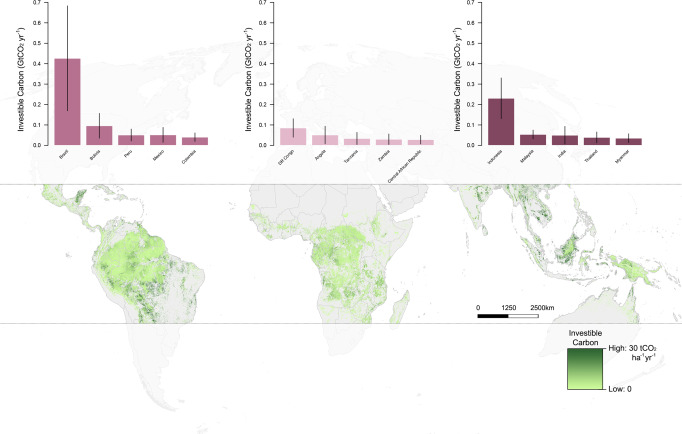
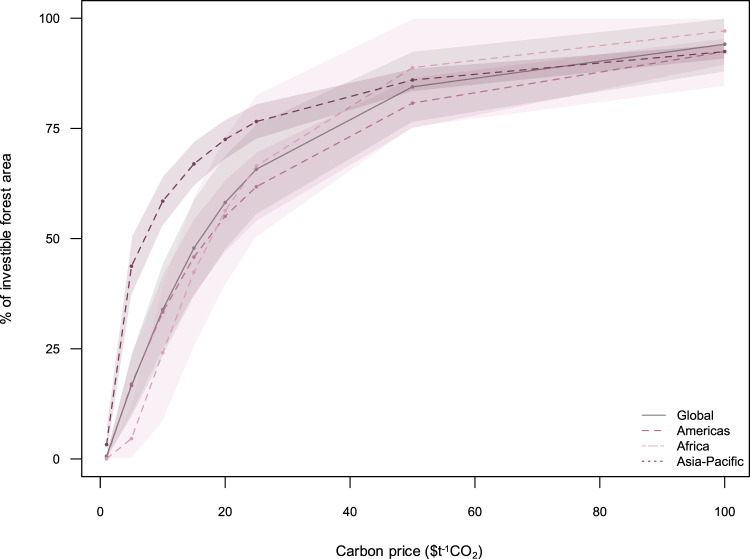
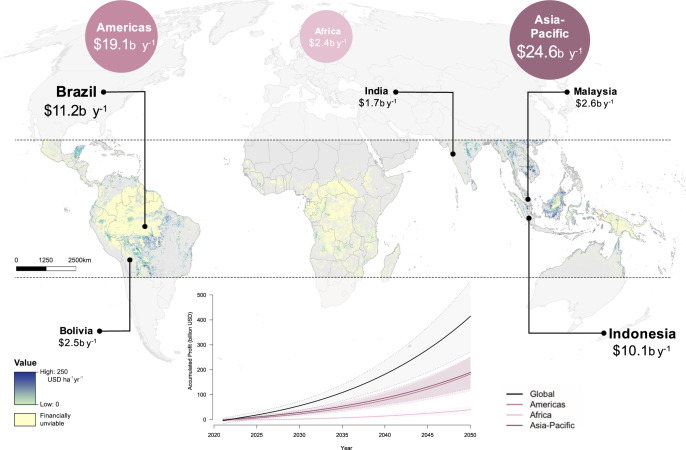
Carbon finance projects that protect tropical forests could support both nature conservation and climate change mitigation goals. Global demand for nature-based carbon credits is outpacing their supply, due partly to gaps in knowledge needed to inform and prioritize investment decisions. Here, we show that at current carbon market prices the protection of tropical forests can generate investible carbon amounting to 1.8 (±1.1) GtCOe yr globally. We further show that financially viable carbon projects could generate return-on-investment amounting to $46.0b y in net present value (Asia-Pacific: $24.6b y; Americas: $19.1b y; Africa: $2.4b y). However, we also find that ~80% (1.24 billion ha) of forest carbon sites would be financially unviable for failing to break even over the project lifetime. From a conservation perspective, unless carbon prices increase in the future, it is imperative to implement other conservation interventions, in addition to carbon finance, to safeguard carbon stocks and biodiversity in vulnerable forests.
碳金融项目可以保护热带雨林,同时实现自然保护和减缓气候变化的目标。由于缺乏投资决策所需的知识,全球对基于自然的碳信用额的需求超过了供应,部分原因是缺乏投资决策所需的知识。在这里,我们表明,按照目前的碳市场价格,保护热带雨林可以产生全球投资级别的碳量为 18 亿吨二氧化碳当量(±1.1)。我们进一步表明,在净现值(亚太地区:246 亿美元;美洲:191 亿美元;非洲:24 亿美元)方面,有盈利潜力的碳项目可以产生 460 亿美元的投资回报。然而,我们还发现,由于在项目生命周期内无法收支平衡,约 80%(12.4 亿公顷)的森林碳汇地在财务上是不可行的。从保护的角度来看,除非未来碳价格上涨,否则除了碳金融之外,还必须实施其他保护干预措施,以保护脆弱森林中的碳储量和生物多样性。