Section of Hygiene, University Department of Life Sciences and Public Health, Università Cattolica del Sacro Cuore, Rome, Italy.
Section of Hygiene, University Department of Life Sciences and Public Health, Università Cattolica del Sacro Cuore, Rome, Italy.
J Psychiatr Res. 2021 Apr;136:319-333. doi: 10.1016/j.jpsychires.2021.02.019. Epub 2021 Feb 13.
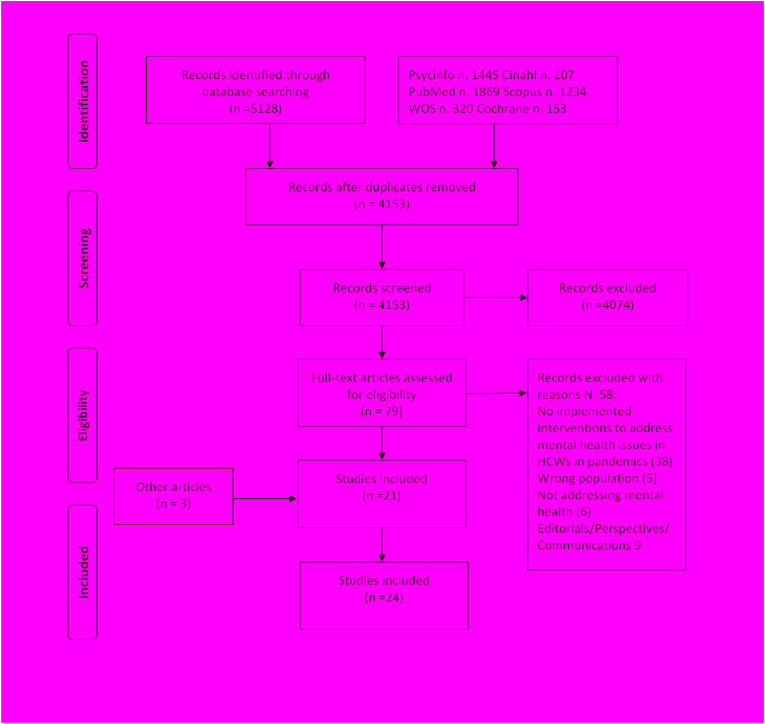
Considering the importance of evidence on interventions to tackle mental health problems in healthcare workers (HCWs) during pandemics, we conducted a systematic review, aiming to identify and summarize the implemented interventions to deal with mental health issues of HCWs during infectious disease outbreaks and report their effectiveness. Web of Science, PubMed, Cochrane, Scopus, CINAHL and PsycInfo electronic databases were searched until October 2nd, 2020. Primary-data articles, describing any implemented interventions and their effectiveness were considered pertinent. Studies were screened according to the inclusion/exclusion criteria and subsequently data extraction was performed. Twenty-four articles, referring to SARS, Ebola, Influenza AH1N1 and COVID-19 were included. Interventions addressing mental health issues in HCWs during pandemics/epidemics were grouped into four categories: 1) informational support (training, guidelines, prevention programs), 2) instrumental support (personal protective equipment, protection protocols); 3) organizational support (manpower allocation, working hours, re-organization of facilities/structures, provision of rest areas); 4) emotional and psychological support (psychoeducation and training, mental health support team, peer-support and counselling, therapy, digital platforms and tele-support). These results might be helpful for researchers, stakeholders, and policymakers to develop evidence-based sustainable interventions and guidelines, aiming to prevent or reduce the immediate and long-term effect of pandemics on mental health status of HCWs.
考虑到在大流行期间针对医护人员(HCWs)心理健康问题的干预措施的证据的重要性,我们进行了一项系统评价,旨在确定和总结在传染病爆发期间针对 HCWs 心理健康问题实施的干预措施,并报告其效果。我们检索了 Web of Science、PubMed、Cochrane、Scopus、CINAHL 和 PsycInfo 电子数据库,检索截至 2020 年 10 月 2 日。符合纳入/排除标准的主要数据文章,描述了任何已实施的干预措施及其有效性,被认为是相关的。根据纳入/排除标准筛选研究,然后进行数据提取。共纳入了 24 篇文章,涉及 SARS、埃博拉、流感 AH1N1 和 COVID-19。在大流行/流行期间针对 HCWs 心理健康问题的干预措施分为四类:1)信息支持(培训、指南、预防计划);2)工具支持(个人防护设备、保护协议);3)组织支持(人力分配、工作时间、设施/结构重新组织、休息区提供);4)情感和心理支持(心理教育和培训、心理健康支持小组、同伴支持和咨询、治疗、数字平台和远程支持)。这些结果可能有助于研究人员、利益相关者和政策制定者制定基于证据的可持续干预措施和指南,旨在预防或减轻大流行对 HCWs 心理健康状况的即时和长期影响。