Department of Psychology, Beijing Anzhen Hospital, Capital Medical University, Beijing, China (mainland).
Peking University Sixth Hospital, Peking University Institute of Mental Health, NHC Key Laboratory of Mental Health (Peking University), National Clinical Research Center for Mental Disorders (Peking University Sixth Hospital), Beijing, China (mainland).
Med Sci Monit. 2021 Feb 28;27:e929710. doi: 10.12659/MSM.929710.
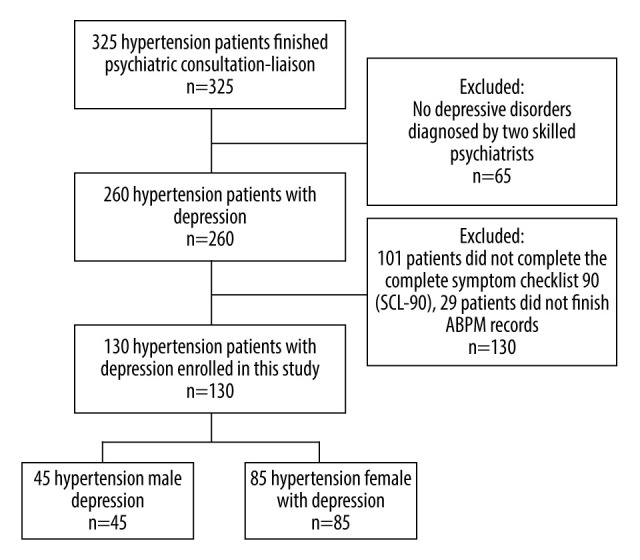
BACKGROUND Hostility in hypertension patients combined with depressive disorders indicates a worse outcome for hypertension management. This study was designed to explore the influence of hostility on 24-h diastolic blood pressure in hypertension patients who also had depressive disorders. MATERIAL AND METHODS A total of 130 people with primary hypertension and depressive disorders were collected through unstructured psychiatric interview by a professional psychiatrist and ambulatory blood pressure monitor in this cross-sectional study. During the study, dynamic blood pressure was examined for 24 h by ambulatory blood pressure monitoring. Patients were divided into 3 groups according to the hostility level. Hostility was defined by hostile factors of the Symptom Checklist 90. The association between hostility and 24-h dynamic blood pressure was analyzed by multivariable logistic regression. RESULTS 30.8% (40 of 130) patients had a high level of 24-h dynamic blood pressure load (>30%), in which 14.6% was for male and 16.2% for female respectively. In male, the proportion of high 24 h DBP load (>30%) in highest hostility group was greater than that of low hostility group and median hostility group significantly (p=0.03). No significant differences were revealed among 3 groups in female. The age-adjusted odds-ratio (OR) 95% confidence interval of diastolic blood pressure across the categories of hostility were: in males, 1.44 (0.60, 3.47) (1 for reference), and in females, 5.86 (0.58, 59.06) (P for trend=0.04). CONCLUSIONS Our results showed that hostility may be a risk factor for increased 24-h diastolic blood pressure in hypertension patients who also have depressive disorders, especially in males. The clinical meaning of the study is that hypertension management should contain psychological interventions for better effects.
高血压患者伴发敌对情绪与抑郁障碍预示着高血压管理的预后更差。本研究旨在探讨敌对情绪对同时患有高血压和抑郁障碍患者 24 小时舒张压的影响。
本横断面研究通过专业精神科医生的非结构化精神科访谈和动态血压监测仪共纳入 130 名原发性高血压合并抑郁障碍患者。在研究期间,通过动态血压监测仪对 24 小时动态血压进行检查。根据敌对情绪水平将患者分为 3 组。敌对情绪由症状清单 90 的敌对因素定义。采用多变量逻辑回归分析敌对情绪与 24 小时动态血压之间的关系。
130 例患者中,30.8%(40/130)的患者 24 小时动态血压负荷(>30%)较高,其中男性为 14.6%,女性为 16.2%。在男性中,最高敌对情绪组的 24 小时 DBP 负荷(>30%)的比例明显大于低敌对情绪组和中敌对情绪组(p=0.03)。在女性中,3 组之间没有明显差异。敌对情绪各分类下的年龄校正舒张压比值比(OR)95%置信区间为:男性为 1.44(0.60,3.47)(1 为参照),女性为 5.86(0.58,59.06)(P 趋势=0.04)。
我们的研究结果表明,敌对情绪可能是高血压合并抑郁障碍患者 24 小时舒张压升高的一个危险因素,尤其是男性。本研究的临床意义在于,高血压管理应包含心理干预,以获得更好的效果。