Yu Duo, Zhu Gen, Wang Xueying, Zhang Chenguang, Soltanalizadeh Babak, Wang Xia, Tang Sanyi, Wu Hulin
Department of Biostatistics and Data Science, The University of Texas Health Science Center at Houston, Houston, USA.
School of Mathematics and Information Science, Shaanxi Normal University, Xi'an, PR China.
Infect Dis Model. 2021;6:461-473. doi: 10.1016/j.idm.2021.02.001. Epub 2021 Feb 23.
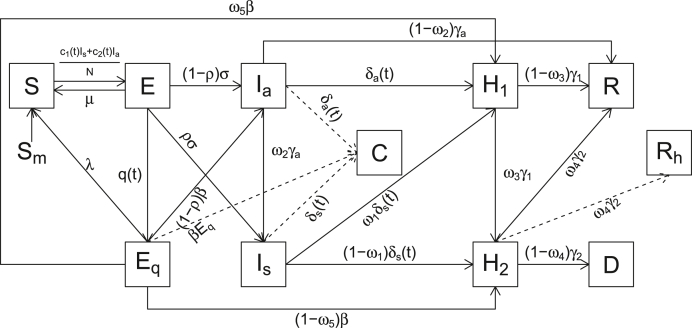
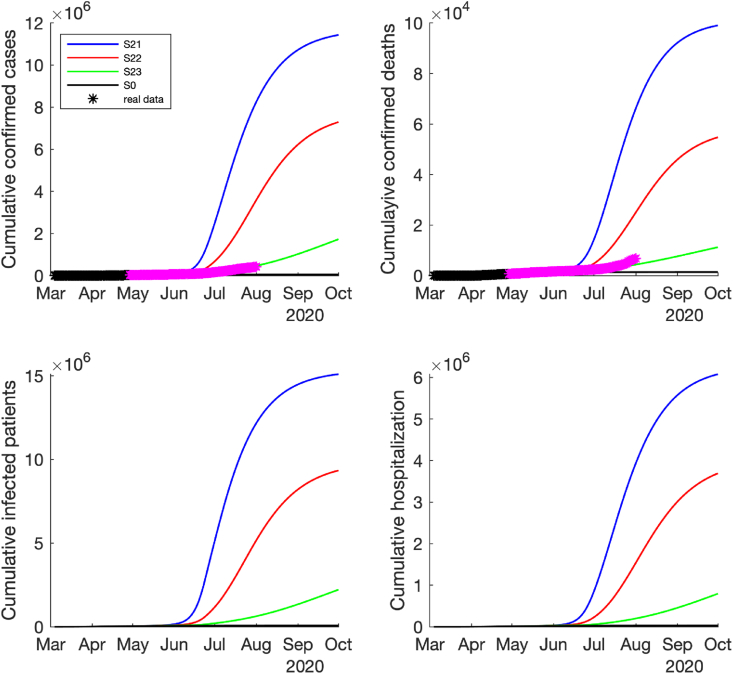
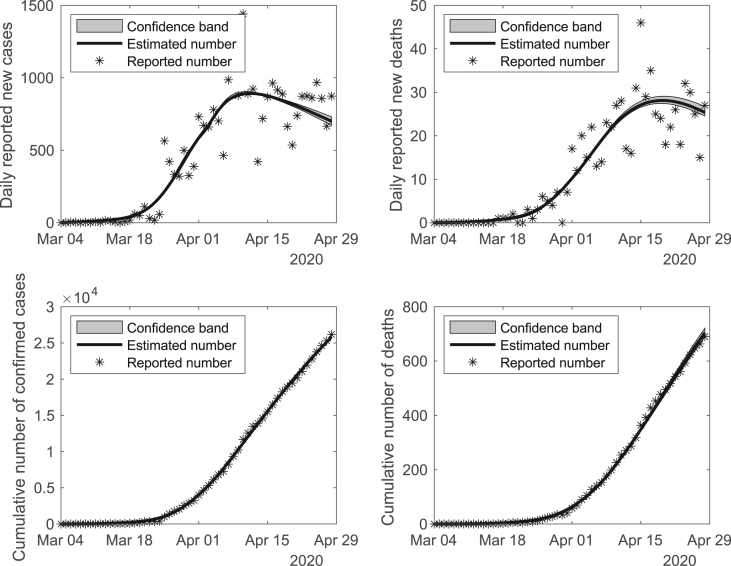
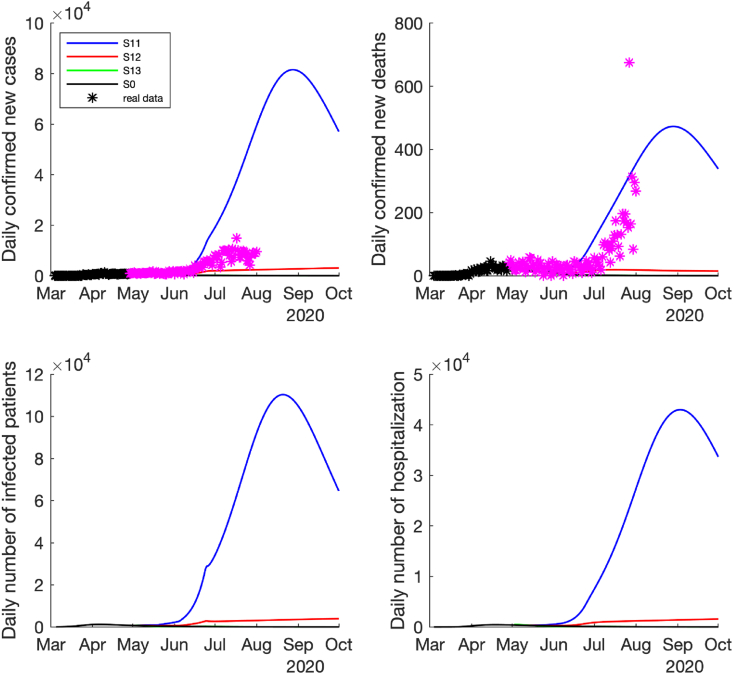
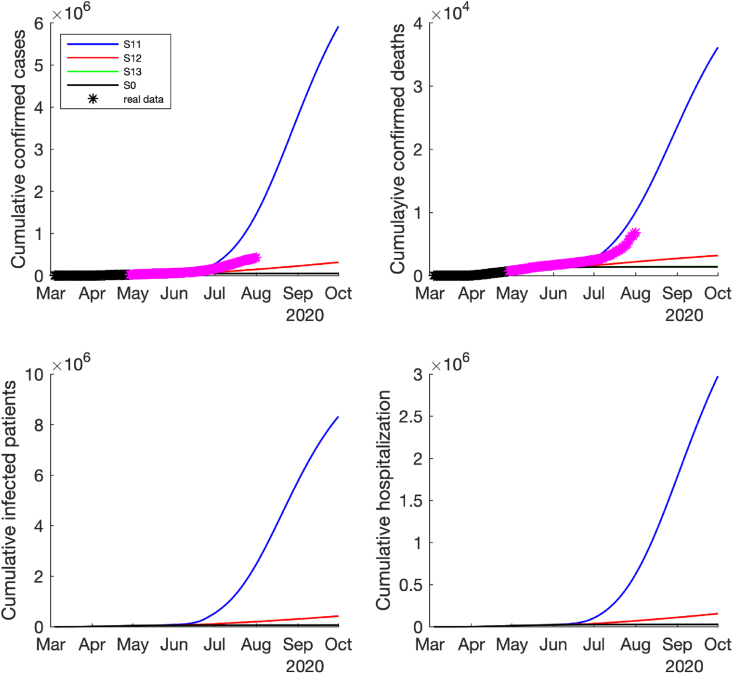
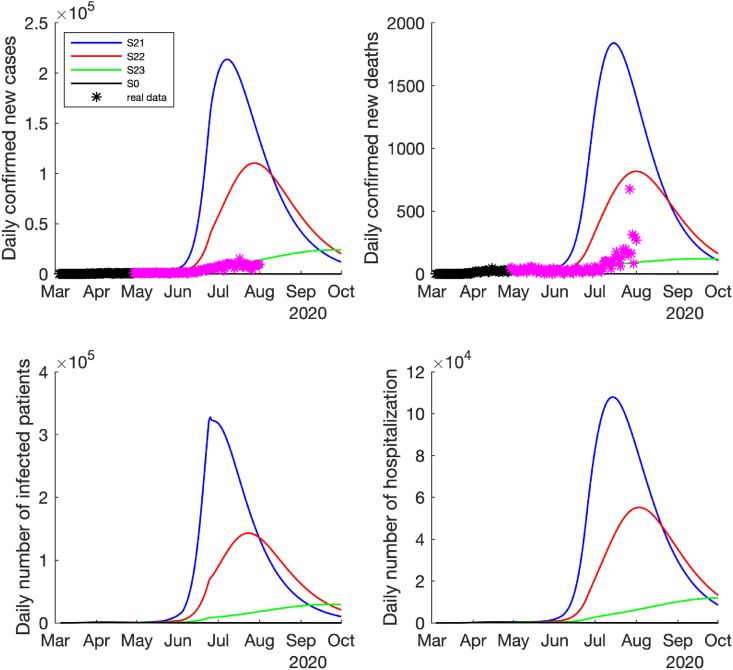
While the Coronavirus Disease 2019 (COVID-19) pandemic continues to threaten public health and safety, every state has strategically reopened the business in the United States. It is urgent to evaluate the effect of reopening policies on the COVID-19 pandemic to help with the decision-making on the control measures and medical resource allocations. In this study, a novel SEIR model was developed to evaluate the effect of reopening policies based on the real-world reported COVID-19 data in Texas. The earlier reported data before the reopening were used to develop the SEIR model; data after the reopening were used for evaluation. The simulation results show that if continuing the "stay-at-home order" without reopening the business, the COVID-19 pandemic could end in December 2020 in Texas. On the other hand, the pandemic could be controlled similarly as the case of no-reopening only if the contact rate was low and additional high magnitude of control measures could be implemented. If the control measures are only slightly enhanced after reopening, it could flatten the curve of the COVID-19 epidemic with reduced numbers of infections and deaths, but it might make the epidemic last longer. Based on the reported data up to July 2020 in Texas, the real-world epidemic pattern is between the cases of the low and high magnitude of control measures with a medium risk of contact rate after reopening. In this case, the pandemic might last until summer 2021 to February 2022 with a total of 4-10 million infected cases and 20,080-58,604 deaths.
在2019冠状病毒病(COVID-19)大流行持续威胁公众健康和安全的情况下,美国每个州都已战略性地重新开放了商业活动。评估重新开放政策对COVID-19大流行的影响,以协助制定控制措施和医疗资源分配的决策,迫在眉睫。在本研究中,基于德克萨斯州实际报告的COVID-19数据,开发了一种新型的SEIR模型来评估重新开放政策的影响。重新开放之前较早报告的数据用于开发SEIR模型;重新开放之后的数据用于评估。模拟结果表明,如果继续实施“居家令”而不重新开放商业活动,COVID-19大流行可能于2020年12月在德克萨斯州结束。另一方面,只有在接触率较低且能够实施额外高强度控制措施的情况下,大流行才能得到与不重新开放类似的控制。如果重新开放后仅略微加强控制措施,可能会使COVID-19疫情曲线变平,感染和死亡人数减少,但可能会使疫情持续更长时间。根据德克萨斯州截至2020年7月的报告数据,实际的疫情模式介于控制措施强度低和高的情况之间,重新开放后接触率处于中等风险。在这种情况下,大流行可能会持续到2021年夏季至2022年2月,感染病例总数为400万至1000万,死亡人数为20080至58604人。