Foroozan-Boroojeni Shaghayegh, Tavalaee Marziyeh, Zakeri Zahra, Lockshin Richard A, Nasr-Esfahani Mohammad Hossein
Department of Animal Biotechnology, Reproductive Biomedicine Research Center, Royan Institute for Biotechnology, ACECR, Isfahan, Iran.
Department of Biology, Queens College and Graduate Center of The City University of New York, Flushing, NY, USA.
Cell J. 2021 Apr;23(1):70-74. doi: 10.22074/cellj.2021.7023. Epub 2021 Mar 1.
Assessment of relationship between LC3II/LC3 and Autophagy-related 7 (Atg7) proteins, as markers of autophagy, as well as evaluating the sperm parameters and DNA fragmentation in spermatozoa of infertile men with globozoospermia.
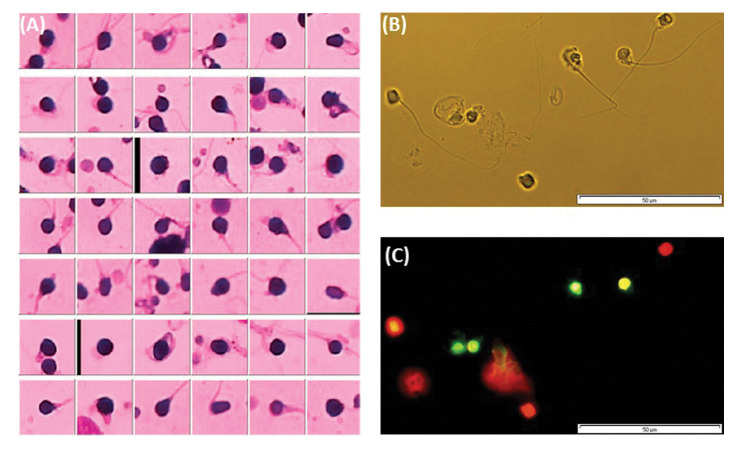
In this case-control study, 10 semen samples from infertile men with globozoospermia and 10 fertile individuals were collected, and the sperm parameters, sperm DNA fragmentation, and main autophagy markers (Atg7 and LC3II/LC3) were assessed according to World Health Organization (WHO) criteria, TUNEL assay, and western blot technique, respectively.
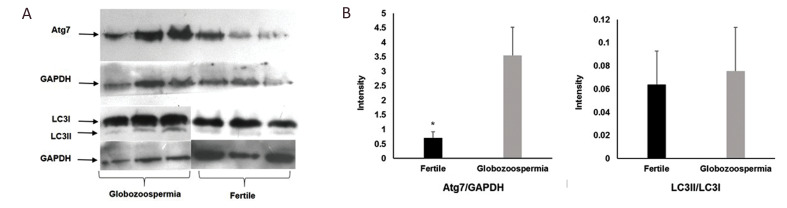
The mean of sperm concentration and motility were significantly lower, while the percentage of abnormal spermatozoa and DNA fragmentation were significantly higher in infertile men with globozoospermia compared to fertile individuals (P<0.01). Unlike the relative expression of LC3II/LC3 that did not significantly differ between the two groups, the relative expression of ATG7 was significantly higher in infertile men with globozoospermia compared to fertile individuals (P <0.05). There was a significantly negative correlation between the sperm concentration (r=-0.679; P=0.005) and motility (r=-0.64; P=0.01) with the expression of ATG7, while a significantly positive association was founf between the percentage of DNA fragmentation and expression of ATG7 (0.841; P =0.018).
The increased expression of ATG7 and unaltered expression of LC3II/LC3 may indicate that the autophagy pathway is initiated but not completely executed in spermatozoa of individuals with globozoospermia. A significant correlation of ATG7 expression with increased sperm DNA fragmentation, reduced sperm concentration, and sperm motility may associate with the activation of a compensatory mechanism for promoting deficient spermatozoa to undergo cell death by the autophagy pathway. Therfore, this pathway could act as a double-edged sword that, at the physiological level, is involved in acrosome biogenesis, while, at the pathological level, such as globozoospermia, could act as a compensatory mechanism.
评估作为自噬标志物的LC3II/LC3与自噬相关蛋白7(Atg7)之间的关系,并评估圆头精子症不育男性精子的参数及DNA碎片化情况。
在这项病例对照研究中,收集了10例圆头精子症不育男性的精液样本和10例生育力正常个体的精液样本,分别根据世界卫生组织(WHO)标准、TUNEL检测法和蛋白质印迹技术评估精子参数、精子DNA碎片化及主要自噬标志物(Atg7和LC3II/LC3)。
与生育力正常个体相比,圆头精子症不育男性的精子浓度和活力平均值显著降低,而异常精子百分比和DNA碎片化程度显著升高(P<0.01)。与两组间LC3II/LC3相对表达无显著差异不同,圆头精子症不育男性的ATG7相对表达显著高于生育力正常个体(P<0.05)。精子浓度(r=-0.679;P=0.005)和活力(r=-0.64;P=0.01)与ATG7表达呈显著负相关,而DNA碎片化百分比与ATG7表达呈显著正相关(r=0.841;P=0.018)。
ATG7表达增加而LC3II/LC3表达未改变可能表明,在圆头精子症个体的精子中自噬途径已启动但未完全执行。ATG7表达与精子DNA碎片化增加、精子浓度降低及精子活力降低显著相关,这可能与激活一种补偿机制有关,该机制通过自噬途径促使缺陷精子发生细胞死亡。因此,该途径可能是一把双刃剑,在生理水平上参与顶体生物发生,而在病理水平上,如圆头精子症,可能作为一种补偿机制。