Strahler Jana, Wachten Hanna, Mueller-Alcazar Anett
1Psychotherapy and Systems Neuroscience, Justus-Liebig-University Giessen, Giessen, Germany.
2Department of Psychology, Faculty of Human Sciences, Medical School Hamburg, Hamburg, Germany.
J Behav Addict. 2021 Feb 25;10(3):456-70. doi: 10.1556/2006.2021.00004.
Orthorexia Nervosa (ON) and exercise addiction (ExAdd) are two phenomena believed to overlap. We conducted a meta-analysis exploring the link between ON and (addictive) exercise behaviors.
A systematic review of major databases and gray literature was carried out for studies reporting on ON and (addictive) exercise behaviors. Random effects meta-analyses were undertaken calculating correlations between ON and (addictive) exercise behaviors. A sub-group analysis investigated gender differences.
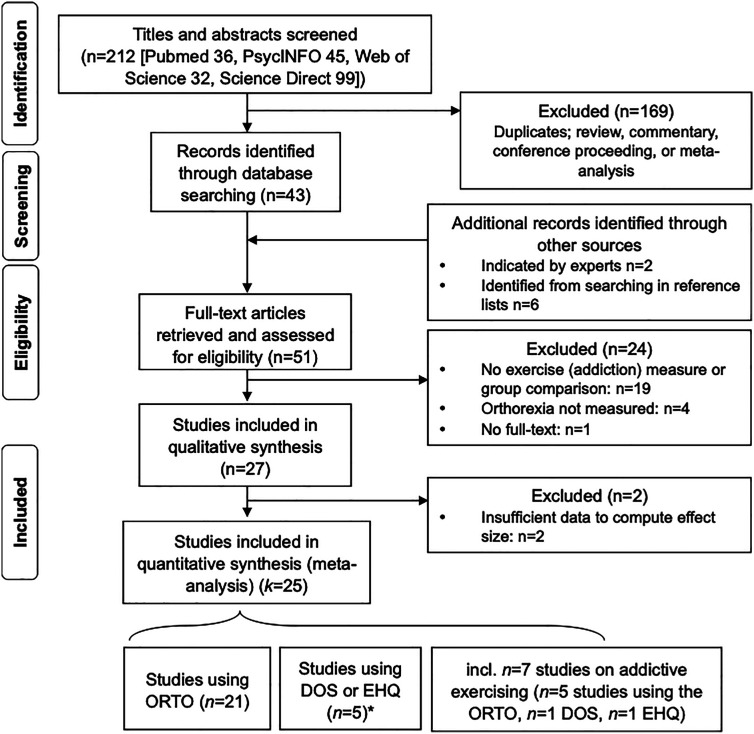
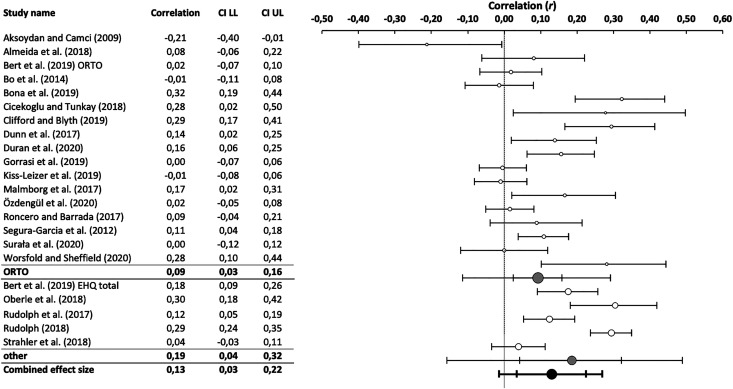
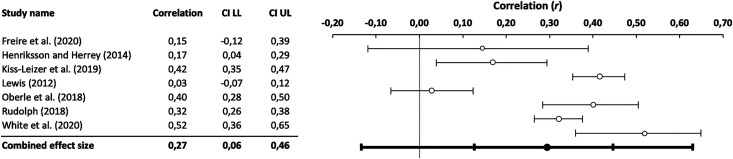
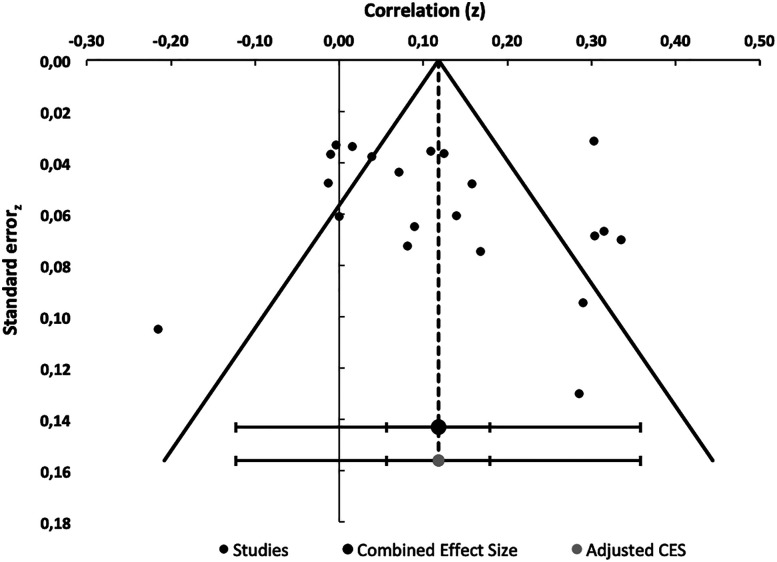
Twenty-five studies with 10,134 participants (mean age = 25.21; 56.4% female) were included. Analyses showed a small overall correlation between ON and exercise (21 studies, r = 0.12, 95% CI |0.06-0.18|) and a medium overall correlation between ON and ExAdd (7 studies, r = 0.29, 95% CI |0.13-0.45|). Gender differences were negligible.
Orthorexic eating correlated slightly and moderately with exercise and ExAdd, respectively, expressing some unique and shared variance of these behaviors. While this does not suggest ON and addictive exercising to be independent, it does not indicate substantial comorbidity. Future research should focus on clinical relevance, underlying mechanisms, vulnerability, and risk factors.
正食癖(ON)和运动成瘾(ExAdd)是两种被认为相互重叠的现象。我们进行了一项荟萃分析,以探索正食癖与(成瘾性)运动行为之间的联系。
对主要数据库和灰色文献进行系统回顾,以查找报告正食癖与(成瘾性)运动行为的研究。进行随机效应荟萃分析,计算正食癖与(成瘾性)运动行为之间的相关性。亚组分析调查了性别差异。
纳入了25项研究,共10134名参与者(平均年龄=25.21岁;56.4%为女性)。分析显示,正食癖与运动之间总体相关性较小(21项研究,r=0.12,95%CI|0.06 - 0.18|),正食癖与运动成瘾之间总体相关性中等(7项研究,r=0.29,95%CI|0.13 - 0.45|)。性别差异可忽略不计。
正食癖饮食分别与运动和运动成瘾存在轻微和中等程度的相关性,表明这些行为存在一些独特的和共同的变异。虽然这并不表明正食癖和成瘾性运动是独立的,但也不表明存在大量共病情况。未来的研究应关注临床相关性、潜在机制、易感性和危险因素。