BGI-Shenzhen, Shenzhen, China.
China National Genebank, Shenzhen, China.
Aging Cell. 2021 Mar;20(3):e13323. doi: 10.1111/acel.13323. Epub 2021 Mar 3.
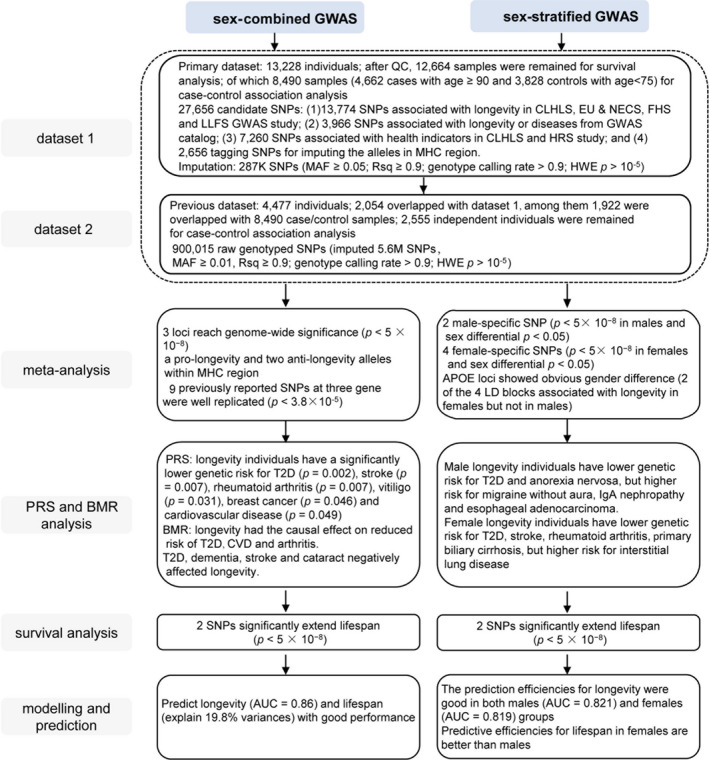
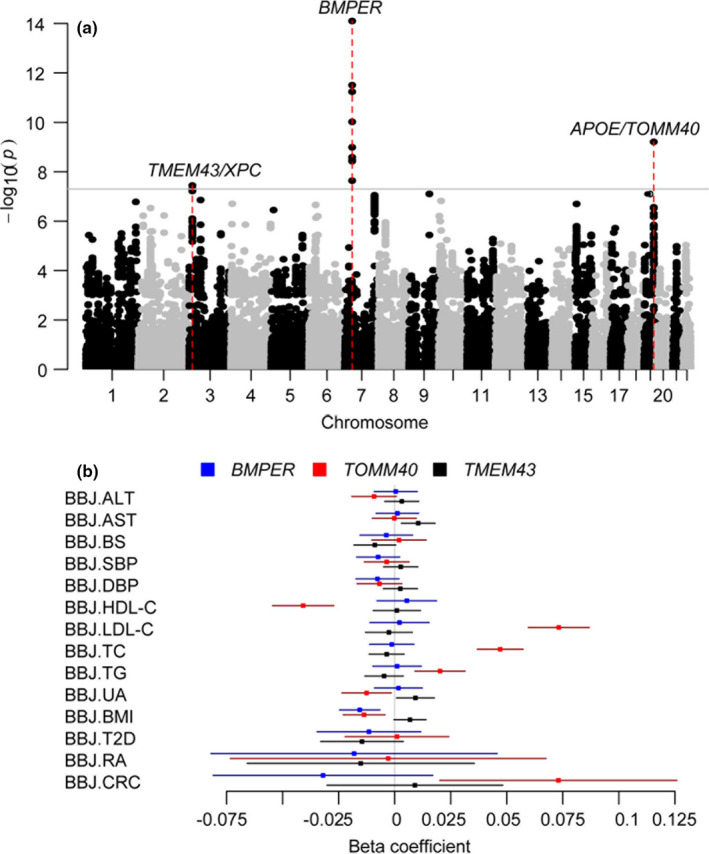
There is growing interest in studying the genetic contributions to longevity, but limited relevant genes have been identified. In this study, we performed a genetic association study of longevity in a total of 15,651 Chinese individuals. Novel longevity loci, BMPER (rs17169634; p = 7.91 × 10 ) and TMEM43/XPC (rs1043943; p = 3.59 × 10 ), were identified in a case-control analysis of 11,045 individuals. BRAF (rs1267601; p = 8.33 × 10 ) and BMPER (rs17169634; p = 1.45 × 10 ) were significantly associated with life expectancy in 12,664 individuals who had survival status records. Additional sex-stratified analyses identified sex-specific longevity genes. Notably, sex-differential associations were identified in two linkage disequilibrium blocks in the TOMM40/APOE region, indicating potential differences during meiosis between males and females. Moreover, polygenic risk scores and Mendelian randomization analyses revealed that longevity was genetically causally correlated with reduced risks of multiple diseases, such as type 2 diabetes, cardiovascular diseases, and arthritis. Finally, we incorporated genetic markers, disease status, and lifestyles to classify longevity or not-longevity groups and predict life span. Our predictive models showed good performance (AUC = 0.86 for longevity classification and explained 19.8% variance of life span) and presented a greater predictive efficiency in females than in males. Taken together, our findings not only shed light on the genetic contributions to longevity but also elucidate correlations between diseases and longevity.
人们对研究遗传因素对长寿的贡献越来越感兴趣,但已确定的相关基因有限。在这项研究中,我们对总共 15651 名中国个体进行了长寿的遗传关联研究。在对 11045 名个体的病例对照分析中,鉴定出了新的长寿基因座 BMPER(rs17169634;p=7.91×10)和 TMEM43/XPC(rs1043943;p=3.59×10)。在对有生存状态记录的 12664 名个体进行分析时,发现 BRAF(rs1267601;p=8.33×10)和 BMPER(rs17169634;p=1.45×10)与预期寿命显著相关。进一步的性别分层分析鉴定出了性别特异性的长寿基因。值得注意的是,在 TOMM40/APOE 区域的两个连锁不平衡块中鉴定出了性别差异的关联,这表明在减数分裂过程中男性和女性之间存在潜在的差异。此外,多基因风险评分和孟德尔随机化分析表明,长寿与多种疾病(如 2 型糖尿病、心血管疾病和关节炎)的风险降低存在遗传因果关系。最后,我们将遗传标记、疾病状况和生活方式纳入分类长寿或非长寿组并预测寿命的模型中。我们的预测模型表现出良好的性能(长寿分类的 AUC=0.86,解释了寿命 19.8%的方差),并且在女性中的预测效率高于男性。总之,我们的研究结果不仅揭示了遗传因素对长寿的贡献,还阐明了疾病与长寿之间的相关性。