Department of International Business, Chien Hsin University of Science and Technology, Taoyuan, Taiwan.
Department of Administration and Insurance Management, Cheng Ching General Hospital and Cheng Ching Medical Care System, Taichung, Taiwan.
Front Public Health. 2021 Feb 15;9:587439. doi: 10.3389/fpubh.2021.587439. eCollection 2021.
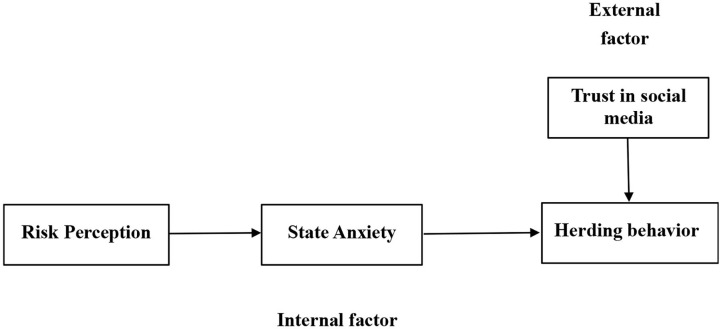
People have felt afraid during the outbreak of coronavirus disease 2019 (COVID-19), because a virus is an invisible enemy. During the pandemic outbreak, society has become worried about the spread of infections and the shortage of protective equipment. This common fear among the public subsequently deepens each person's fear, increasing their belief in the content reported by the media and thus actively compelling these individuals to engage in the behavior of panic buying. In this study, we explored the effects of the public's risk perception, state anxiety, and trust in social media on the herding effect among individuals. The study was based on an online questionnaire survey and convenience sampling. The results showed that the public's risk perception increased their state anxiety and then deepened their willingness to wait in line for a purchase. In addition, the more people that trust the message delivered by the media, the more actively they will join the queue to buy goods. This study also found that anxiety had a greater impact on the public's willingness to wait for a purchase than trust in social media. Therefore, the top priority for the government should be to reduce the public's state anxiety and then reduce the herding effect.
人们在 2019 冠状病毒病(COVID-19)爆发期间感到恐惧,因为病毒是无形的敌人。在大流行期间,社会对感染的传播和防护设备的短缺感到担忧。公众普遍存在的这种恐惧随后加深了每个人的恐惧,增加了他们对媒体报道内容的信任,从而积极迫使这些个人采取恐慌性购买的行为。在这项研究中,我们探讨了公众的风险感知、状态焦虑和对社交媒体的信任对从众效应的影响。该研究基于在线问卷调查和便利抽样。结果表明,公众的风险感知增加了他们的状态焦虑,从而加深了他们排队购买的意愿。此外,越多人信任媒体传递的信息,他们就越积极地加入购买商品的队列。本研究还发现,焦虑对公众购买意愿的影响大于对社交媒体的信任。因此,政府的首要任务应该是降低公众的状态焦虑,然后降低从众效应。