Université de Lorraine, CNRS, IMoPA (UMR7365), F54000 Nancy, France.
Université de Lorraine, CNRS, INSERM, IBSLor (UMS2008/US40), Epitranscriptomics and RNA Sequencing Core Facility, F54000 Nancy, France.
Genes (Basel). 2021 Feb 16;12(2):278. doi: 10.3390/genes12020278.
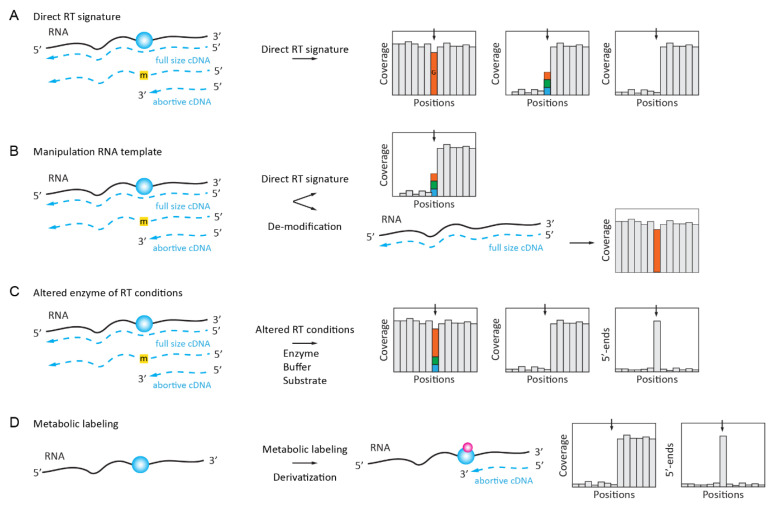
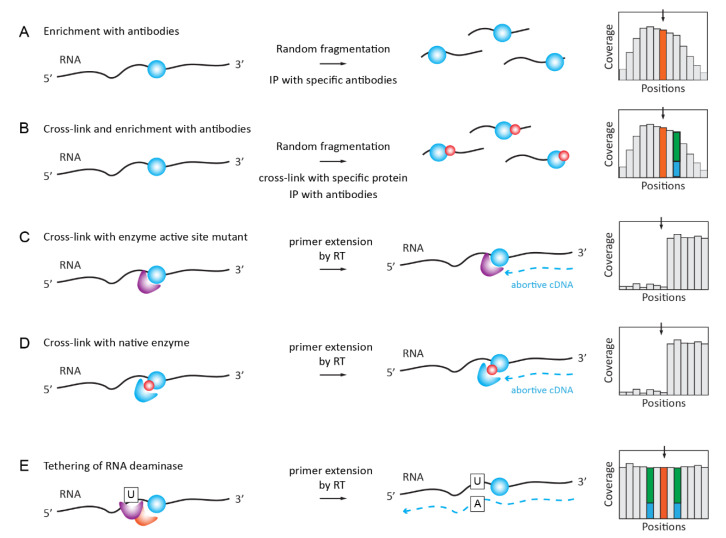
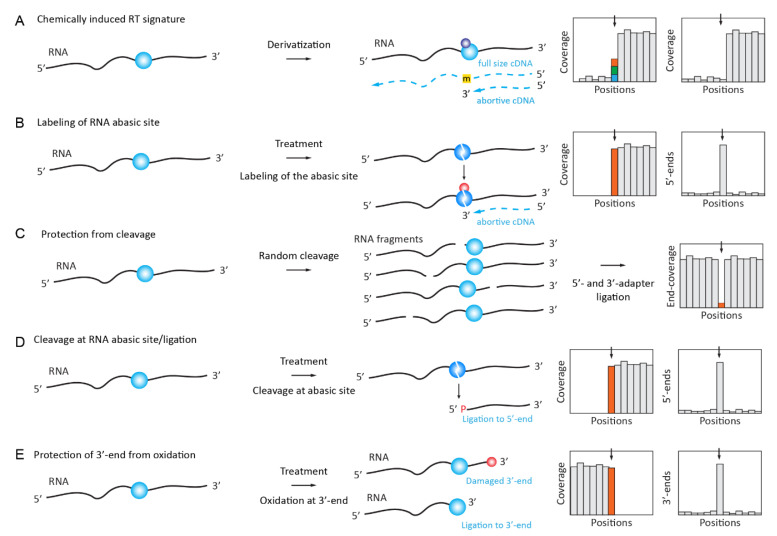
The precise mapping and quantification of the numerous RNA modifications that are present in tRNAs, rRNAs, ncRNAs/miRNAs, and mRNAs remain a major challenge and a top priority of the epitranscriptomics field. After the keystone discoveries of massive mA methylation in mRNAs, dozens of deep sequencing-based methods and protocols were proposed for the analysis of various RNA modifications, allowing us to considerably extend the list of detectable modified residues. Many of the currently used methods rely on the particular reverse transcription signatures left by RNA modifications in cDNA; these signatures may be naturally present or induced by an appropriate enzymatic or chemical treatment. The newest approaches also include labeling at RNA abasic sites that result from the selective removal of RNA modification or the enhanced cleavage of the RNA ribose-phosphate chain (perhaps also protection from cleavage), followed by specific adapter ligation. Classical affinity/immunoprecipitation-based protocols use either antibodies against modified RNA bases or proteins/enzymes, recognizing RNA modifications. In this survey, we review the most recent achievements in this highly dynamic field, including promising attempts to map RNA modifications by the direct single-molecule sequencing of RNA by nanopores.
精确绘制和定量 tRNA、rRNA、ncRNA/miRNA 和 mRNA 中存在的大量 RNA 修饰仍然是表观转录组学领域的主要挑战和首要任务。在 mRNAs 中发现大量 mA 甲基化这一关键发现之后,提出了数十种基于深度测序的方法和方案来分析各种 RNA 修饰,这使得我们能够大大扩展可检测修饰残基的列表。目前使用的许多方法都依赖于 RNA 修饰在 cDNA 中留下的特殊逆转录特征;这些特征可能是自然存在的,也可能是由适当的酶或化学处理诱导的。最新的方法还包括对 RNA 脱碱基位点进行标记,这些位点是由 RNA 修饰的选择性去除或 RNA 核糖-磷酸链的增强切割(也许还能防止切割)引起的,然后进行特定的接头连接。基于经典亲和/免疫沉淀的方案使用针对修饰 RNA 碱基的抗体或识别 RNA 修饰的蛋白质/酶。在本综述中,我们回顾了这一高度动态领域的最新成果,包括通过纳米孔直接对 RNA 进行单分子测序来绘制 RNA 修饰图谱的有前途的尝试。