Biosensors and Bioanalytical Technology for Cells and Innovative Testing Device Research Unit, Chulalongkorn University, Bangkok 10330, Thailand.
Department of Biomedical Science, Faculty of Health and Society, Malmö University, SE-205 06 Malmö, Sweden.
Sensors (Basel). 2021 Feb 28;21(5):1659. doi: 10.3390/s21051659.
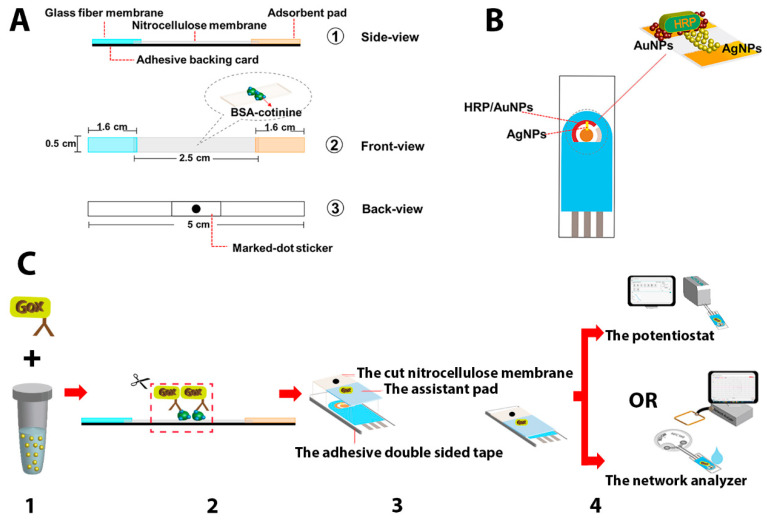
This paper proposes a combined strategy of using paper-based competitive immunochromatography and a near field communication (NFC) tag for wireless cotinine determination. The glucose oxidase labeled cotinine antibody specifically binds free cotinine in a sample, whereas the unoccupied antibody attached to BSA-cotinine at the test line on a lateral flow strip. The glucose oxidase on the strip and an assistant pad in the presence of glucose generated HO and imposed the Ag oxidation on the modified electrode. This enabled monitoring of immunoreaction by either electrochemical measurement or wireless detection. Wireless sensing was realized for cotinine in the range of 100-1000 ng/mL (R = 0.96) in PBS medium. Undiluted urine samples from non-smokers exhibited an Ag-oxidation rate three times higher than the smoker's urine samples. For 1:8 diluted urine samples (smokers), the proposed paper-based competitive immunochromatography coupled with an enzyme-modified electrode differentiated positive and negative samples and exhibited cotinine discrimination at levels higher than 12 ng/mL. This novel sensing platform can potentially be combined with a smartphone as a reader unit.
本研究提出了一种结合纸质竞争免疫层析和近场通信(NFC)标签的策略,用于无线烟碱检测。葡萄糖氧化酶标记的烟碱抗体特异性结合样品中的游离烟碱,而未占据的抗体则与 BSA-烟碱结合在侧流条的测试线上。在存在葡萄糖的情况下,条带上的葡萄糖氧化酶和辅助垫会产生 HO,并对修饰电极施加 Ag 氧化。这使得可以通过电化学测量或无线检测来监测免疫反应。在 PBS 介质中,无线感应可实现 100-1000ng/mL 范围内的烟碱检测(R = 0.96)。未稀释的非吸烟者尿液样本的 Ag 氧化速率比吸烟者尿液样本高三倍。对于 1:8 稀释的尿液样本(吸烟者),所提出的基于纸张的竞争性免疫层析与酶修饰电极相结合,可以区分阳性和阴性样本,并在高于 12ng/mL 的水平上显示出烟碱的区分能力。这种新型传感平台可以与智能手机结合作为读取单元。