Pathogens & Inflammation/EPILAB Laboratory, EA 4266, Université de Franche-Comté, Université Bourgogne Franche-Comté (UBFC), 25030 Besançon, France.
Lebanese University, P.O. Box 6573/14 Badaro Museum, Beirut, Lebanon.
Viruses. 2021 Feb 23;13(2):354. doi: 10.3390/v13020354.
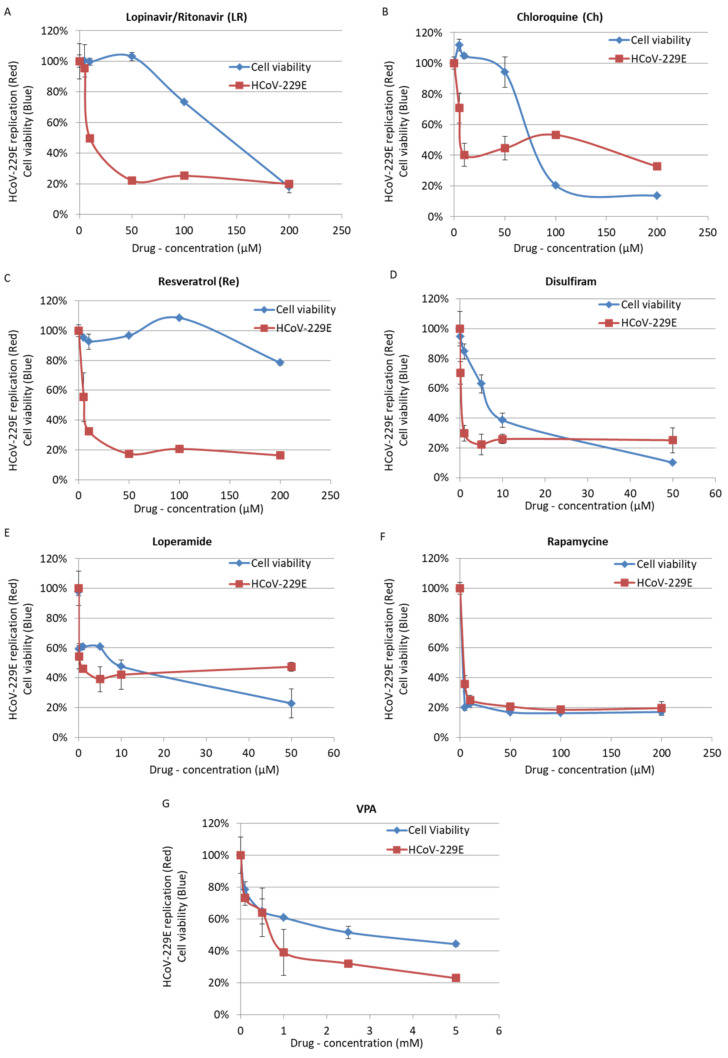
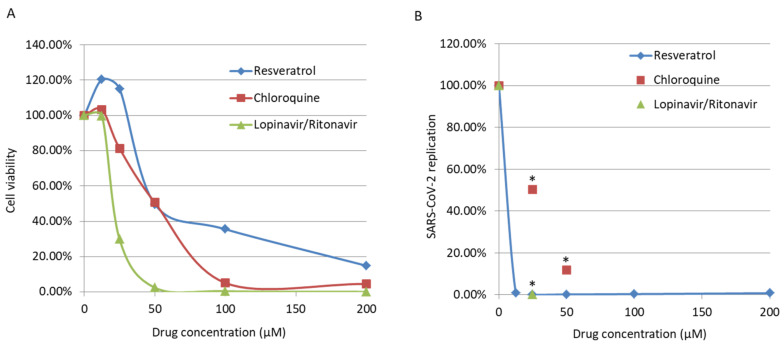
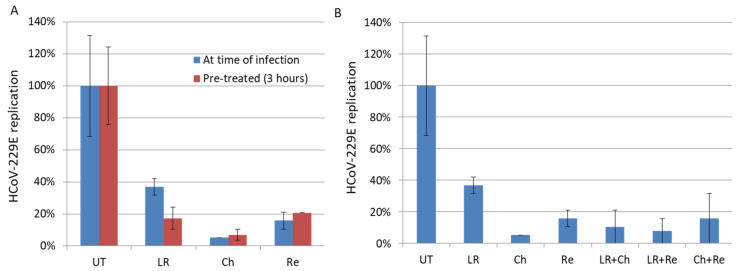
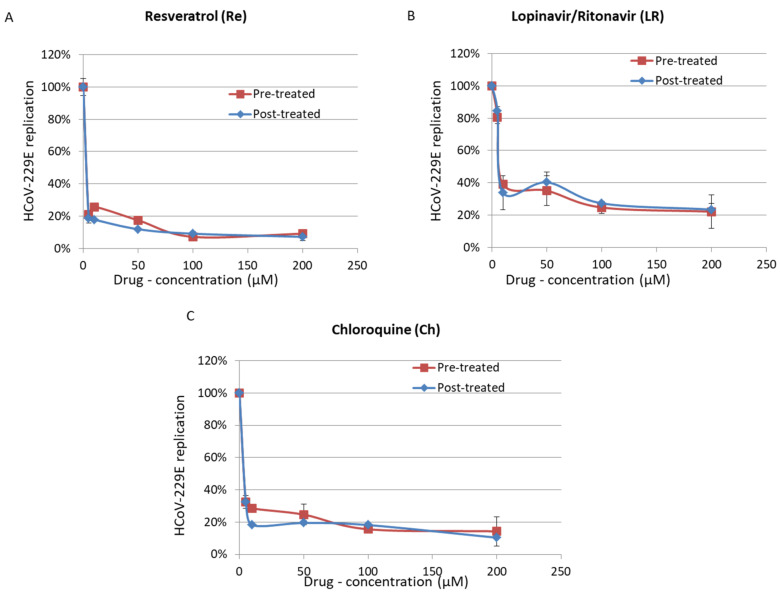
A novel coronavirus, severe acute respiratory syndrome coronavirus 2 (SARS-CoV-2), emerged in China at the end of 2019 causing a large global outbreak. As treatments are of the utmost importance, drug repurposing embodies a rich and rapid drug discovery landscape, where candidate drug compounds could be identified and optimized. To this end, we tested seven compounds for their ability to reduce replication of human coronavirus (HCoV)-229E, another member of the coronavirus family. Among these seven drugs tested, four of them, namely rapamycin, disulfiram, loperamide and valproic acid, were highly cytotoxic and did not warrant further testing. In contrast, we observed a reduction of the viral titer by 80% with resveratrol (50% effective concentration (EC50) = 4.6 µM) and lopinavir/ritonavir (EC50 = 8.8 µM) and by 60% with chloroquine (EC50 = 5 µM) with very limited cytotoxicity. Among these three drugs, resveratrol was less cytotoxic (cytotoxic concentration 50 (CC50) = 210 µM) than lopinavir/ritonavir (CC50 = 102 µM) and chloroquine (CC50 = 67 µM). Thus, among the seven drugs tested against HCoV-229E, resveratrol demonstrated the optimal antiviral response with low cytotoxicity with a selectivity index (SI) of 45.65. Similarly, among the three drugs with an anti-HCoV-229E activity, namely lopinavir/ritonavir, chloroquine and resveratrol, only the latter showed a reduction of the viral titer on SARS-CoV-2 with reduced cytotoxicity. This opens the door to further evaluation to fight Covid-19.
一种新型冠状病毒,严重急性呼吸系统综合症冠状病毒 2(SARS-CoV-2),于 2019 年底在中国出现,引发了全球大爆发。由于治疗方法至关重要,药物重定位体现了丰富而快速的药物发现领域,候选药物化合物可以在此被识别和优化。为此,我们测试了七种化合物抑制人冠状病毒(HCoV)-229E 复制的能力,HCoV-229E 是冠状病毒家族的另一个成员。在这七种测试的药物中,有四种,即雷帕霉素、双硫仑、洛哌丁胺和丙戊酸,具有高度细胞毒性,不值得进一步测试。相比之下,我们观察到白藜芦醇(50%有效浓度(EC50)=4.6µM)和洛匹那韦/利托那韦(EC50=8.8µM)使病毒滴度降低 80%,氯喹(EC50=5µM)使病毒滴度降低 60%,而细胞毒性非常有限。在这三种药物中,白藜芦醇的细胞毒性(细胞毒性浓度 50(CC50)=210µM)低于洛匹那韦/利托那韦(CC50=102µM)和氯喹(CC50=67µM)。因此,在七种针对 HCoV-229E 的测试药物中,白藜芦醇表现出最佳的抗病毒反应,同时具有低细胞毒性,选择性指数(SI)为 45.65。同样,在具有抗 HCoV-229E 活性的三种药物中,即洛匹那韦/利托那韦、氯喹和白藜芦醇中,只有后者显示出降低 SARS-CoV-2 病毒滴度的作用,同时具有降低的细胞毒性。这为进一步评估抗击新冠病毒提供了可能。