Sjögren Forss Katarina, Kottorp Anders, Rämgård Margareta
Department of Care Science, Malmö University Faculty of Health and Society, 205 06, Malmö, Sweden.
Arch Public Health. 2021 Mar 6;79(1):27. doi: 10.1186/s13690-021-00544-0.
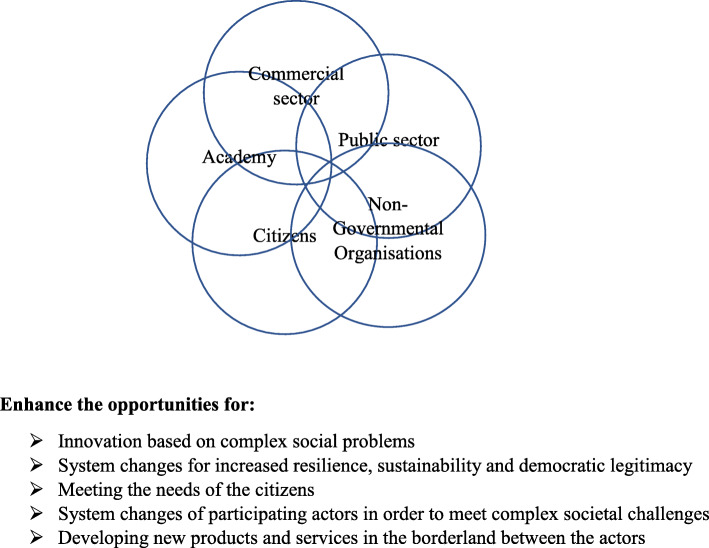
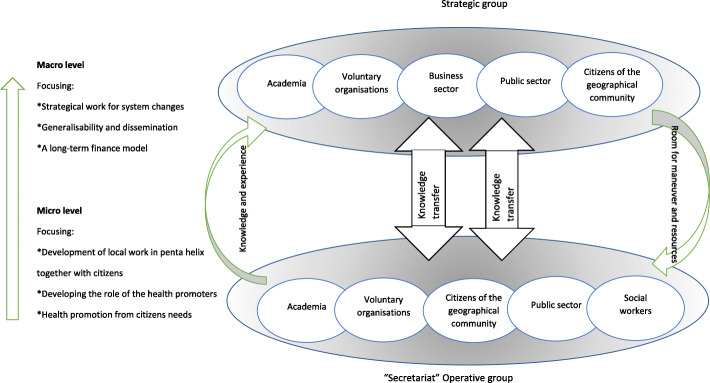
In the light of the existence of social inequalities in health, a CBPR (Community Based Participatory Research) programme for health promotion started in Malmö, Sweden, in 2017. The programme was based on a penta-helix structure and involved a strategic steering group with representatives from academia, voluntary organisations, the business sector, the public sector, and citizens from the community where the programme took place. The aim of this study was to explore how the penta-helix collaboration worked from the perspectives of all partners, including the citizens.
Individual interviews, that were based on a guide for self-reflection and evaluation of CBPR partnerships, were conducted with the representatives (N = 13) on three occasions, during the period 2017-2019. A qualitative content analysis was used to analyse the interviews.
Six themes emerged from the analysis, including Challenges for the partners in the penta-helix collaboration; Challenges for the professionals at the local level; Citizen-driven processes are important for the penta-helix collaboration; Health promoters are essential to build trust between different sectors of society; Shift of power; and System changes take time. The analysis shows that the penta-helix collaboration worked well at the local level in a governance-related model for penta-helix cooperation. In the overall cooperation it was the citizen-driven processes that made the programme work. However, the findings also indicated an inflexibility in organisations with hierarchical structures that created barriers for citizen involvement in the penta-helix collaboration.
The main issue uncovered in this study is the problem of vertically organised institutions where discovery and innovation processes flow down from the top, thereby eliminating the essential input of the people and community that they are supposed to serve. The success of the programme was based on an interprofessional cooperation at a local level, where local professions worked together with voluntary organisations, social workers, CBPR researchers from the university, citizens and local health promoters.
鉴于健康方面存在社会不平等现象,2017年在瑞典马尔默启动了一项基于社区的参与式研究(CBPR)健康促进项目。该项目基于五螺旋结构,涉及一个战略指导小组,成员包括学术界、志愿组织、商业部门、公共部门以及项目实施社区的公民代表。本研究的目的是从包括公民在内的所有合作伙伴的角度探讨五螺旋合作是如何开展的。
在2017 - 2019年期间,对代表们(N = 13)进行了三次基于CBPR伙伴关系自我反思和评估指南的个人访谈。采用定性内容分析法对访谈进行分析。
分析得出六个主题,包括五螺旋合作中伙伴面临的挑战;地方层面专业人员面临的挑战;公民驱动的过程对五螺旋合作很重要;健康促进者对于在社会不同部门之间建立信任至关重要;权力转移;以及系统变革需要时间。分析表明,五螺旋合作在地方层面以与治理相关的五螺旋合作模式运作良好。在总体合作中,是公民驱动的过程使项目得以开展。然而,研究结果还表明,具有等级结构的组织缺乏灵活性,这为公民参与五螺旋合作设置了障碍。
本研究发现的主要问题是垂直组织的机构存在的问题,在这些机构中,发现和创新过程从顶部向下流动,从而消除了它们本应服务的人民和社区的重要投入。该项目的成功基于地方层面的跨专业合作,地方专业人员与志愿组织、社会工作者、大学的CBPR研究人员、公民和地方健康促进者共同协作。